
How To Write Etsy Product Descriptions That Sell
Want to sell more on Etsy? Your product description is your secret weapon. Here’s why:
- 87% of online shoppers say descriptions influence their buying decisions.
- Etsy’s algorithm scans descriptions for keywords, impacting your visibility.
- A clear, detailed description reduces returns and builds buyer trust.
Start with this:
Transform Any Text, On Any Site, In Seconds
Rephrase, translate, and improve text with one shortcut. Works everywhere you write.
Add to Chrome - It's Free!- Lead with key details like materials, dimensions, and color options.
- Use bullet points for easy readability.
- Address common buyer questions upfront (e.g., care instructions, shipping info).
- Blend keywords naturally to improve SEO without sounding clunky.
- Highlight benefits over features – show how your product improves the buyer’s life.
- Add a short product story to create an emotional connection.
Pro Tip: Use tools like BeLikeNative to refine tone, rephrase, and translate for global reach. With these strategies, you can turn casual browsers into loyal customers.
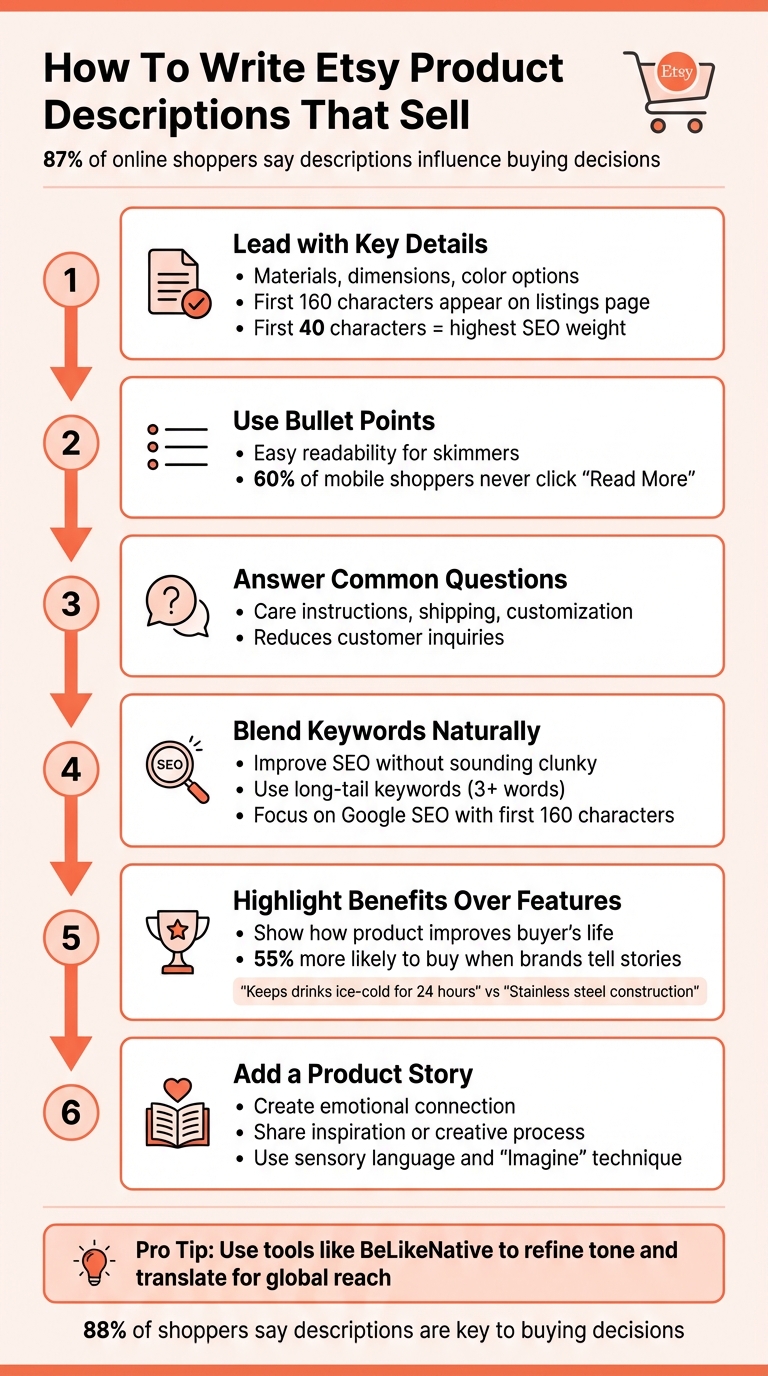
6-Step Guide to Writing High-Converting Etsy Product Descriptions
How To Write Etsy Product Descriptions That Sell
Include Product Details First
When someone lands on your Etsy listing, they’re there for answers. The first 160 characters of your product description show up on Etsy’s listings page, and with about 60% of mobile shoppers never clicking "Read More", those opening lines need to pack a punch.
Start by clearly stating what your product is and including essential details like materials, dimensions, and color options. This helps buyers quickly confirm if the item fits their needs. Plus, the first 40 characters carry the most SEO weight, and Etsy’s algorithm now prioritizes detailed keywords in this section. But this isn’t just about search rankings – providing clear specs upfront helps buyers decide faster and reduces the likelihood of returns.
"The first line of your listing’s description is important because it’s what grabs shoppers’ attention. You want to make sure your opening is catchy and speaks to the main selling points of your product."
– Rachel Rofé
For example, if someone can’t tell whether your handmade mug holds 12 oz. or 16 oz., they’re likely to move on to another listing. By front-loading key information, you eliminate confusion and keep potential buyers engaged.
List Specs and Features Clearly
Shoppers tend to skim rather than read, which is why long paragraphs can hurt conversions. Instead, use short lines or bullet points to present technical details. For international buyers, include dimensions in both inches and centimeters. Be specific about materials, weight, and available color options.
Here’s an example of a clear, concise format:
"Handmade ceramic planter – 6 inches tall, 5 inches wide (15 cm x 12.5 cm) – Solid stoneware with matte glaze – Available in charcoal, sage, and cream – Includes drainage hole and bamboo saucer."
This approach gives shoppers all the critical details without making them search for information. If it fits your brand’s style, you can even use emojis as bullet markers to add personality while keeping things organized. Just make sure clarity remains the priority.
Answer Common Questions Upfront
In addition to listing specs, addressing common buyer questions early in your description builds trust and reduces hesitation. It also cuts down on customer inquiries. Cover details like care instructions, customization options, shipping timelines, and whether free shipping is available.
For example, if your product is dishwasher safe, mention it right away. If you offer free shipping, highlight that too – shoppers are 20% more likely to buy items with free shipping. Selling a set? Clearly outline what’s included (e.g., "Set includes 4 coasters and a matching holder").
"Answer the questions you would have as a buyer."
– Etsy Help
By addressing these key points early, you not only reduce back-and-forth with potential buyers but also build confidence in your product, making it easier for shoppers to hit "Add to Cart."
When your listing opens with clear, detailed information, you set the stage for buyers to understand your product’s value – and keep reading for more reasons to make a purchase.
Write for Buyers and Search Engines
Once you’ve nailed down the product specifics, the next step is creating a description that grabs buyers’ attention while also performing well in search results. On Etsy, while titles, tags, and attributes are key for internal search rankings, your description plays a bigger role in Google SEO and converting browsers into buyers. The first 160 characters are especially important since they often become the meta-description displayed in Google search results.
To strike the right balance, weave keywords into your writing naturally. Focus on clarity and flow by introducing your most important descriptive terms in the first sentence. For instance, instead of repeatedly saying "handmade leather wallet", mix it up with alternatives like "artisan cowhide cardholder" or "genuine leather billfold" to appeal to different search queries without sounding repetitive. Tools like Marmalead ($19/month) and eRank (free plan or $5.99/month for Basic) can help uncover high-volume, long-tail keywords shoppers are actually searching for.
"The purpose [of the description] is not to rank high on the searching results but to convince potential clients… to click on your listing and buy your product."
– Nembol
Keep your tone conversational and engaging. Speak directly to the buyer by using "you" and "your." For example, instead of writing, "This candle features a soy wax blend", try something more personal like, "You’ll love how this hand-poured soy candle fills your home with warm sandalwood notes." This approach shifts the focus from technical details to how the product enhances the buyer’s life.
Add Keywords Naturally
The key to effective keyword use is understanding what your buyers are searching for. Long-tail keywords – phrases with three or more words, like "minimalist leather wallet" instead of just "wallet" – tend to attract shoppers who are ready to buy because they know exactly what they want. Use your 13 Etsy tags wisely by including synonyms, regional variations (like "flip-flops" versus "thong sandals"), or niche terms to reach more potential buyers.
Make sure to place your primary keywords at the beginning of your description. If a sentence feels clunky, rephrase it until the keywords flow naturally. For example, instead of writing, "Ceramic mug handmade ceramic coffee mug for coffee lovers", you could say, "This handmade ceramic mug is perfect for coffee lovers who appreciate artisan craftsmanship."
Don’t forget to fill out all available Etsy attributes – such as color, material, and style – because these act like additional tags. This frees up your 13 tags for more creative or specific phrases. By doing so, you avoid "keyword cannibalization", where multiple listings compete for the same search terms.
Emphasize Benefits, Not Just Features
When buyers shop, they’re looking for solutions, not just technical specs. A "24-megapixel camera" might sound impressive, but "capture detailed images of your treasured moments" is what truly resonates. This distinction is crucial. In fact, when brands tell a compelling story, 55% of people are more likely to make a future purchase, and 15% might buy immediately.
"Consumers don’t buy products because of features; they buy them for benefits. Adding product benefits makes product descriptions more persuasive and lets you stand out from the competition."
– Omar Deryan, Founder, OJ Digital Solutions
Start by addressing the problem your product solves. For example, if you’re selling a reusable water bottle, don’t just list "stainless steel construction" and "17 oz. capacity." Instead, describe how it keeps drinks ice-cold for 24 hours on a summer road trip or how it fits snugly in a car’s cup holder. Use sensory words like "velvety", "crisp", or "refreshing" to help buyers imagine the experience of owning your product.
sbb-itb-32359dc
Add a Product Story
A product story doesn’t have to be lengthy. Even a single sentence explaining your inspiration or the audience you had in mind can turn a generic listing into something memorable. A great product story draws buyers in, boosts your listing’s search appeal, and helps create an emotional connection. This connection can justify the purchase and remove any lingering doubts. Since many shoppers skim listings on their phones, it’s smart to put your story front and center.
Think of your story as the link between browsing and buying. For example, when you explain the inspiration behind your handmade leather journal – perhaps it’s designed for writers seeking a distraction-free space to think – you’re selling more than just paper and leather. You’re offering a ritual, a sense of calm, and a solution to a specific need. Ultimately, buyers are drawn to the transformation your product promises.
"A well-crafted narrative can make your product more relatable and memorable, helping it stand out in a crowded marketplace."
– Shopify
Make sure your story matches your brand’s voice. If your shop has a fun, quirky vibe, let that energy shine in your product descriptions. Even a quick sign-off, like “Hand-poured in my Brooklyn studio after way too much coffee,” reminds buyers there’s a real person behind the product.
Explain What Inspired the Product
Your creative process is worth sharing. Whether it’s a challenge you overcame, a personal need you addressed, or a value that drives your brand, explaining the “why” behind your product makes it more personal. This is something mass-produced items can’t compete with. For instance, instead of simply listing a "handmade ceramic planter", you could say: “I designed this planter after losing my third succulent to overwatering – it includes a hidden reservoir to keep plants happy and healthy.”
Keep it concise. Use the “So what?” test: ask yourself how each detail benefits the buyer. If your story doesn’t connect to something tangible – like better functionality, a unique design, or an improved experience – it’s better to leave it out.
A strong opening might be: “Born from late-night sketches and a love of minimalist design, this wallet holds everything you need – and nothing you don’t.” This kind of introduction sets the tone for a description that feels personal and engaging, leading naturally into sensory details.
Use Descriptive Language
While clear product specs are important, sensory language turns curiosity into desire. Words that appeal to the senses help buyers picture the product in their lives. For instance, instead of saying “soft blanket,” try “velvety fleece that feels like a warm hug on a chilly evening.” Instead of “scented candle,” describe it as “a soy candle with cedar and bergamot that fills your space with a cozy, woodsy aroma.”
The “Imagine” technique works wonders here. Prompt readers with scenarios like, “Imagine sipping your morning coffee from this hand-thrown ceramic mug,” to help them envision owning the product. This technique often creates a sense of ownership before they even hit “Buy.”
Avoid generic terms like “high quality” or “beautiful.” Instead, use specific details that build trust. For example, replace “durable construction” with “triple-stitched seams that can handle everyday wear.” Swap “effective cleanser” for “removes 99% of makeup buildup without drying your skin.”
"A great product description doesn’t just say what you’re selling; it tells your customer exactly why they need it and how it will enrich their lives."
– Big Cartel
Keep paragraphs short – just two or three sentences – to make your descriptions easy to skim, especially on mobile devices. Use sensory details thoughtfully to keep the tone engaging and avoid overloading the reader.
Polish Descriptions with BeLikeNative
Once you’ve crafted an engaging product story, the next step is to fine-tune your descriptions for clarity and universal appeal. BeLikeNative is a Chrome extension designed to help Etsy sellers refine their product descriptions through rephrasing, translation, and tone adjustments – all directly from your clipboard. According to a November 2025 merchant survey, 75% of business owners now use AI tools, with 69% leveraging them for content creation. For sellers managing multiple listings, creating unique, consistent descriptions can be a time-intensive task, making tools like this an essential resource.
The tool supports over 80 languages and allows you to adjust tone and style to align with your brand identity. Whether you want a professional, friendly, or persuasive tone, BeLikeNative helps you move beyond generic phrases like "high quality" and replace them with detailed, trust-building descriptions. Considering that 88% of online shoppers see product descriptions as a key factor in their buying decisions, nailing the tone is more than a nice-to-have – it’s a must.
Improve Tone with Rephrasing
Your shop’s personality should shine through in every listing. For instance, if you’re selling handmade jewelry with a bohemian touch, your descriptions should feel warm and artistic. On the other hand, minimalist home goods call for a clean and straightforward tone. BeLikeNative’s rephrasing feature lets you tweak your writing to match your brand’s voice without having to start from scratch.
Swap overused phrases for vivid, sensory descriptions that resonate with buyers. For example, instead of "soft blanket", try "velvety fleece that feels like a warm hug." This kind of language builds trust and helps shoppers imagine your product in their lives. Always review AI-generated suggestions to ensure they accurately represent your product and stay true to your brand.
Once your tone is polished in your primary language, it’s time to connect with customers worldwide.
Reach International Buyers
Expanding into international markets can be a smart way to grow your business, but translating product descriptions manually can be daunting. With support for over 80 languages, BeLikeNative simplifies this process, enabling you to provide accurate and accessible descriptions for buyers across the globe. Writing descriptions in your customers’ native languages not only improves accessibility but also builds trust.
When translating, steer clear of casual expressions or regional slang that might not translate well. Focus on clear, straightforward descriptions that maintain your brand’s tone across all languages. For technical details like materials or dimensions, use bullet points to ensure the information is easy to skim, regardless of the language. This approach allows you to connect with a global audience while maintaining professionalism and clarity.
Conclusion
Include clear product specifications and naturally integrate keywords within the first 160 characters to improve search rankings. Since 2022, Etsy’s algorithm has factored in description keywords for SEO. Turn features into benefits – rather than saying "12 oz capacity", explain that it "holds the perfect amount to kickstart your morning".
"A standout product description can help make the difference between a first sale or no sales." – Rachel Rofé
Use storytelling to bring your product to life. Sensory language helps buyers picture your item, while addressing them directly with "you" and "your" fosters a personal connection. End with a clear call to action, such as encouraging them to add the item to their cart or linking back to your shop. These strategies align with earlier tips on creating content that appeals to both buyers and search engines. Consistently applying these techniques can lead to noticeable improvements in your shop’s performance.
Once you’ve nailed the basics, you can refine your descriptions using advanced tools. After crafting the core elements, tools like BeLikeNative can help polish your copy by adjusting tone, correcting grammar, and translating descriptions into over 80 languages to reach global audiences. With 87% of online shoppers saying product descriptions influence their purchase decisions, fine-tuning your listings can have a big impact. Keep an eye on your Etsy Shop Stats to track performance and make data-driven adjustments to your listings.
FAQs
How can I use keywords to make my Etsy product descriptions stand out?
To make your Etsy product descriptions pop, focus on using keywords that match what buyers are actively searching for. Start by researching popular search terms related to your product. Once you have a list, weave those keywords naturally into your titles, descriptions, tags, and attributes. But here’s the key: don’t overdo it. Keyword stuffing can make your text feel clunky and unappealing. Instead, aim for a smooth, natural flow that also highlights what makes your product special.
It’s also smart to refresh your keywords regularly. Search trends change, and keeping your listings up-to-date ensures your products stay visible. By thoughtfully placing keywords, you can improve your chances of showing up in Etsy search results and connecting with the right buyers.
Why should I include a story in my Etsy product description?
Including a story in your Etsy product description can create a strong emotional connection with potential buyers. Sharing the inspiration behind your product, the process of how it was made, or unique details about its creation adds a personal touch that makes your listing stand out. This kind of storytelling helps buyers picture how your product fits into their lives, making it more relatable and increasing the likelihood of a purchase.
Beyond just connecting emotionally, a well-crafted story builds trust by showing the authenticity of your work. Sharing what makes your product special – whether it’s the materials, craftsmanship, or the story behind it – can make it more appealing and boost buyer confidence. In a crowded marketplace, a thoughtful story can be the key to grabbing attention and turning views into sales.
Why is it important to answer common buyer questions in your product descriptions?
Answering common buyer questions directly in your Etsy product descriptions can make a big difference in building trust and increasing sales. When shoppers see clear details about things like size, materials, care instructions, or how a product works, they’re more likely to feel confident about hitting "Add to Cart."
This approach helps minimize hesitation and creates a smoother shopping experience. When buyers feel informed, they’re more likely to complete their purchase – and it can even cut down on returns by setting clear expectations upfront. By showing you understand their concerns, you not only come across as a dependable seller but also encourage loyalty and drive more conversions.
Related Blog Posts
- How BeLikeNative Simplifies Multilingual Writing
- How Writing Tools Adapt to Your Style
- How To Polish Your Writing With Chrome Ai Extensions
- Best Amazon Product Description Writer For Seller Central
BeLikeNative fixes grammar, rephrases, translates, and simplifies text on any website in 1 second — just highlight and hit a keyboard shortcut. No tab switching. Try it free →