
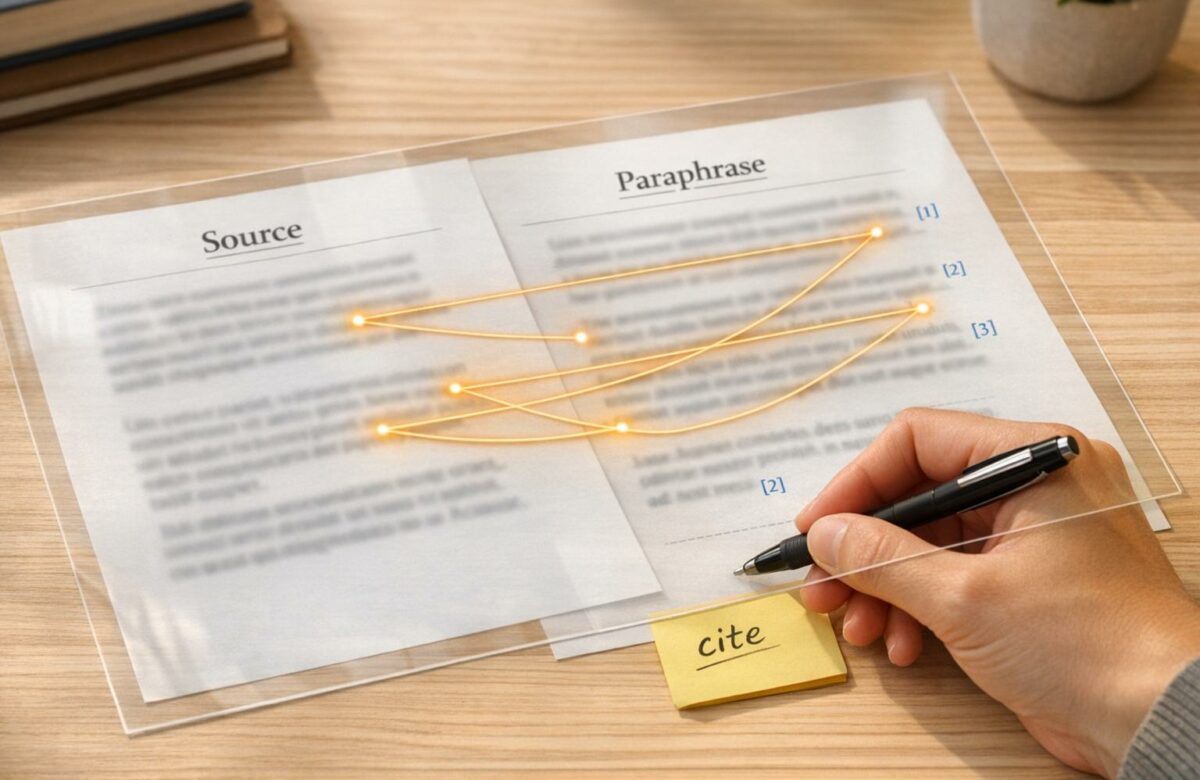
How To Paraphrase Academic Papers Without Plagiarism
Want to avoid plagiarism while paraphrasing academic papers? Here’s how:
- Understand the source material first: Read it thoroughly and ensure you can explain it in your own words without looking. This helps you grasp the meaning fully.
- Rewrite, don’t just swap words: Change sentence structures, use synonyms thoughtfully, and adjust the flow to make it your own. Avoid simply replacing words with synonyms while keeping the original structure.
- Keep the meaning intact: Ensure your version accurately reflects the source without distorting the original ideas.
- Always cite your sources: Even when paraphrasing, credit the original author to avoid plagiarism.
- Use tools wisely: AI tools can assist with phrasing but require your review to ensure accuracy and alignment with your style.
Proper paraphrasing requires effort but ensures your work is original, ethical, and credible. Follow these steps to maintain academic integrity and produce polished writing.
Transform Any Text, On Any Site, In Seconds
Rephrase, translate, and improve text with one shortcut. Works everywhere you write.
Add to Chrome - It's Free!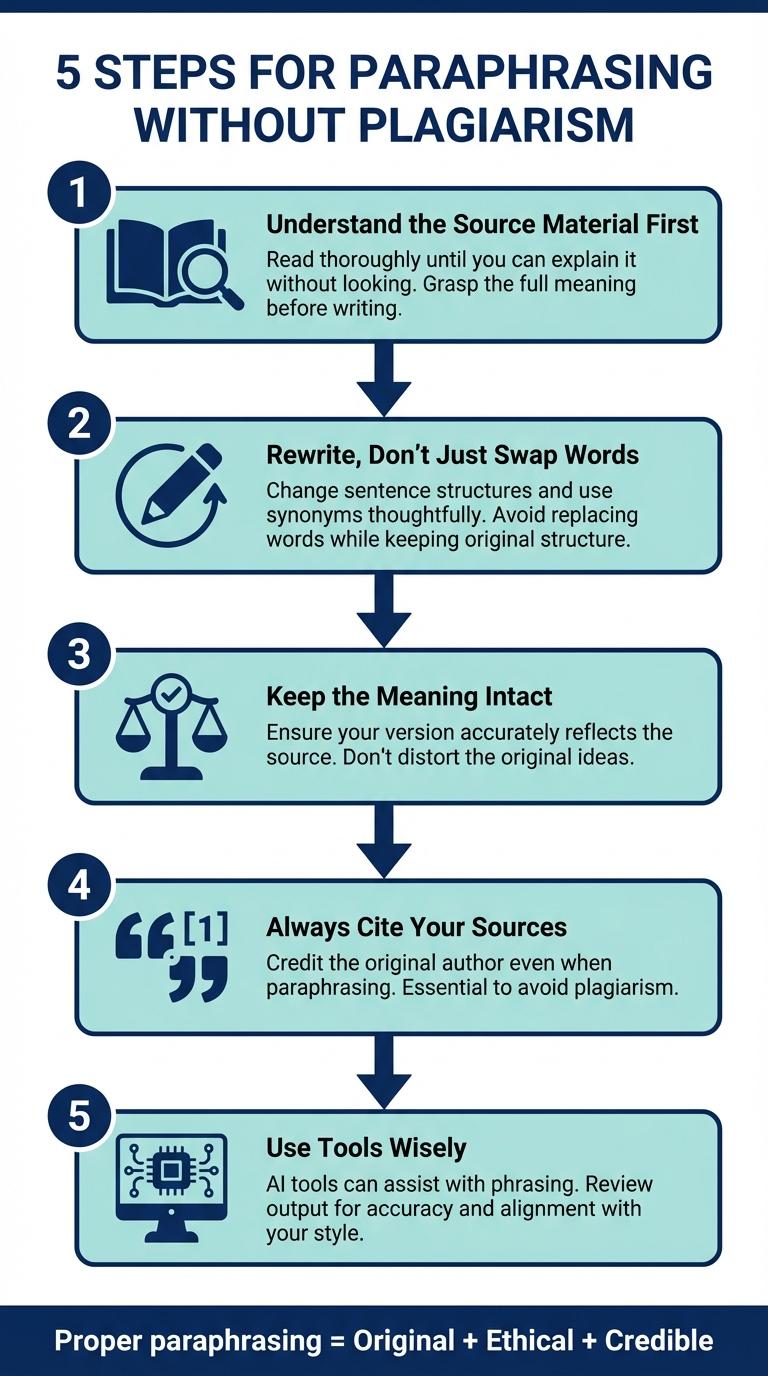
5-Step Process for Paraphrasing Academic Papers Without Plagiarism
How to Paraphrase in a Research Paper (to Avoid Plagiarism) 📚🔍
sbb-itb-32359dc
Core Strategies for Paraphrasing Correctly
Paraphrasing effectively goes beyond swapping out words. It’s about reshaping the content while preserving its original meaning. The following strategies will help you rewrite material in your own words while staying true to the source.
Read and Understand the Source Material First
Before you can paraphrase, you need to fully grasp the original content. Read the passage several times until you’re confident you could explain it to someone else without referring back to it. This not only helps avoid plagiarism but also ensures a deeper understanding of the material. As Purdue University explains, “The mental process required for successful paraphrasing helps you to grasp the full meaning of the original.”
Once you’ve understood the text, pinpoint key terms that are central to the message. Separate generic words (like "world", "science", or "brain") from unique phrases that need to be reworded. Then, set aside the original text and try writing your version from memory. This approach encourages you to rely on your own vocabulary and sentence structure, making your paraphrase distinct. Finally, compare your version with the source to check that the meaning is intact while the wording and structure have been sufficiently changed. This method is essential for maintaining academic integrity.
Replace Words and Restructure Sentences
Effective paraphrasing involves more than just finding synonyms; it requires reworking the structure of sentences. One way to do this is by switching between active and passive voice. For instance, "Researchers discovered a new method" can be changed to "A new method was discovered by researchers." Rearranging the order of clauses – such as moving a phrase from the end of a sentence to the beginning – can also create a new flow while keeping the logic intact.
You can also change parts of speech. For example, turn a noun into a verb, an adjective into an adverb, or a gerund into a standard verb. Combine short sentences into a single, more cohesive statement, or break down long, complex sentences into simpler ones. When replacing words, use synonyms for general terms (e.g., "vegetation" instead of "plants"), but keep technical terms like "photosynthesis" unchanged. These techniques help you stay true to the original message while making the text your own.
Keep the Original Meaning Intact
No matter how much you modify the structure or wording, the original meaning must remain unchanged. After drafting your paraphrase, compare it to the source to ensure that every important detail is still there. This step helps avoid mistakes like unintentionally altering the meaning or falling into "patchwriting", where only a few words are substituted, but the structure remains too similar.
Use straightforward language rather than overcomplicating sentences with unnecessary jargon. Break down dense or technical passages into smaller, easier-to-understand segments. When introducing paraphrased material, use signaling verbs like "explains", "suggests", or "states" to clearly separate your voice from the source’s. Staying true to the original meaning not only ensures accuracy but also shows respect for the author’s work and demonstrates your understanding of the content.
Common Paraphrasing Errors and How to Fix Them
Even seasoned writers can stumble into plagiarism if they’re not careful. This risk is even higher when collaborating, making plagiarism prevention in teams a critical focus. Understanding common paraphrasing mistakes and how to address them can help you maintain academic integrity while producing original work.
Relying Too Much on Synonyms
One big mistake in paraphrasing is patchwriting – a practice where you substitute words with synonyms but leave the sentence structure almost untouched. This approach creates "patches" of text that plagiarism detection tools like Turnitin can easily flag. Matt Ellis from Grammarly puts it clearly:
Paraphrasing is more than just swapping out words for their synonyms; you need to completely rewrite a sentence in your own style.
Overusing synonyms without altering the structure doesn’t make your work original. To avoid this, try the "hide and write" technique: read the source material until you grasp the idea, then set it aside and write it out in your own words. Also, keep in mind that common terms like "globalization" or "Americans" and technical terms with specific meanings don’t need to be rephrased. Using them as they are ensures clarity and accuracy.
Not Changing the Sentence Structure
Paraphrasing is about more than just words – it’s about rethinking how ideas are presented. If you only swap out vocabulary but leave the sentence structure unchanged, your writing remains too close to the original. Newcastle University emphasizes this point:
A paraphrase which is too close to the original over a longer portion will be flagged as problematic [by Turnitin].
To truly make the text your own, adjust the sentence structure. Change the order of clauses, switch from active to passive voice (or vice versa), and experiment with turning verbs into nouns or adjectives into adverbs. These changes can help you break away from the source’s framework. Always compare your final version to the original to ensure you’ve restructured it effectively. And remember, no matter how much you rework the text, proper citation is still essential.
Forgetting to Cite the Original Source
A common myth is that rewriting eliminates the need for citation. It doesn’t. Even if you’ve completely rephrased and restructured a passage, the idea still belongs to the original author. Proper citation is not just a formality – it’s a way to give credit where it’s due.
To avoid plagiarism, include narrative citations like "According to Smith…" or "Research by Johnson suggests…" even when paraphrasing extensively. Additionally, list full citations in your bibliography following the required format (APA, MLA, Chicago, etc.). Direct quotes should make up no more than 10% of your final work, so mastering paraphrasing and proper citation is crucial for academic success.
Tools and Methods for Better Paraphrasing
Combine technology with solid writing techniques to achieve the best results.
Using AI-Powered Paraphrasing Tools
AI tools can be great for brainstorming, but they shouldn’t be used as simple copy-and-paste solutions. Take BeLikeNative, for example – it helps you tweak tone (academic, formal, concise), rephrase sentences, and even work in over 80 languages through a straightforward clipboard integration. Once you’ve fully grasped the source material, AI can help you explore alternative ways to express the same ideas [18, 19].
Think of AI as a "Text Tuner" that lets you play around with sentence structure and word choice. After carefully reading a section of text, these tools can help simplify complex sentences or flip between active and passive voice. But here’s the key: always review the AI’s output yourself. As experts point out, "AI tools can help brainstorm phrasing, but you need to revise the output to match your voice and ensure accuracy". To ensure your final work is clean, run it through a plagiarism checker to catch any accidental patchwriting [17, 19].
Manual Methods for Paraphrasing Academic Content
Manual paraphrasing is the best way to ensure you truly understand the material. One effective technique is the "no-look" method – close the source or set it aside and write the concept from memory [14, 19]. This helps you avoid unintentionally copying the original sentence structure.
When you write from memory, your brain naturally reshapes the information into new patterns. Keep technical terms (like "photosynthesis" or "globalization") unchanged, but find synonyms for the descriptive parts around them [2, 11]. And don’t forget to cite your source immediately to steer clear of plagiarism [11, 19].
Pairing these manual strategies with AI tools can make the paraphrasing process even smoother and more effective.
Blending Technology with Your Writing Skills
Maintaining the original meaning and giving proper credit to sources should always be your top priorities when paraphrasing. A balanced approach – starting with manual drafting and using AI for refinement – often works best. Begin by reading the source carefully, paraphrasing from memory, and then using AI tools to polish the language or explore alternative phrasings [18, 22].
You can also use narrative citations (like "Research by [Author] suggests…") to integrate paraphrased content seamlessly while making it clear where the ideas originated. Since only about 10% of your final paper should be direct quotes, mastering this blend of manual and AI-assisted methods is crucial. While AI can help simplify tricky concepts or adjust tone, it’s up to you to ensure the original meaning stays intact [18, 22].
Conclusion: Paraphrase Correctly and Cite Properly
Paraphrasing and citation go hand in hand – one is incomplete without the other. If you paraphrase without citing, it’s plagiarism, as it misrepresents someone else’s ideas as your own. On the flip side, citing a source but sticking too closely to its original structure or wording (without using quotation marks) is also plagiarism. To uphold academic integrity, both paraphrasing and citation must work together.
Effective paraphrasing demonstrates that you’ve fully grasped the material while bolstering the credibility of your research. As Matt Ellis puts it, "Paraphrasing requires you to understand ideas well enough to write them in your own words, so it not only transfers information but also aids retention". By paraphrasing successfully, you show that you truly understand the material and can connect expert insights to your arguments. This balance also ensures a thoughtful mix of direct quotes and reworded content.
The majority of your work should reflect your own analysis, supported by properly paraphrased material from reliable sources. This method allows you to maintain a consistent tone throughout your writing while still incorporating key evidence and background information.
Always cite as you go. Whether you’re using the "look away" method to rephrase or leveraging tools to refine your writing, make sure to include the in-text citation immediately after paraphrasing. Signal phrases like "According to [Author]…" can also help clearly separate your own thoughts from sourced material. This habit not only prevents unintentional plagiarism but also keeps your research process organized and transparent.
Mastering these skills – thoughtful paraphrasing and precise citation – does more than just avoid plagiarism. It enhances your academic credibility and ensures your work stands out as original and well-supported.
FAQs
How different does my paraphrase need to be?
To avoid plagiarism, it’s crucial to do more than just swapping words with synonyms. Instead, rework the sentence structure, rearrange the flow of ideas, and use entirely different phrasing while keeping the original meaning intact. This approach ensures the content feels fresh and unique. Additionally, always give proper credit to the source to maintain originality and uphold academic honesty.
When should I quote instead of paraphrase?
When the exact wording of a source carries special weight – whether it’s especially impactful, precise, or irreplaceable – it’s time to quote. Quoting is also the way to go when the original language plays a key role in your argument or analysis and paraphrasing would dilute its meaning. Just make sure to include proper citations to uphold academic integrity and steer clear of plagiarism.
How can I verify my paraphrase isn’t plagiarism?
To avoid plagiarism, make sure to write in your own words and use a different sentence structure than the original text. Always include proper citations for any source material. Be cautious of patchwriting – this happens when you only swap out a few words or fail to use quotation marks. Patchwriting is still considered plagiarism. Prioritize originality and clear credit to the original source to uphold academic integrity.
Related Blog Posts
- The Complete Guide to APA Paraphrasing: Rules, Examples & AI Assistance!
- How To Paraphrase In Apa Format With Step-by-step Examples
- How To Paraphrase And Reference In Apa Without Plagiarism
- Everything You Need To Know About Apa Paraphrasing And Citation
Ready to improve your language skills?
Visit belikenative.com to get started!
BeLikeNative fixes grammar, rephrases, translates, and simplifies text on any website in 1 second — just highlight and hit a keyboard shortcut. No tab switching. Try it free →