How To Write Performance Reviews For Employees Fast
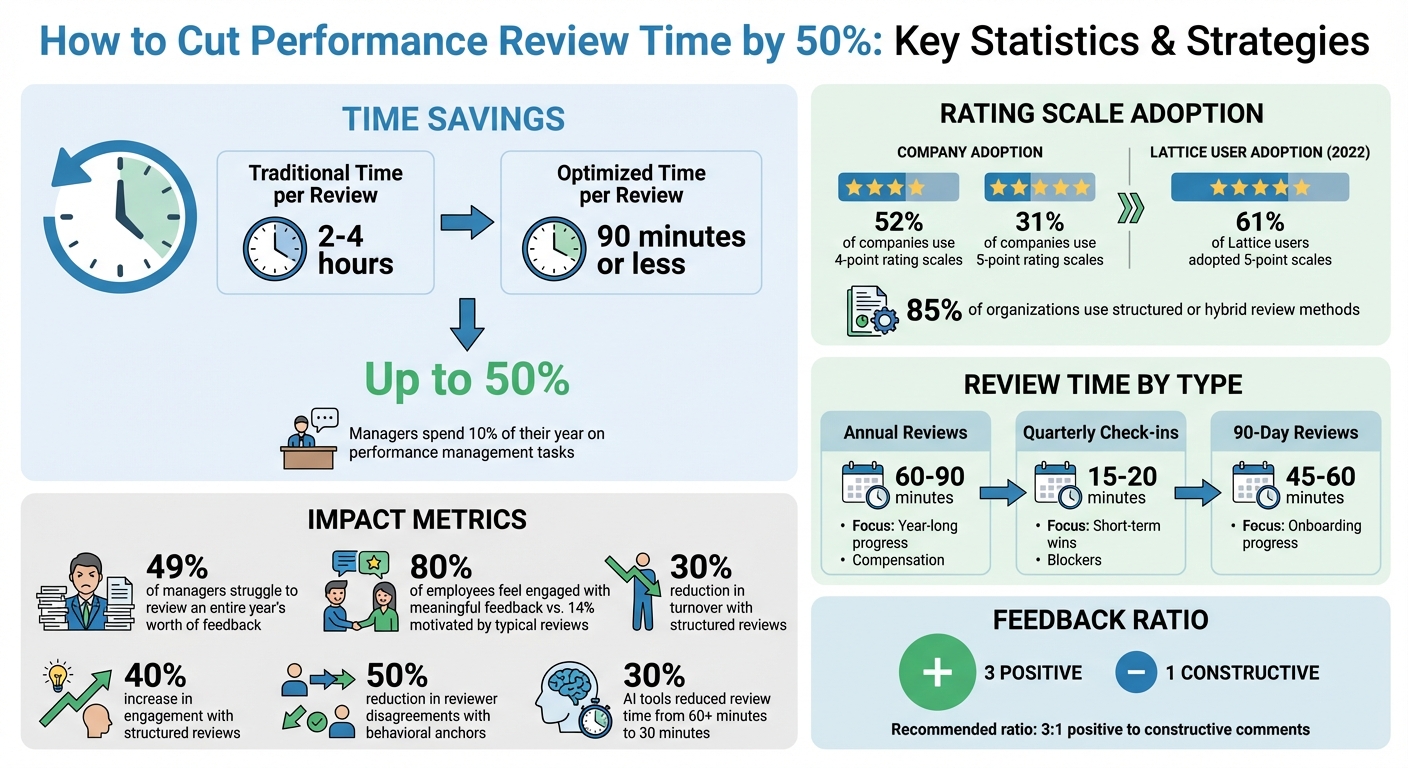
Writing performance reviews can feel overwhelming, but it doesn’t have to be. Managers often spend 2–4 hours per review, but with the right tools and strategies, you can cut that time down to 90 minutes or less without losing quality. Here’s how:
- Use Templates: Pre-built formats save time and ensure consistency across reviews. Adjust them for specific roles to keep evaluations relevant.
- Leverage Rating Scales: Structured scales like 1–5 or descriptive terms simplify grading and reduce bias.
- Organize Feedback: Break reviews into clear sections like achievements, growth areas, and goals to stay focused and avoid repetition.
- Include Self-Assessments: Employees can highlight their own accomplishments, giving you a solid starting point and saving time.
- Set SMART Goals: Create clear, actionable objectives for the next review cycle to keep employees on track.
Performance Review Time-Saving Statistics and Key Metrics
Write Performance Reviews in 30 Minutes (AI Method for Managers)
sbb-itb-32359dc
Use Performance Review Templates to Save Time
Templates take the hassle out of starting performance reviews from scratch. Instead of staring at a blank page, you get a pre-designed format that includes all the key categories. This eliminates the guesswork in figuring out evaluation criteria and lets you focus on delivering meaningful feedback. As AIHR puts it, "A predefined format saves time for both managers and HR. Managers can focus on meaningful feedback instead of designing their own process". Plus, these templates set the stage for using objective metrics and tailoring reviews to specific roles.
On top of that, features like auto-generated summaries and structured formats can cut preparation time by over a third. With 85% of organizations using either fully structured or hybrid review methods, templates not only save time but also ensure consistency. This consistency makes it easier to compare performance across teams and reduces the time spent defending evaluation methods that might otherwise seem inconsistent.
Why Pre-Built Templates Work
Pre-built templates don’t just save time – they create a standardized approach to evaluations. When every employee is assessed using the same criteria, it helps reduce bias and ensures fair evaluations. This standardization also makes it easier to track progress across multiple review cycles. Considering that managers can spend up to 10% of their year on performance management tasks, templates help reclaim that time while keeping the quality of reviews intact.
Most companies rely on either a four-point (52%) or five-point (31%) rating scale in their templates. These frameworks make the grading process quicker by providing clear benchmarks for different levels of performance.
Adjust Templates for Different Job Roles
While standardized templates are great for efficiency, customizing them ensures they stay relevant to specific roles. For instance, you might assess Individual Contributors based on their technical skills and work quality, but for Managers, you’d focus on team growth, retention rates, and coaching abilities. The trick is to keep the company’s core standards intact while tweaking metrics and competencies to fit different job functions.
Templates can also be tailored to fit various review cycles. For example, annual reviews, which cover year-long performance and compensation decisions, typically take 60–90 minutes. On the other hand, quarterly check-ins, which focus on short-term wins and challenges, are much quicker – usually requiring only 15–20 minutes.
| Review Type | Primary Focus | Typical Time Investment |
|---|---|---|
| Annual Review | Year-long progress, competencies, compensation | 60–90 minutes |
| Quarterly/Continuous | Immediate wins, blockers, short-term goals | 15–20 minutes |
| 90-Day Review | Onboarding progress, early integration | 45–60 minutes |
Use Rating Scales and Competency Frameworks
Structured tools like rating scales and competency frameworks help make performance reviews more systematic and fair. By using predefined criteria, these tools minimize personal bias. As Matt Raskin, Senior Talent Strategist at Lattice, puts it: "Five-point scales are great because they’re simple and intuitive. They’re also efficient in terms of setup and structure".
In fact, 61% of organizations using Lattice in 2022 adopted a five-point performance rating scale. These scales not only bring consistency to evaluations but also provide HR teams with actionable data for decisions on pay and promotions.
Add Rating Scales for Objective Reviews
Rating scales make evaluations easier by offering clear categories rather than leaving reviewers with open-ended choices. Whether you opt for numbers (1–5) or descriptive terms like "Developing", "Proficient", and "Expert", these frameworks streamline the process. Research even shows that reviewers are 10 times more likely to give a qualitative "needs improvement" rating than to assign the lowest numeric score of "1". This suggests that word-based scales can encourage more honest feedback.
The effectiveness of a scale hinges on how well each level is defined. For instance, in March 2024, an aerospace company led by HR Director Anthony introduced a four-point scale (Exceptional, Superior, Fully Successful, Unsuccessful) to address grade inflation. By defining "Exceptional" as the top 5% and "Superior" as the top 20%, they aligned performance expectations with reality and set clear paths for growth. Clear definitions like these prevent inflated scores and ensure evaluations lead to actionable outcomes.
While rating scales provide a way to quantify performance, competency frameworks dive deeper into specific skills.
Apply Competency-Based Assessments
Competency frameworks evaluate skills like technical expertise, communication, and teamwork using standardized criteria. This structured approach saves time and eliminates the need to start from scratch for each employee. One manufacturing firm that introduced a five-point rubric with behavioral anchors and held quarterly calibration meetings saw a dramatic drop in employee appeals – from eight per year to just two.
The most effective frameworks often use Behaviorally Anchored Rating Scales (BARS), which replace vague ratings with specific examples. For instance, rather than simply rating "communication skills" as a 4 out of 5, a BARS framework would clarify what that score represents: "clearly articulates ideas in meetings and provides written updates within 24 hours."
"Behavioral anchors reduce subjectivity in ratings by providing concrete examples of what each performance level looks like" – Jürgen Ulbrich, CEO of Sprad
This approach can reduce disagreements among reviewers by nearly 50% compared to generic scales. By combining clarity and objectivity, competency-based assessments ensure more accurate and actionable feedback.
Organize Reviews by Performance Categories
Breaking performance reviews into clear sections not only simplifies the writing process but also makes them easier to read. Just like templates or rating systems, organizing feedback into specific categories creates consistency and avoids redundancy. Without this structure, managers might find themselves repeating the same points – whether achievements or concerns – because there’s no clear place for each observation. Using categories ensures evaluations are targeted and objective, setting the stage for more meaningful feedback.
Another common challenge is reviewing an entire year’s worth of feedback. In fact, 49% of managers struggle with this task when preparing reviews. By grouping notes, messages, and records into themes, you can transform scattered observations into a cohesive story.
Main Performance Categories to Include
Effective reviews typically follow a standard layout that balances past performance with future planning. Below is an overview of key categories and their purpose:
| Performance Category | Key Elements to Include | Purpose |
|---|---|---|
| Basic Information | Name, job title, reviewer name, and review period | Establishes context and serves as an official record |
| Core Competencies | Communication, teamwork, problem-solving, and values | Evaluates behaviors and alignment with company expectations |
| Achievements | Major accomplishments and successful projects | Recognizes contributions and fosters motivation |
| Areas for Growth | Skills or behaviors needing improvement | Highlights gaps and offers constructive feedback |
| Goal Review | Progress on past KPIs or OKRs | Tracks accountability and results |
| Development Plan | Training needs, resources, and career goals | Outlines steps for long-term growth and retention |
Using these categories ensures all critical points are addressed. Within each, applying the Situation-Action-Result (SAR) model helps ground feedback in observable facts. For instance, instead of saying, “John is a great communicator,” you could detail the situation (“During the Q3 product launch”), the action (“John prepared weekly status updates and led client presentations”), and the result (such as reduced client inquiries).
Prevent Repetition Through Clear Organization
Assigning feedback to specific categories reduces the risk of repeating the same examples throughout the review. For example, if you’ve already highlighted an employee’s strong project management skills under "Achievements", there’s no need to reference the same project in other sections. This approach not only saves time but also ensures the review remains focused and easy to navigate.
The order of categories also matters. Many managers choose to begin with achievements and strengths to build morale, then move to areas for improvement, and finish with future goals. This flow feels natural and leaves the conversation on a forward-thinking note. Keeping the review concise – around two pages – further ensures it serves as a guide for discussion rather than an overwhelming document.
When reviews are well-organized like this, employees respond positively. In fact, 80% report feeling fully engaged at work compared to just 14% who say typical reviews motivate them to improve. Clear organization makes all the difference.
Include Self-Assessments and Employee Input
Getting employees to complete a self-assessment before you start their review can save you a lot of time. Instead of staring at a blank page or digging through old records, you’ll have a ready-made summary of their achievements, challenges, and areas for growth. It shifts the initial burden of gathering information to the person who knows the work best – the employee themselves. Using structured self-assessment templates makes this process even smoother.
The stats back this up. Nearly half (49%) of managers struggle to review an entire year’s worth of feedback when preparing performance reviews. Self-assessments solve this issue by giving you a clear starting point, eliminating the need to piece together a year’s worth of details from memory. Employees often highlight accomplishments or contributions you might not have noticed, so you’re less likely to miss important wins or scramble to verify details.
Use Self-Assessments for Employee Contributions
To make self-assessments work, it’s essential to structure them well. A concise template should ask employees to outline measurable achievements, progress toward goals, skills they’ve developed, and areas for improvement. Encourage them to maintain a "brag sheet" throughout the year, where they can jot down accomplishments as they happen. This way, completing the self-assessment becomes a simple task rather than a stressful memory test.
When employees quantify their contributions – like "boosted customer satisfaction scores by 12%" or "cut onboarding time by three days" – it gives you solid data to include in their review. This not only makes the review more credible but also speeds up the writing process by removing vague language. Comparing their self-assessment with your own observations can also reveal gaps or differences in perspective, ensuring a more balanced evaluation.
Combine Feedback More Quickly
Once you have the self-assessment, use it as your foundation. Pull out key accomplishments, cross-check with records or peer feedback, and add your own insights. This collaborative approach streamlines the entire review process.
AI tools can make this even faster. These platforms can summarize self-assessments, notes from one-on-ones, and goal progress to draft a review in minutes. For example, in September 2025, Alli Doyle, Strategic People Program Manager at Figma, shared that AI-assisted tools helped reduce the time managers spent on reviews from over an hour to just 30 minutes. The trick is to treat AI as a helper – it can suggest themes and phrasing, but your input adds the context and personal touch that makes the review meaningful.
When employees have already reflected on their performance, the review meeting shifts from a one-sided recap to a productive conversation about growth. This approach doesn’t just save time – it also boosts engagement. 80% of employees who receive meaningful feedback report feeling more engaged at work.
Set SMART Goals for Future Planning
Once you’ve gathered and organized feedback, it’s time to plan ahead with clear, actionable goals. This is where the SMART framework – Specific, Measurable, Achievable, Relevant, and Time-bound – comes into play. SMART goals not only wrap up the review process but also lay out a clear path for the next one.
Why does this matter? Because only 14% of employees feel that performance reviews motivate them to improve. Goals like "improve performance" or "be more proactive" are too vague and don’t offer a clear direction. Instead, focus on goals like, "Update the e-commerce report with two new industry trends by June 15". This kind of specificity simplifies future evaluations by setting clear, actionable benchmarks for success.
"Clear objectives are your employee’s roadmap to success in their role. They’re also your playbook for evaluating performance." – Grammarly
Rather than dictating goals, collaborate with employees to create them. When employees have a say, they’re more committed to achieving the desired outcomes. Stick to 3–5 specific goals per review period to keep things manageable and focused. Make sure each goal aligns with both the employee’s development and the company’s objectives – this ensures the "Relevant" part of SMART is fully addressed.
Adding a time frame to goals creates a sense of urgency and establishes clear checkpoints for evaluation.
Apply Structured Feedback Frameworks
Frameworks for Faster Performance Review Writing
Structured feedback frameworks can make writing performance reviews much easier and more efficient. By focusing on key areas, these frameworks help you avoid starting from scratch every time. When combined with templates and clear categories, they create a solid system for delivering meaningful feedback. One widely used approach is the Situation-Behavior-Impact (SBI) model. This method ensures your feedback stays objective by breaking it into three parts: the specific situation, the observed behavior, and its impact on the team or organization. For instance, instead of vaguely stating, "John needs to communicate better", you could say: "During the Q3 product launch (situation), John sent status updates only twice over six weeks (behavior), which caused the marketing team to miss two key deadlines (impact)."
Another effective tool is the "Start, Stop, Continue" framework, which simplifies peer feedback. Ask colleagues to identify 2–3 actions the employee should start, stop, and continue doing. This straightforward structure encourages contributors to provide actionable insights without overthinking, leaving you with feedback that’s easy to incorporate into the review.
Build Repeatable Processes for Consistency
Sticking to the same framework for all reviews can save time and reduce decision fatigue. Instead of reinventing the process for each employee, you can concentrate on the conversation itself. This consistency also ensures that everyone is evaluated using the same criteria, which helps minimize bias and avoids post-review disputes.
Different frameworks work best for different types of discussions. For example, the GOOD model (Goals, Obstacles, Opportunities, Decisions) is ideal for monthly check-ins, keeping conversations focused and under 20 minutes. On the other hand, annual reviews benefit from comprehensive competency assessments. Separating these formats prevents you from trying to cover too much in one session, which can slow things down significantly.
Companies that implement consistent review frameworks often see a 30% drop in turnover, and structured reviews have been linked to a 40% increase in engagement. Tailoring templates to specific roles is another way to boost efficiency. For instance, individual contributors and managers require different evaluation criteria, so focusing only on relevant competencies saves time and ensures the feedback is meaningful. These repeatable processes align seamlessly with earlier strategies, maintaining both consistency and efficiency in your review system.
Conclusion
Performance reviews don’t have to be a time-consuming ordeal. With templates, structured frameworks, and employee input, you can go from staring at a blank page to completing a polished review in 90 minutes or less, instead of spending 3–4 hours. Tools like the SBI framework and self-assessments simplify the process, making it easier to create focused, meaningful reviews.
This approach not only saves time but ensures reviews remain impactful. Think of these tools as partners in delivering quality. Experts highlight that AI tools can significantly cut review time while increasing their effectiveness. Templates and frameworks provide the structure, allowing you to focus on what really matters – personalizing feedback and fostering meaningful coaching conversations.
Here’s the reality: only 14% of employees find reviews inspiring, but 80% are fully engaged when feedback feels meaningful. Specific, timely feedback makes all the difference. Keep a continuous log of feedback throughout the year, back up ratings with evidence (especially for deviations from "meets expectations"), and aim for a 3:1 ratio of positive to constructive comments.
The benefits of streamlining reviews go beyond saving time. Structured performance reviews can reduce turnover by 30% and increase engagement by 40%. By combining advanced tools with a clear evaluation process, you can create reviews that are efficient, fair, and personal. These aren’t just routine tasks – they’re opportunities to build trust, improve team performance, and drive meaningful change. Use repeatable processes and the right tools to make your reviews more effective and impactful.
FAQs
What should I prepare before writing a review?
Before diving into a performance review, it’s important to gather all the necessary details about the employee’s role, responsibilities, and overall performance. Start by reviewing their job description, the skills required for their position, and any feedback or notes from past evaluations. Take a close look at their goals – both completed and ongoing – as well as any observations you’ve made over time.
Digging into performance records and notes from previous discussions ensures your review is not only thorough but also balanced and fair. With this information at your fingertips, you’ll be able to craft a review that’s both clear and effective without wasting time.
How do I choose the right rating scale for my team?
To choose the best rating scale for your team, prioritize consistency and clarity while ensuring it aligns with your organization’s objectives. You can consider options like numerical scales, descriptive categories, or behavior-based rubrics – each offering unique ways to assess performance. It’s crucial to train managers on how to use the chosen scale effectively to minimize biases. Additionally, gather input from both employees and managers to confirm the scale is easy to understand, meaningful, and fosters constructive performance evaluations.
How can I keep reviews fast but still personal?
To make performance reviews both efficient and personal, consider using structured frameworks and helpful tools. Templates and AI-driven tools can simplify the process of creating customized feedback, making it quicker to deliver thoughtful responses. Methods like STAR (Situation, Task, Action, Result) or SMART+ (Specific, Measurable, Achievable, Relevant, Time-bound, plus an added focus on growth) ensure your feedback is clear and actionable. By blending these strategies, you can save time while still delivering meaningful and personalized reviews that make employees feel appreciated and understood.