
How To Write A Salary Negotiation Email With Confidence
Negotiating salary via email is a practical way to secure fair compensation while maintaining clarity and professionalism. Research shows 85% of workers who negotiate get at least part of their request, yet only 37% actually negotiate. Writing an email allows you to avoid the pressure of live discussions, back your request with data, and create a clear record. Here’s how to do it:
- Research market value: Use tools like Glassdoor, Payscale, and the Bureau of Labor Statistics to find salary benchmarks for your role and location. Focus on specific ranges to strengthen your case.
- Highlight achievements: Use measurable results (e.g., “increased sales by 34%”) to demonstrate your value.
- Structure effectively: Start with gratitude, present your value, make a specific counteroffer, and end with a call to action.
- Maintain professionalism: Use clear and confident language, avoid vague requests, and stay open to discussing benefits beyond salary.
Salary Negotiation Email template walkthrough
sbb-itb-32359dc
Research Your Market Value Before Negotiating
Before you start drafting your negotiation email, take the time to gather solid market data to back up your salary request. Having this information at your fingertips can make a huge difference in how your proposal is received. The Bureau of Labor Statistics emphasizes this point:
"Understanding how wages and wage distributions vary by occupation, industry, and location is invaluable information when negotiating a starting salary or requesting a raise".
To get started, check out trusted resources like the Bureau of Labor Statistics’ Occupational Employment and Wage Statistics (OEWS) program. This tool provides wage data for about 830 occupations across 580 geographic areas. You can also use platforms like Glassdoor’s "Know Your Worth" tool to get a personalized estimate based on your job title, location, and experience. Other helpful sites, such as Salary.com and Payscale, offer detailed compensation reports that even factor in how specific skills can influence pay.
If you have specialized skills or years of experience, focus on salaries in the 75th or 90th percentile. On the other hand, if you’re early in your career, the 10th or 25th percentile can help you set realistic expectations. And don’t forget how much location can affect pay – a marketing manager in San Francisco, for example, will likely earn much more than one in Topeka, Kansas, even if their responsibilities are identical.
Use Reliable Salary Benchmarking Tools
When crafting your email, make sure to include specific, research-backed salary numbers. Emails that mention exact ranges (like $85,000–$92,000) are reopened 2 to 3 times more often than vague requests for a "competitive salary". These precise figures also make it easier for hiring managers to justify your request to their finance teams.
Tools like CareerOneStop, sponsored by the U.S. Department of Labor, offer a "Salary Finder" feature with localized wage data. For industries that evolve quickly, such as marketing, SalaryGuide provides up-to-date percentile data with timestamps to ensure accuracy. As of February 2026, about 41% of marketing job listings included salary ranges, making it simpler to benchmark your ask.
To stay prepared, identify three key numbers: your target salary, your initial asking figure, and your minimum acceptable offer. This strategy ensures you avoid settling for less than you’re worth or making demands that seem arbitrary.
Once you’ve nailed down the market data, the next step is to tie it to your proven achievements.
Quantify Your Achievements
While market data is crucial, pairing it with measurable results from your career makes your case even stronger. Replace vague claims with hard numbers, like "increased sales by 34%" or "reduced late payments by 80%". These specifics leave little room for doubt about your contributions.
Take the example of Rebecca, a museum gallery manager who, in April 2018, negotiated an $11,000 salary increase – from $41,000 to $52,000. She achieved this by highlighting her unique ability to create new programs from scratch. By researching a market range of $40,000 to $65,000, she positioned herself confidently at the higher end of the scale. Stories like this show how quantifiable achievements can lead to significant pay raises.
When presenting your accomplishments, frame them as solutions to the company’s future needs rather than just a list of past responsibilities. For instance, instead of saying "managed a team of five", you could say, "led a team of five that delivered a product launch three weeks ahead of schedule, generating $200,000 in first-quarter revenue." This approach not only showcases your track record but also demonstrates how your skills align with the company’s goals, making your email more persuasive and impactful.
Structure Your Salary Negotiation Email
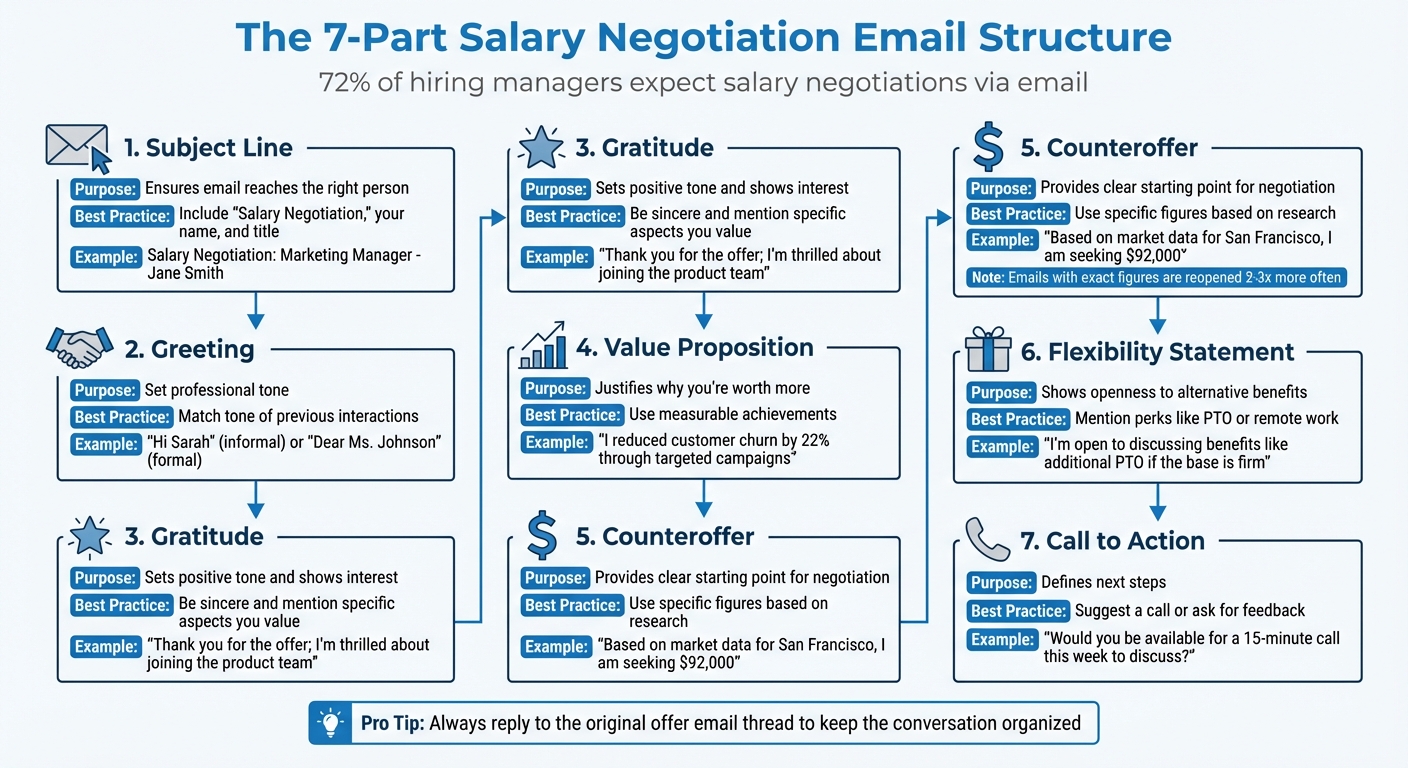
7 Essential Components of a Salary Negotiation Email Structure
Once you’ve gathered your market data and outlined your accomplishments, it’s time to focus on crafting a well-organized email that effectively communicates your value.
A clear and structured email makes it easier for hiring managers to understand your request and advocate for you internally. The aim is to create a message that flows naturally, transitioning from gratitude to highlighting your value, and finally presenting your specific request. Considering that 72% of hiring managers expect salary negotiations to happen via email, getting this right is crucial.
Your email should include seven essential parts: a clear subject line (e.g., "Salary Negotiation: Marketing Manager – Jane Smith"), a professional greeting, an opening that expresses appreciation for the offer, a value proposition linking your achievements to the company’s needs, a specific counteroffer based on your research, a statement showing flexibility on alternative benefits, and a call to action for further discussion. Each element plays a role in strengthening your case.
Key Components of a Salary Negotiation Email
Here’s how to structure your email effectively:
- Subject Line: Start with a direct subject line that includes your name and job title to ensure the email reaches the right person. For example, "Salary Negotiation: Marketing Manager – Jane Smith."
- Greeting: Match the tone of your previous interactions. Use "Hi Sarah" for informal exchanges or "Dear Ms. Johnson" for formal ones.
- Gratitude: Open with a positive tone by thanking the employer and expressing excitement about the role. Mention specifics, like the team’s expertise or the company’s mission, to show genuine enthusiasm.
- Value Proposition: Highlight your achievements with measurable results that address the company’s challenges. For example, "Increased ROI by 15%" or "Reduced customer churn by 22%."
- Counteroffer: Be specific. Emails that include precise figures, such as "$88,000", are revisited more often than those with vague ranges.
- Flexibility Statement: Show that you’re open to discussing other benefits, such as signing bonuses, additional PTO, or professional development opportunities.
- Call to Action: End with a clear next step, like requesting a follow-up call to discuss further. For instance, "Would you be available for a 15-minute call this week to discuss?"
When all these elements are in place, you can refine the tone and presentation to ensure your email is both professional and persuasive.
Use a Professional and Confident Tone
Confidence comes across best when you rely on data to back up your request. As Carol Frohlinger, Co-founder of Negotiating Women, explains:
"money is one indicator that contributes to an overall feeling of career success".
Avoid overly casual or aggressive language. Instead, use collaborative phrases like, "I’d love to explore options", to maintain professionalism. Keep your email concise – 3 to 4 paragraphs is ideal – and focus on your qualifications and market research.
Chris Voss, CEO of The Black Swan Group, emphasizes the importance of shifting the focus to mutual benefit:
"Salary pays your bills. But terms build your future. To accelerate your career, you have to break out of the ‘self-centered’ approach to a salary negotiation and transform it into the ‘us-centered’ approach".
This approach helps you remain confident while avoiding an entitled tone.
Email Structure Comparison Table
Here’s a quick breakdown of the ideal structure, purpose, and examples for each section of your email:
| Email Section | Purpose | Best Practice | Example |
|---|---|---|---|
| Subject Line | Ensures the email is opened by the right person | Include "Salary Negotiation", your name, and title | "Salary Negotiation: Marketing Manager – Jane Smith" |
| Gratitude | Sets a positive tone and shows interest | Be sincere and mention specific aspects you value | "Thank you for the offer; I’m thrilled about joining the product team" |
| Value Prop | Justifies why you’re worth more | Use measurable achievements | "In my previous role, I reduced customer churn by 22% through targeted campaigns" |
| Counteroffer | Provides a clear starting point for negotiation | Use specific figures based on research | "Based on market data for San Francisco, I am seeking $92,000" |
| Flexibility | Shows openness to alternative benefits | Mention perks like PTO or remote work | "I’m open to discussing benefits like additional PTO if the base is firm" |
| Call to Action | Defines the next steps | Suggest a call or ask for feedback | "Would you be available for a 15-minute call this week to discuss?" |
A final tip: Always reply to the original offer email thread. This keeps the conversation organized and ensures HR and the hiring manager are on the same page.
Salary Negotiation Email Templates for Common Scenarios
Now that we’ve covered how to craft a persuasive email, here are five ready-to-use templates tailored for common salary negotiation situations. These examples will help you adapt your approach based on your specific circumstances.
New Job Offer Negotiation Template
Subject: Salary Negotiation: Marketing Manager – Jane Smith
Email:
Hi Sarah,
Thank you so much for offering me the opportunity to join the marketing team at ACME Corp. I’m genuinely excited about contributing to your product launch strategy and collaborating with such a talented team.
After reviewing the offer and researching similar roles in the San Francisco market, I’d like to discuss the base salary. With seven years of experience in digital marketing and a proven track record of increasing ROI by 18% in my current role, I was anticipating a range closer to $92,000–$98,000.
I’m confident my expertise in scaling campaigns and my MBA will allow me to deliver immediate value. That said, I’m open to discussing the overall compensation package, including options like equity or a six-month performance review if the base salary has limited flexibility.
Would you be available for a quick call this week to discuss this further?
Best,
Jane Smith
Countering a Below-Market Offer Template
If the initial offer doesn’t align with market standards, this template can help you address it.
Subject: Re: Job Offer – Data Analyst Position
Email:
Hi Michael,
Thank you for the offer and for the time you’ve dedicated to the interview process. I’m genuinely excited about the opportunity to work on predictive analytics projects at your company.
After reviewing the offer and comparing it to market data from Glassdoor and Payscale for similar roles in Chicago, I noticed the base salary of $65,000 is below the typical range of $72,000–$80,000 for someone with my five years of SQL and Python experience. In my previous role, I reduced reporting time by 30% and developed dashboards that saved the team 15 hours per week.
I’d feel more comfortable with a base salary of $75,000, which I believe better reflects the role’s expectations and responsibilities. I’m happy to discuss other benefits if the base salary isn’t flexible.
Can we schedule a quick call to discuss this?
Thank you,
Alex Martinez
Post-Promotion Salary Request Template
If you’ve recently been promoted, this email can help you align your compensation with your new responsibilities.
Subject: Salary Discussion Following Promotion to Senior Developer
Email:
Hi Jennifer,
I wanted to reach out regarding my compensation following my recent promotion to Senior Developer. I’m grateful for the recognition and excited to take on additional responsibilities, such as mentoring junior team members and leading the API redesign project.
As I step into this role, I’d like to align my salary with the market rate for senior developers in Austin, which typically ranges from $105,000–$115,000. Considering my contributions – like reducing deployment errors by 25% over the past year – and my new responsibilities managing a team of three, I believe a base salary of $110,000 would be appropriate.
I’d love to discuss this further and explore a timeline that works for the company. Are you available for a brief meeting next week?
Best regards,
David Chen
Follow-Up on a Counteroffer Template
If you haven’t received a response to your initial negotiation, this follow-up helps keep the conversation moving.
Subject: Re: Salary Negotiation – Product Manager Position
Email:
Hi Rebecca,
I’m following up on my counteroffer for the Product Manager role that I sent last Thursday. I remain excited about the opportunity to join your team and contribute to your mobile app roadmap.
I understand these discussions often require internal approvals, so I wanted to check on the timeline for a decision to help me plan my next steps. If there’s any additional information I can provide to support my request, please let me know.
I’m committed to finding a package that works for both of us and look forward to your reply.
Thanks again,
Emily Rodriguez
Negotiating with Multiple Offers Template
When juggling competing offers, this email helps you tactfully leverage them while expressing genuine interest.
Subject: Salary Discussion – Software Engineer Offer
Email:
Hi Tom,
Thank you for offering me the opportunity to join your engineering team. I’m very impressed by the company’s mission and the technical challenges you’re tackling.
I’ve received another offer with a base salary of $125,000, but I’m particularly drawn to your team’s work. If we could adjust the base salary to $128,000 – closer to the competing offer – I’d be thrilled to accept and contribute to your infrastructure projects right away.
I’m open to discussing other components of the package, such as equity or a signing bonus, if that provides more flexibility. I have until Friday, March 7, 2026, to make my decision, so I’d appreciate the chance to connect before then.
Are you available for a quick call tomorrow or Thursday?
Best,
Marcus Johnson
As Nick Singh, co-author of Ace the Data Science Interview, wisely points out:
"With these negotiations, thirty seconds more thinking about something before you respond can lead to $30,000. Why not? This is not a normal conversation you’re having with someone. This is a high-stakes thing".
Take your time to tailor these templates to your specific situation and always support your requests with clear, data-backed reasoning.
Polish Your Email with BeLikeNative
A polished email not only boosts your professional image but also strengthens your negotiation approach. BeLikeNative helps you refine your salary negotiation emails for clarity, tone, and professionalism.
Rephrase for Confidence and Collaboration
The tone of your email matters just as much as the content. BeLikeNative’s "Improve Existing Email" feature transforms passive phrases like, "I was wondering if we could possibly discuss the salary", into confident yet collaborative statements such as, "I’d like to discuss aligning the base salary with my experience and market rates." This shift ensures you come across as self-assured without sounding demanding – a balance that research suggests is more effective in negotiations.
Ensure US English Accuracy
Typos or inconsistent spelling can undermine your message. BeLikeNative ensures your email adheres to US English standards, from using words like "analyze" to formatting numbers correctly, such as "$92,000." These small but critical details demonstrate professionalism and show that you’re in tune with regional business norms, especially when negotiating with US-based companies.
Instant Edits with Clipboard Integration
BeLikeNative’s clipboard integration makes quick edits effortless. Simply copy your text from any email platform, and with a keyboard shortcut, you’ll receive real-time suggestions for improvement. Whether you’re working on a laptop or making last-minute tweaks on your phone, this feature allows you to refine your email without switching apps, saving time and ensuring your message is polished and ready to send.
Common Mistakes to Avoid in Salary Negotiation Emails
After crafting a compelling email, it’s crucial to sidestep common errors that can undermine your efforts. Even well-prepared negotiations can falter due to avoidable missteps.
Avoid Vague or Unclear Requests
One of the quickest ways to derail your salary negotiation is by making unclear or nonspecific requests. For instance, asking for a "better offer" or a "more competitive salary" without providing specific numbers often leads to your email being overlooked. HR teams work with concrete data, and emails with precise figures are reopened 2–3 times more often. Instead of vague phrases like "I was hoping for a higher offer", say something like, "Based on my experience and industry research, I’m seeking a base salary of $88,000."
Wide salary ranges can also work against you. If you suggest $50,000 to $65,000, employers are likely to gravitate toward the lower end of the range. Only propose a range if you’re comfortable with the lowest number. Otherwise, stick to a single, well-researched figure to set the right tone for the negotiation.
Maintain a Positive and Professional Tone
The tone of your email is just as important as the content. Many employees avoid salary discussions altogether – 44% of workers never negotiate because they fear straining their relationship with their employer. However, approaching the conversation with professionalism and gratitude can actually strengthen your position. Begin your email by expressing genuine enthusiasm for the role and appreciation for the offer before transitioning into your request.
Avoid using ultimatums or threats, such as mentioning you’ll leave for another company if your request isn’t met. These tactics often create unnecessary tension and can backfire. Instead, focus on collaborative language. Use phrases like "I’m excited to discuss" or "I’d appreciate the opportunity to align" to keep the conversation constructive.
"As long as you make it clear that you’re really interested in the job… no reasonable employer will pull an offer simply because you asked for more money." – Alison Green, Author, Ask a Manager
Maintaining professionalism is key. In fact, 85% of employees who negotiate receive at least part of what they ask for, but this success often hinges on a respectful and positive approach.
Consider Benefits Beyond Salary
If the salary is non-negotiable, don’t overlook the possibility of negotiating other benefits. Many companies have strict salary bands but can offer flexibility in areas like bonuses, vacation days, remote work arrangements, or professional development budgets. These additional perks can significantly enhance your overall compensation package.
"Salary pays your bills. But terms build your future." – Chris Voss, CEO, The Black Swan Group
For example, if the base salary is fixed, you might ask: "Is there flexibility to discuss additional PTO or a performance-based bonus?" This kind of request shows you’re thinking strategically and are open to finding a solution that benefits both sides. By broadening the conversation to include the full package, you demonstrate that you’re invested in a long-term partnership rather than just the immediate paycheck.
Conclusion
Crafting a salary negotiation email is a smart way to advocate for fair pay. To make your case, rely on market data from trusted sources, highlight your achievements with measurable results, and present a well-supported argument that gives HR the tools to champion your request internally.
Equally important is how you structure the email. A clear subject line, a friendly opening, a specific salary proposal, evidence of your contributions, and a positive closing all contribute to a professional and focused message. Research indicates that most employees who negotiate their salary achieve at least part of their goal. This underscores the importance of maintaining a confident yet cooperative tone throughout the process.
BeLikeNative can help polish your email, ensuring it aligns with US English standards and strikes the right balance between assertiveness and respect. By combining solid market research with a clear and confident message, you can present a strong case for fair compensation.
"Your starting salary calibrates all your future raises and bonuses – meaning if you don’t negotiate that first offer, the impacts are going to be long term." – Harvard Business Review
Treat salary negotiation as a strategic discussion aimed at equitable pay. With thorough preparation, a structured approach, and a professional tone, you can secure compensation that reflects your worth.
FAQs
When should I send a salary negotiation email after getting an offer?
When it comes to salary negotiation, timing is key. Aim to send your email within a few days of receiving the job offer. This keeps the conversation relevant and ensures the employer still has the offer fresh in their mind. While it’s important to take the time to carefully review the offer details, don’t delay too much – waiting too long might lessen your chances of negotiating successfully.
How do I negotiate if I don’t have strong metrics to prove my impact?
If you don’t have solid metrics to back up your case, shift the focus to your skills, experience, and the unique value you contribute to the team. You can also bring in market rates and industry benchmarks to frame your request with a data-backed approach. Make sure to present your points in a professional and cooperative manner, showing both your excitement for the role and your dedication to the team. These tactics can help you navigate negotiations successfully, even without hard numbers.
What should I ask for if the employer says the base salary is non-negotiable?
If the base salary isn’t up for discussion, consider negotiating for other perks that can improve your overall package. Think about options like signing bonuses, performance bonuses, additional vacation days, flexible work schedules, professional development opportunities, or even stock options. These can add meaningful benefits while keeping the conversation professional and focused on your priorities.