
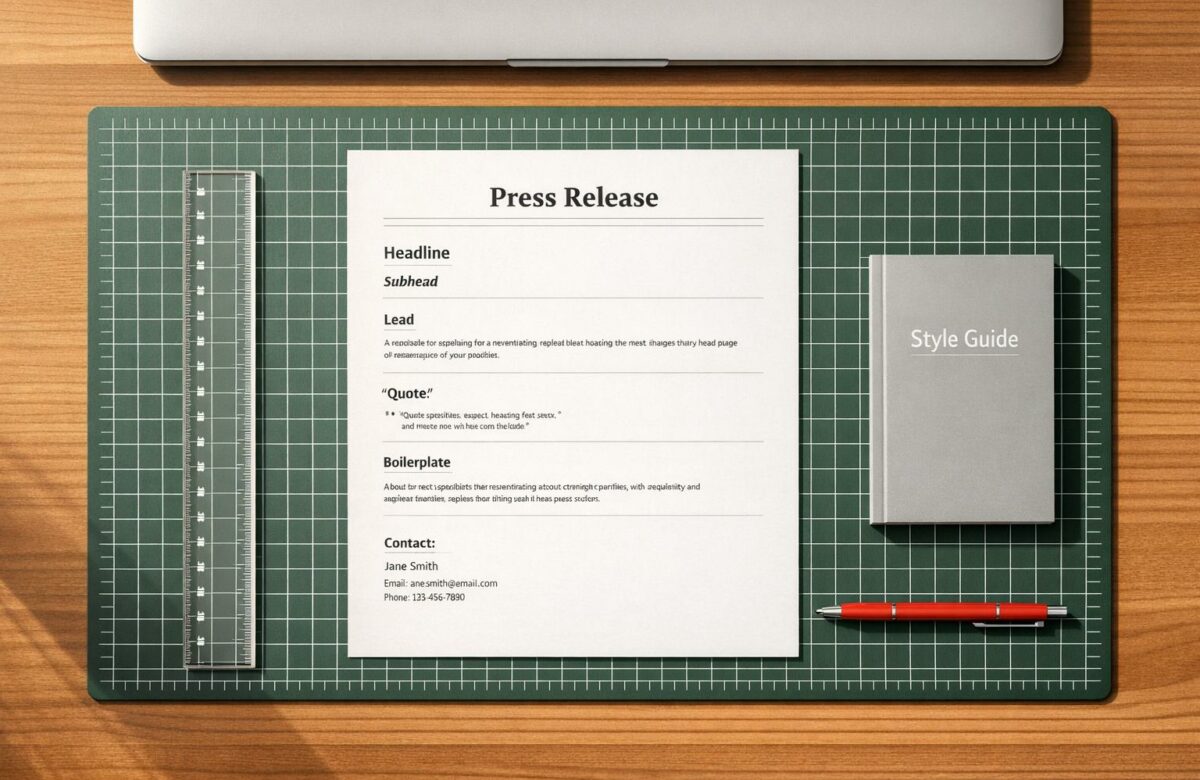
How To Write A Press Release In Perfect English
A press release is your direct line to journalists and the public, making it essential to present your news clearly and professionally. Writing in proper English boosts credibility and increases the chances of media coverage. Here’s what you need to know:
- Structure matters: Follow the standard press release format – headline, dateline, lead paragraph, body, quotes, boilerplate, and contact information.
- Headlines are key: Keep them under 100 characters, use active verbs, and stick to AP Style capitalization rules.
- Write for clarity: Use short sentences, active voice, and avoid jargon. Answer the five Ws (Who, What, When, Where, Why) upfront.
- Use the inverted pyramid: Start with the most critical information and follow with supporting details.
- Stick to U.S. standards: Follow AP Style for grammar, punctuation, and formatting, including dates, times, and measurements.
Tools like BeLikeNative can polish your writing, ensuring error-free, professional press releases. Focus on brevity, precision, and proper formatting to make your story stand out.
How to write a press release? [Examples, Tips, Format and Templates]
sbb-itb-32359dc
Press Release Format and Structure
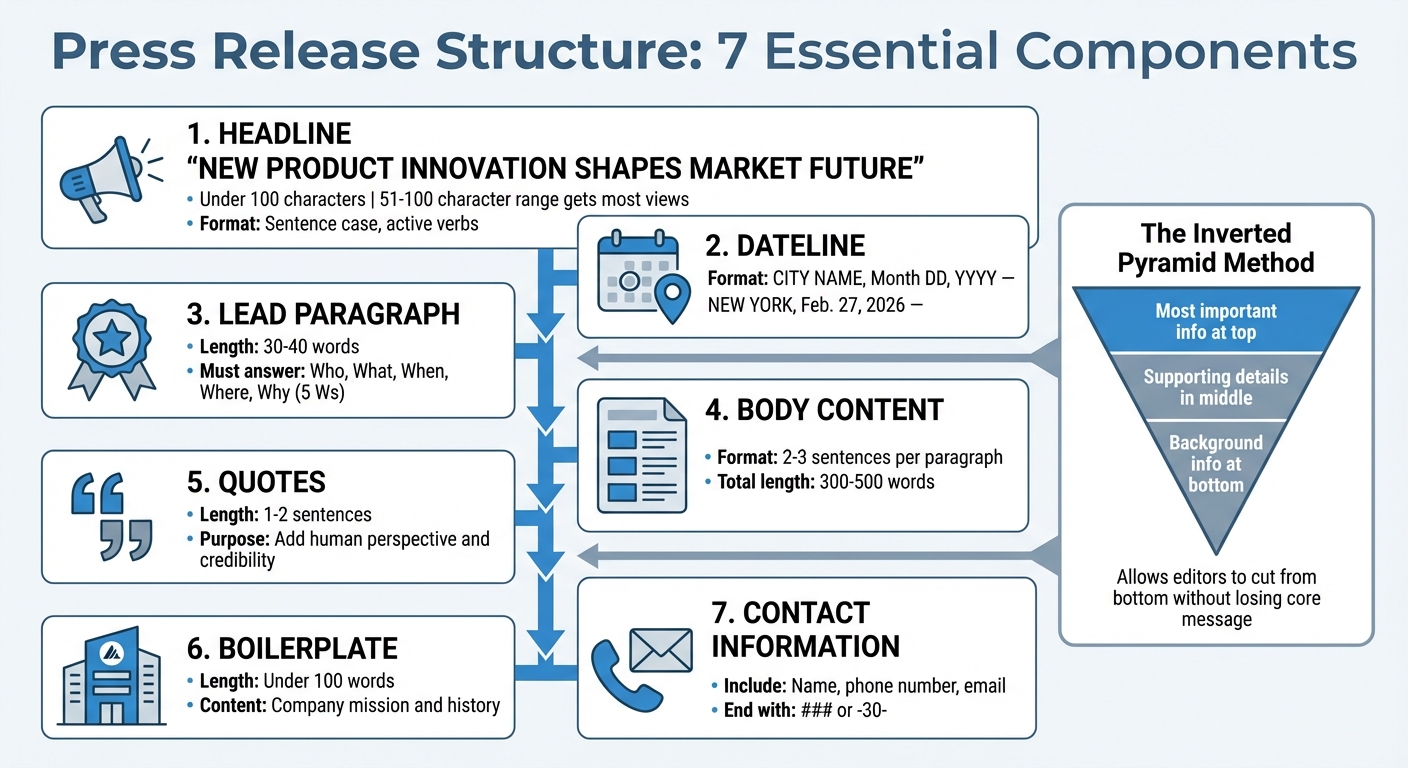
Press Release Structure: 7 Essential Components and Formatting Guide
A press release follows a standard format that journalists are familiar with, making it easier for them to process and more likely to publish. Here’s a breakdown of its essential components.
Main Parts of a Press Release
A well-crafted press release includes seven core elements:
The headline sits at the very top. It’s a short, action-oriented summary that grabs attention. Headlines should stay under 100 characters since research shows headlines in the 51–100 character range typically get the most views.
The dateline comes next, showing where and when the release was issued. It includes the city in uppercase, followed by the abbreviated month, day, and year, separated by an em dash (e.g., NEW YORK, Feb. 27, 2026 – ). AP style requires months to be abbreviated when paired with a specific date.
The lead paragraph is crucial. It answers the five Ws – Who, What, When, Where, and Why – in just 30 to 40 words, offering a concise summary of the story.
The body content builds on the lead, providing additional details. Keep paragraphs short – two to three sentences each – for easy readability.
Quotes from key individuals bring a personal perspective and help establish credibility.
The boilerplate is a brief "About Us" section, typically under 100 words, that highlights your organization’s mission and history.
Contact information is essential for media inquiries. Include a name, phone number, and email address. To signal the end of the document, center "###" or "-30-" at the bottom.
| Component | Purpose | Formatting Note |
|---|---|---|
| Headline | Grab attention and summarize news | Sentence case; under 100 characters; active verbs |
| Dateline | Provide context of time and place | City in uppercase; abbreviated month; specific date |
| Lead | Convey critical details immediately | 30–40 words covering the five Ws |
| Body | Deliver supporting details | Organized in short, clear paragraphs |
| Quotes | Add a human touch and credibility | Statements from key stakeholders |
| Boilerplate | Explain company background | Standardized text; under 100 words |
| Contact | Enable media follow-up | Include a name, phone number, and email address |
The Inverted Pyramid Method
Once you’ve outlined the structure, the inverted pyramid method helps organize your content effectively. Unlike traditional storytelling, this approach prioritizes the most newsworthy information upfront, gradually moving to supporting details.
"The inverted pyramid is a tried and true method that helps writers address the most important information at the beginning of the press release."
– Charlie Terenzio, CMO and SVP of Media and Communications, Newswire
Using this method, place the five Ws in the lead paragraph at the very top. Follow this with a middle section containing supporting facts, expert quotes, and additional context. The bottom section should include the boilerplate, background information, and contact details. This structure ensures that even if only the top part is read, the main message is clear. It also allows editors to cut less critical information without losing the core story.
Writing Clear and Effective Content
Once your format is set, the next step is to create content that’s both precise and engaging. For professional press releases in the U.S., clarity is key. Journalists prefer releases they can use with minimal edits, so clear writing directly boosts your chances of media coverage.
Creating Strong Headlines
Your headline should be straightforward, factual, and relevant – steer clear of overly promotional language. Keep it between 65 and 100 characters to ensure it performs well on mobile devices and grabs attention. Use active voice and strong, action-oriented verbs. For instance, "Tech Startup Unveils AI Platform That Cuts Data Analysis Time by 60%" is far more engaging than "New AI Platform Launched by Tech Startup."
Stick to AP style capitalization rules: capitalize the first word, the last word, and major words, but leave articles, short conjunctions, and prepositions lowercase. Avoid ALL CAPS headlines, as they come off as unprofessional. Naturally include your company name and primary keywords for better search engine visibility. Adding specific data points, like percentages or dollar amounts, can make your headline more credible and attention-grabbing. Above all, your headline should answer, "Why should I care?"
"Your headline is the first thing a journalist will see, so it needs to grab attention and succinctly convey the main point of your news to your target audience." – PR Newswire
A strong headline lays the groundwork for an equally compelling lead paragraph, which should immediately deliver the essential details.
Writing the Lead Paragraph and Body
The lead paragraph is where you establish the foundation for the rest of your release. In 35 to 60 words, it should answer the essential questions: Who, What, When, Where, and Why. Start with the actual announcement – avoid generic phrases like "Today, the company is proud to announce…" Keep each paragraph concise with two to three sentences, making it easy to read on digital screens.
Use active voice throughout. For example, say "The CEO announced" instead of "It was announced by the CEO." Stick to a neutral, journalistic tone, and avoid promotional language or over-the-top adjectives. Steer clear of industry jargon that might confuse your audience. Aim for an overall length of 300 to 500 words. With roughly 300 press releases issued daily in the U.S., brevity and clarity will help yours stand out.
"Journalists live and breathe AP style because it keeps content consistent across thousands of publications. If your release doesn’t match those standards, it can scream ‘amateur’." – Anthony Santiago, Director of Marketing, Newswire
Adding Quotes, Data, and Company Information
Quotes bring life to your release, adding a human element that turns plain facts into a story. Write quotes that sound conversational and avoid corporate buzzwords or technical terms that feel unnatural. Make sure quotes add new insights rather than repeating earlier details. Always use "said" for attribution and place it after the first sentence of the quote:
"Small business owners don’t have time to become data scientists", said Maria Chen, CEO of Acme Software.
Back up your claims with data. For example, Acme Software’s January 2026 press release for DataPulse included detailed statistics like a $49 monthly starting price and $14,000 in annual savings reported by beta users. Similarly, ClimaTech’s February 2026 funding announcement highlighted its technology’s ability to reduce installation time from 18 months to just 6 weeks, cutting costs by 60%.
| Element | Recommended Length | Primary Purpose |
|---|---|---|
| Headline | 65–100 characters | Summarize news with active verbs |
| Lead Paragraph | 35–60 words | Answer Who, What, When, Where, Why |
| Quote | 1–2 sentences | Add human perspective |
| Boilerplate | < 100 words | Provide company background |
| Total Release | 300–500 words | Deliver concise, newsworthy information |
US Language and Formatting Standards
Getting the technical details right can make or break your press release. American journalists rely on specific formatting conventions, and straying from these norms can make your release seem unpolished. The Associated Press (AP) Stylebook, in use since 1846, is the go-to guide for these standards.
Grammar and Style Rules
AP style has its own set of grammar and punctuation rules. For example, always use a single space after a period – never two. Skip the Oxford comma in simple lists, writing "red, white and blue" instead of "red, white, and blue." However, in complex lists where clarity might suffer, adding the comma is acceptable. Also, remember to place commas and periods inside quotation marks.
When it comes to numbers, the rules are straightforward: spell out numbers from one to nine, but use numerals for 10 and above. There are exceptions, though. For ages (e.g., 5 years old), percentages (e.g., 7 percent), monetary amounts (e.g., $8 million), dimensions (e.g., 5 feet 3 inches), and dates (e.g., Jan. 15), always use numerals. If a number begins a sentence, spell it out completely unless it’s a year (e.g., "2026 was a record year").
Job titles are another area where AP style stands out. Capitalize them only when they immediately precede a person’s name, like "President Maria Chen announced." If the title follows the name, use lowercase, as in "Maria Chen, the president, announced." For quotes, stick to "said" rather than more formal alternatives like "stated" or "says."
Datelines should start with the city name in all caps. Major cities like CHICAGO, BOSTON, or NEW YORK can stand alone, while smaller cities need a state abbreviation (e.g., MURRAY, Ky.). There are 30 major U.S. cities, including Atlanta, Detroit, Miami, and Seattle, that don’t require state names in datelines.
"The difference between one [press release] that gets picked up by journalists and one that gets ignored often comes down to a single factor: AP style." – eReleases
These rules form the backbone of professional press release writing in the U.S.
US Formatting Conventions
Building on grammar and style, U.S. formatting standards dictate how to handle dates, times, currency, and measurements. Dates should follow this format: Jan. 15, 2026. Only abbreviate Jan., Feb., Aug., Sept., Oct., Nov., and Dec. when paired with a specific date. Do not abbreviate March, April, May, June, or July, and avoid ordinal numbers like "1st" or "2nd." When including a full date in a sentence, offset the year with commas (e.g., "The launch on June 15, 2024, exceeded expectations").
For times, use lowercase a.m. and p.m. with periods (e.g., 9 a.m. or 3:30 p.m.), and skip the ":00" for whole hours. Currency should always include a dollar sign and numerals (e.g., $5.25 or $8 million), spelling out "million" or "billion" as needed. Measurements should stick to imperial units (e.g., 5 feet 3 inches), and percentages should use numerals with "percent" spelled out (e.g., 6 percent).
American spelling rules also differ from British English. Use "color" instead of "colour", "center" instead of "centre", and "organize" instead of "organise." As of 2024, the AP Stylebook references Merriam-Webster as its official dictionary, making it the definitive source for any style questions. For tech terms, write "email" (no hyphen), "internet" (lowercase), "website" (one word), and "iPhone" (lowercase "i", unless it begins a sentence).
| Category | AP Style Rule | Example |
|---|---|---|
| Date Format | Abbreviate Jan., Feb., Aug., etc. | Jan. 27, 2026 |
| Time Format | Lowercase a.m./p.m. with periods | 8 a.m. or 2:15 p.m. |
| Currency | Dollar sign with numerals; spell out large amounts | $5.25; $8 million |
| Measurements | Use imperial units | 5 feet 3 inches |
| Percentages | Numerals with "percent" spelled out | 5 percent |
Tools for Error-Free Press Releases
Even if you’re confident in your AP style skills, tight deadlines can make catching every grammar slip or awkward phrase a tough task. Writing tools can help fine-tune your press releases, ensuring they’re polished and professional before hitting journalists’ inboxes.
Using BeLikeNative for Better Writing
BeLikeNative is a handy Chrome extension designed to turn rough drafts into polished, native-level English. All it takes is highlighting a sentence, pressing a shortcut, and voilà – your revised text is ready in your clipboard. This seamless process keeps your creative momentum intact.
The extension works across popular web platforms, so you can refine your press release wherever you’re drafting it. Supporting over 80 languages, it’s a lifesaver for translating international announcements into English or for those whose first language isn’t English. Plus, you can adjust the tone to match your needs – choose "formal" for business announcements or tweak the style to enhance vocabulary.
"BeLikeNative eliminates that friction entirely [by removing the need to switch tabs and write prompts]." – BeLikeNative
This tool is built for efficiency, helping you craft error-free press releases without breaking your workflow. Users report saving over an hour daily by skipping repetitive tasks like switching tabs or manually copy-pasting. Top users have even seen a 66% boost in productivity. The character limits are also tailored to press release needs, ranging from 500 characters in the free plan to 6,000 characters in premium plans.
With these features, BeLikeNative becomes an essential tool for elevating your press release game. Its pricing options, detailed below, make it accessible for a variety of needs.
BeLikeNative Pricing Plans
BeLikeNative offers a free Explorer plan alongside three paid options, each including a 7-day free trial so you can test it on your actual press release drafts before committing.
| Plan | Price (Monthly) | Daily Limits | Character Limit | Key Features |
|---|---|---|---|---|
| Explorer | $0 | 5 | 500 | Basic grammar and spelling fixes, supports 80+ languages |
| Learner | $4 | 25 | 2,000 | Editable shortcuts and extra writing tools |
| Native | $6 | 50 | 4,000 | Priority bandwidth for smoother workflow |
| Premium | $14 | 125 | 6,000 | Priority access to new features and partnership perks |
For PR professionals juggling multiple weekly releases, the Native or Premium plans are ideal, supporting frequent revisions without hitting usage limits.
Conclusion
Crafting a press release in flawless English requires a strong grasp of structure, attention to detail, and careful refinement. Start with the inverted pyramid method: lead with the most critical information – the five Ws (Who, What, When, Where, Why) – and follow with supporting details arranged by importance. Use active verbs in your headlines and stick to AP Style formatting. This approach ensures clarity and professionalism, laying the groundwork for the vital step of thorough editing.
Both precise language and a clear structure are non-negotiable. Flawless writing not only demonstrates professionalism but also increases the chances of media outlets picking up your story. Journalists expect neutral, factual language without excessive marketing jargon. Even minor issues, like typos or incorrect names, can damage your credibility and result in rejection. That’s why meticulous proofreading and professional editing are essential before distributing your press release.
"A well-crafted, AP-style press release can boost your chances of getting media coverage. Remember, your goal is to make journalists’ jobs easier." – PR Newswire
To uphold this level of precision, using effective writing tools can make all the difference. Platforms like BeLikeNative simplify the revision process by eliminating awkward phrasing and grammar mistakes, ensuring your press release is polished and professional. With flexible revision options, the Native and Premium plans are particularly helpful for PR professionals handling multiple press releases each week.
FAQs
What makes a press release newsworthy?
A press release grabs attention when it delivers relevant, timely, and meaningful information that goes beyond mere self-promotion. This could involve major announcements, important updates, or ties to larger trends or pressing issues. To make an impact, emphasize what’s new, why it matters, and how it connects with people on a personal level.
How do I choose the right city for the dateline?
When crafting a dateline, the city name should always appear in all capital letters. For cities that are widely recognized (like NEW YORK or LOS ANGELES), the name alone is enough. However, for less familiar locations, include both the city name and the state abbreviation to ensure clarity (e.g., NASHVILLE, Tenn.).
This approach ensures readers can quickly identify the location without confusion, adhering to AP style’s emphasis on consistency and readability.
When should I use commas in AP Style lists?
In AP Style, commas are used in lists with three or more items. However, the serial (Oxford) comma – placed before the final conjunction – is generally avoided unless its absence might cause confusion. If leaving it out could lead to misinterpretation, include the comma for clarity. For straightforward lists, AP Style typically skips the final comma unless it’s essential for understanding.