
Best AI Proofreader For Medical Writing
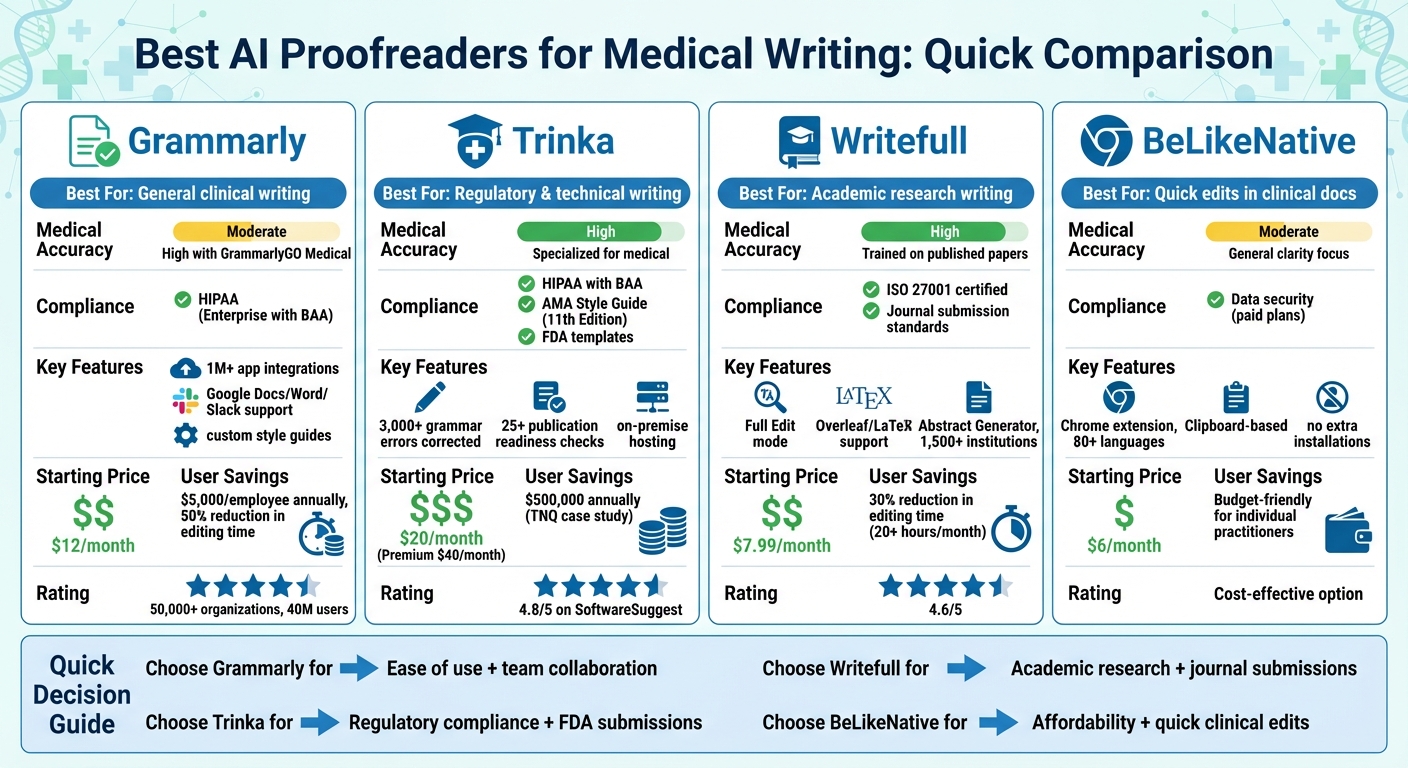
Medical writing demands accuracy and compliance. A single error can jeopardize patient safety or delay approvals. AI proofreading tools now help medical professionals save time and improve precision. But which tool is best for your needs? Here’s a quick breakdown:
- Grammarly: General-purpose with a medical module, HIPAA-compliant for enterprise users, integrates with many platforms, starting at $12/month.
- Trinka: Tailored for medical and academic writing, includes AMA style checks, advanced grammar corrections, and regulatory support, priced at $20–$40/month.
- Writefull: Focused on academic research, offers tools like sentence rewrites and citation checks, starting at $7.99/month.
- BeLikeNative: Budget-friendly Chrome extension for quick edits in clinical writing, starting at $6/month.
Quick Comparison:
Transform Any Text, On Any Site, In Seconds
Rephrase, translate, and improve text with one shortcut. Works everywhere you write.
Add to Chrome - It's Free!| Tool | Best For | Medical Accuracy | Compliance | Price (Starting) |
|---|---|---|---|---|
| Grammarly | General clinical writing | Moderate | HIPAA | $12/month |
| Trinka | Regulatory & technical writing | High | HIPAA | $20/month |
| Writefull | Academic research writing | High | Limited | $7.99/month |
| BeLikeNative | Quick edits in clinical docs | Moderate | Limited | $6/month |
Choose based on your writing needs: Grammarly for ease of use, Trinka for compliance, Writefull for research, or BeLikeNative for affordability.
AI Proofreading Tools for Medical Writing: Feature and Price Comparison
Artificial Intelligence Tools in Medical Writing
sbb-itb-32359dc
1. Grammarly
Grammarly is relied upon by more than 50,000 organizations and 40 million people globally. While it isn’t exclusively designed for medical use, its GrammarlyGO Medical module includes specialized medical dictionaries. These tools help healthcare professionals verify dosage information, check the accuracy of medical terminology, and maintain consistency in drug names.
Medical Terminology Accuracy
The standard version of Grammarly might flag correct medical terms as errors or overlook intricate technical mistakes. These issues can be addressed by upgrading to GrammarlyGO Medical. For organizations, the Enterprise tier offers custom style guides that enforce institutional standards, ensuring consistency in terminology. However, it’s worth noting that Grammarly doesn’t natively support the American Medical Association (AMA) style guide, making it more appropriate for drafting rather than finalizing medical documents.
Regulatory compliance is another key factor for healthcare professionals.
Regulatory Compliance Support
Grammarly complies with HIPAA Security, Privacy, and Breach Notification rules. However, handling Protected Health Information (PHI) is only allowed under the Enterprise plan, which requires a minimum of 100 seats and a signed Business Associate Agreement (BAA). To protect sensitive data, Grammarly encrypts information at rest using AES-256 and in transit via TLS 1.2 protocol. It also holds certifications like SOC 2 Type 2, ISO/IEC 27001:2022, and ISO/IEC 27701:2019.
In addition to compliance, Grammarly integrates with the tools healthcare professionals use daily.
Integration Options
Grammarly supports over 1 million apps and websites. It integrates seamlessly with Microsoft Word, Google Docs, Outlook, and Gmail through native add-ins. Browser extensions for Chrome, Firefox, Edge, and Safari enable real-time editing in web-based platforms, including research databases and Electronic Health Record (EHR) systems. For flexibility, Grammarly also offers desktop apps for Windows and Mac and mobile apps for iOS and Android, making it easy to use across various clinical and reporting software.
Jenna Kozel-King, VP of Corporate Marketing, shared that her team experienced a 50% reduction in writing and editing time after incorporating Grammarly into their workflow.
Pricing
| Plan | Price | Key Features |
|---|---|---|
| Free | $0/month | Basic grammar, spelling, punctuation, and tone detection |
| Pro | $12/member/month (annual) | Full sentence rewrites, brand style alignment, and 2,000 AI prompts |
| Enterprise | Contact Sales | Unlimited members, data loss prevention, SSO, custom style guides, and HIPAA compliance with BAA |
Organizations using Grammarly have reported saving approximately $5,000 per employee annually. In 2025, Lauren Reed, a Content Strategist, noted that her organization saved $210,000 within nine months of adopting Grammarly’s tools. Additionally, users reported a 66% improvement in writing quality and a 3x faster editing process.
2. Trinka
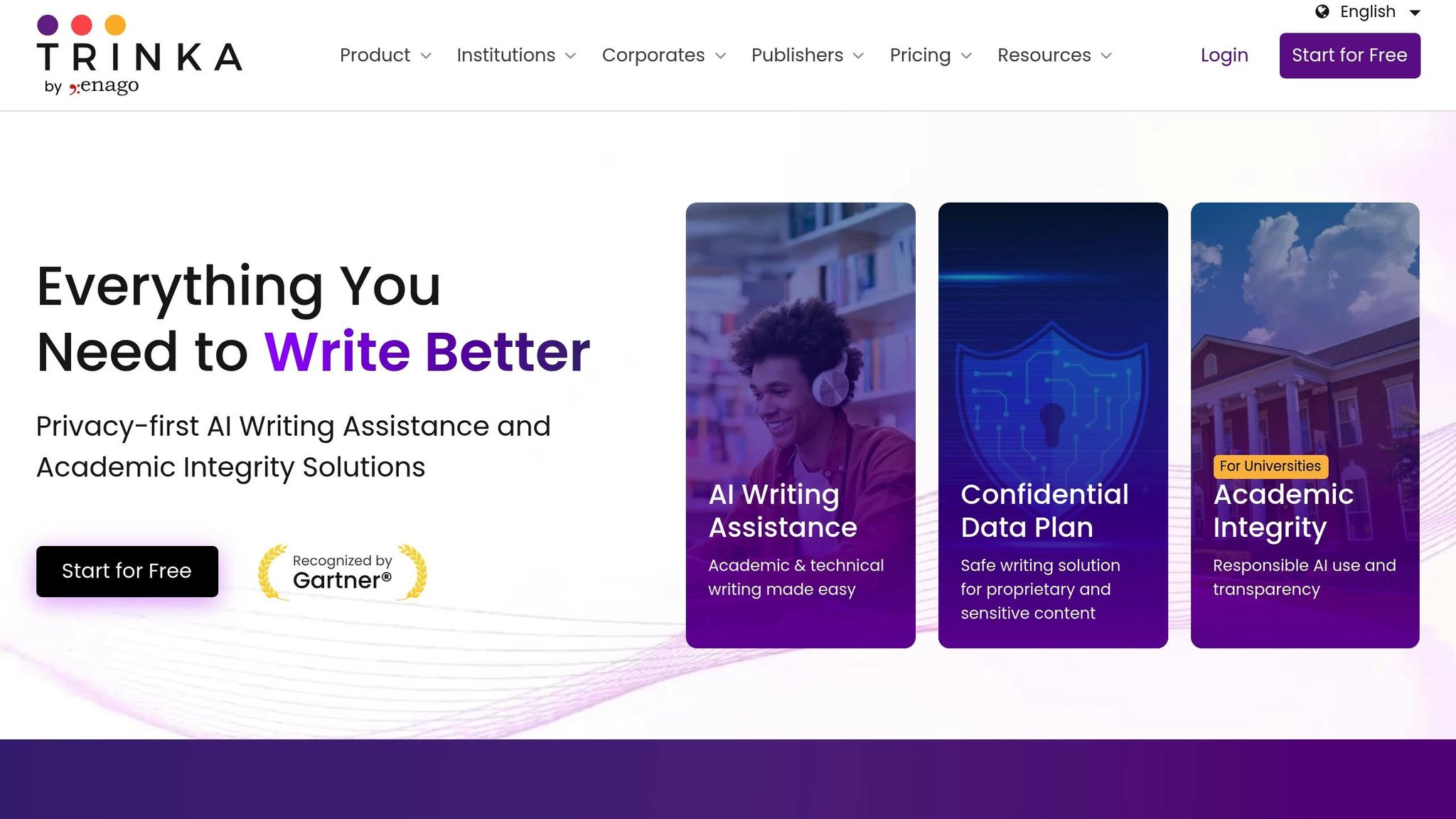
Trinka is designed specifically for academic and medical writing, drawing insights from millions of papers across over 1,300 subjects. It features a robust integrated dictionary packed with thousands of medical terms, and users can even add custom drug names and terminology.
Medical Terminology Accuracy
This tool is built to handle the nuances of medical language, correcting more than 3,000 grammar errors. It can differentiate between context-specific terms like "severe" versus "serious" in clinical settings, and it catches common drug spelling errors, such as "pregabalin." By incorporating the American Medical Association (AMA) Manual of Style (11th Edition) and APA standards, Trinka ensures that manuscripts align with the formal requirements for publication.
It has an in-built medical dictionary and an AMA style guide which is such a boon for medical students like me.
- Keith Santos, a medical student.
Beyond grammar, Trinka performs over 25 publication readiness checks tailored to journal requirements. These checks identify issues like retracted references, missing ethical statements, and citation inconsistencies, helping to minimize desk rejections. This thorough review process ensures manuscripts are ready for regulatory scrutiny.
Regulatory Compliance Support
Trinka prioritizes data security and compliance. It is HIPAA-compliant and offers Business Associate Agreements (BAAs). For added flexibility, it provides an offline desktop app and on-premise hosting options, ensuring data sovereignty and enabling real-time data deletion. The "Confidential Data Plan" guarantees that user data is not used for AI training.
In a notable case study, TNQ Technologies deployed Trinka’s API as part of an AI solution called "Language Central" for a leading international STM publisher. Between 2022 and 2023, this system evaluated over 20,000 articles, allowing editors to focus only on "high-intervention" pieces. This automation saved the publisher more than $500,000 annually by eliminating unnecessary copyediting tasks.
Integration Options
Trinka offers seamless integration across platforms. Its native Microsoft Word add-in provides real-time suggestions without disrupting the editing process. Browser extensions for Chrome, Firefox, and Edge enable support on web-based submission portals and research tools. For organizations, Trinka’s API can be embedded into proprietary software to automate language assessments. Additionally, the cloud-based editor accepts .doc, .docx, and .pdf uploads, allowing users to download edited documents with tracked changes for easy review.
Pricing
| Plan | Price | Key Features |
|---|---|---|
| Free | $0/month | Basic grammar checks, limited plagiarism and paraphrasing (5,000 words/month) |
| Basic | $20/month | Unlimited grammar and style corrections, tone adjustments |
| Premium | $40/month | Includes citation, plagiarism, and AI detection |
| Enterprise | Custom Pricing | API access, IP whitelisting, BAA, on-premise hosting, and priority support |
Trinka has earned a 4.6/5 rating on SoftwareSuggest, based on 17 user reviews.
Trinka AI enables me to accurately choose and correct the appropriate scientific terms when writing academic articles in English.
- Oliver P., a PhD researcher.
However, some users have noted slower performance when using the Microsoft Word add-in for documents longer than 10–15 pages.
3. Writefull
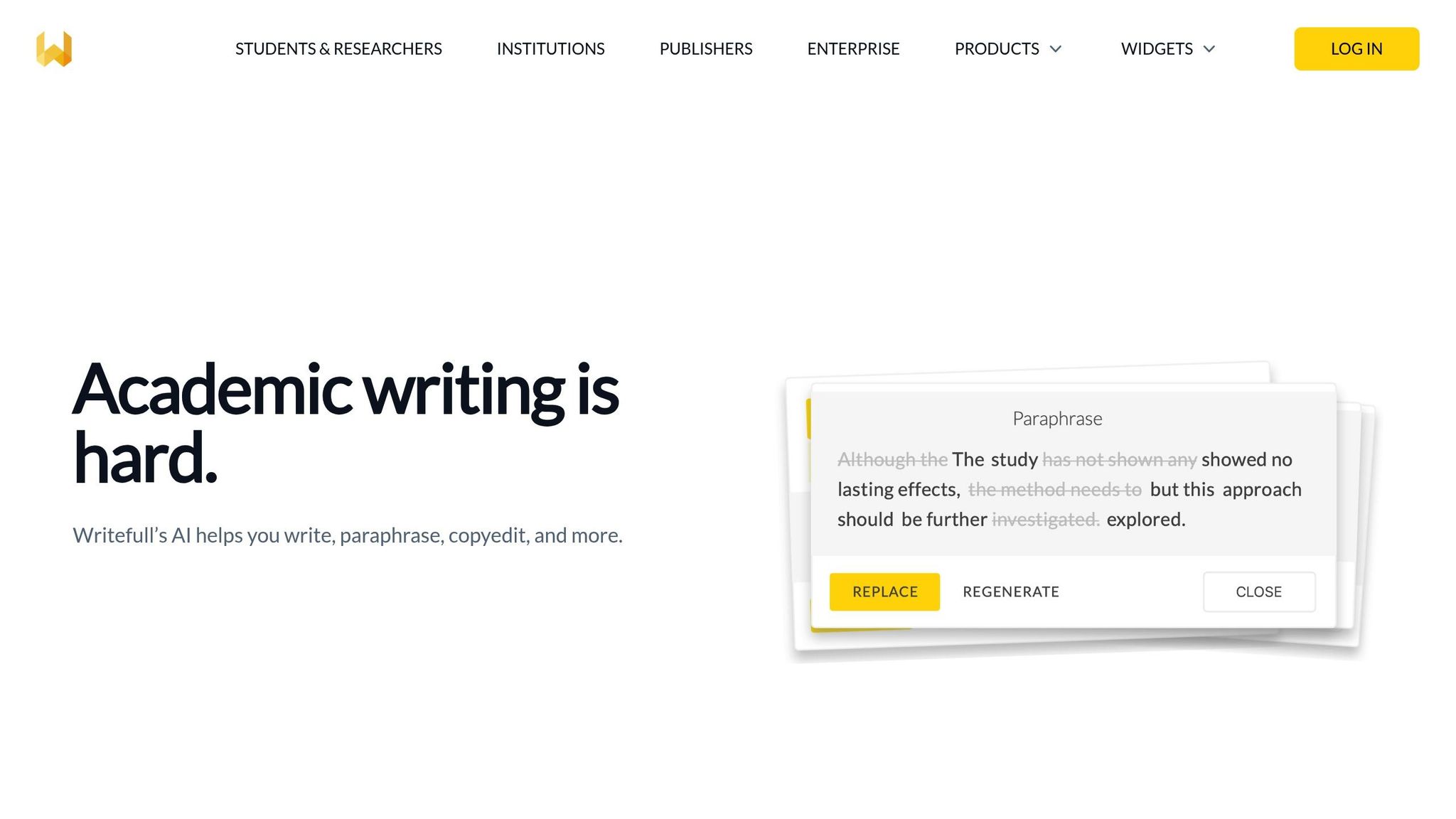
Writefull is tailored specifically for researchers, using AI models trained on millions of published research articles instead of general web content. By focusing on academic language, it helps users refine their writing to meet the high standards required in fields like medical research. The platform combines scientific precision with an easy-to-use interface, making it a standout choice for academic and technical writing.
Medical Terminology Accuracy
Writefull’s Full Edit mode is a standout feature, offering sentence-level rewrites that improve clarity, structure, and tone. It compares your work against a massive database of published papers, ensuring corrections are precise and contextually accurate. This is especially helpful for using complex medical terms correctly and aligning with the conventions of scientific literature.
It is clearly designed for researchers by researchers! I have used other more generic proofreading software as well, but it is really optimized for academic writing! – Afshin Jafari, Postdoctoral Research Fellow, RMIT University.
The platform also includes tools like the Academizer, which converts informal text into formal academic language, and the Abstract Generator, designed to summarize research papers. These features ensure that even the most technical writing maintains a polished academic tone.
In addition to refining terminology, Writefull is built to meet the strict regulatory requirements often associated with medical writing.
Regulatory Compliance Support
Writefull is explicitly designed for regulatory, medical, patent, and technical writing. It’s ISO 27001 certified and operates on Google Compute infrastructure located in the Netherlands. All data is encrypted end-to-end, with SSL certificates renewed every 90 days.
The platform prioritizes user privacy by not storing submitted texts or using them to train its AI models. This makes it a trusted choice for handling sensitive clinical trial data and proprietary research. Writefull is already in use at over 1,500 institutions worldwide, and publishers like the American Chemical Society and the Royal Society of Chemistry have integrated it into their systems.
Integration Options
Writefull is designed to fit seamlessly into the tools researchers already use. Its Microsoft Word add-in works on Mac, Windows, and the online version, offering real-time feedback as you write. For those who use LaTeX, the Overleaf extension includes TeXGPT, which generates LaTeX code for tables and formulas.
The Writefull Revise web app allows users to upload .docx files for thorough language checks. It returns a revised file with "Track Changes" enabled, streamlining the review process. Organizations can also integrate Writefull into their workflows using the Writefull API, which supports custom platforms and publishing processes. Additional tools include Writefull Cite for reference checking and a Sentence Palette with over 600 academic phrases to help structure sections like methods and results.
As a non-native English speaker, I should edit my writing carefully. I use many apps to do so. Writefull spots mistakes others do not. Incredible. – Andrea Beltran Lizarazo, PhD student, Boston University.
Pricing
| Plan | Price | Key Features |
|---|---|---|
| Free | $0/month | Basic feedback, 500-word daily limit, limited title generation |
| Premium Individual | $7.99/month or $60/year | Unlimited word count, full integrations, advanced suggestions, citation checker |
| Team/Institutional | Custom Pricing | Centralized billing, usage analytics, admin dashboard, API access |
Writefull has received a 4.6/5 rating on multiple review platforms. Users report that it can cut editing time by up to 30%, potentially saving medical writers over 20 hours each month. The Writefull for Teams plan costs around $100 per user per month, while institutional licenses grant full access to all staff and students.
4. BeLikeNative
BeLikeNative is a Chrome extension designed to streamline writing tasks in over 80 languages. It provides tools for rephrasing, translation, and text refinement – all accessible directly from your clipboard. Instead of switching between multiple apps, medical writers can make quick edits with a single keyboard shortcut, which is especially helpful during fast-paced clinical workflows.
Medical Terminology Accuracy
BeLikeNative prioritizes clarity and readability across various writing scenarios. For clinical writing, it ensures precise grammar and fluency improvements. This reliability aligns with the high standards required in medical communications, making it a valuable tool for professionals in the field.
Integration Options
Beyond its language tools, BeLikeNative offers seamless integration with platforms like Google products, WhatsApp Web, and Notion, eliminating the need for additional installations. Its clipboard-based functionality allows users to work directly within electronic health record systems, email platforms, or any browser-based text fields. Plus, customizable shortcuts for language, tone, and style ensure that users can adapt the tool to their specific workflows.
Pricing
| Plan | Price | Daily Uses | Character Limit | Best For |
|---|---|---|---|---|
| Free | $0/month | 5 | 500 | Basic grammar checks |
| Learner | $4/month | 25 | 2,000 | Occasional medical documentation |
| Native | $6/month | 50 | 4,000 | Regular clinical writing |
| Premium | $14/month | 125 | 6,000 | High-volume medical writing teams |
The Native plan, priced at $6/month, is an excellent middle-ground option for medical professionals needing reliable proofreading without the expense of high-end academic tools. All paid plans include features like data security and priority customer support, making them a practical choice for individual practitioners and smaller medical offices. These features position BeLikeNative as an efficient tool for everyday medical writing tasks.
Strengths and Weaknesses
Here’s a streamlined breakdown of the strengths and weaknesses of each tool for medical writing.
Grammarly stands out for its extensive integration capabilities. It works seamlessly with platforms like Google Docs, Word, Slack, and various CMS tools, making it a solid choice for teams juggling multiple apps. However, its style suggestions often miss the mark for medical contexts unless upgraded to GrammarlyGO Medical. On the bright side, it ensures PHI security with HIPAA-compliant measures and BAAs.
Trinka shines in regulatory and technical accuracy. For example, it can spot errors like "pregabolin" instead of "pregabalin". Its built-in AMA Manual of Style (11th Edition) checker and FDA template libraries make it a go-to for regulatory submissions. That said, its price – around $150/month – may be a hurdle, and its integration options are limited to MS Word and cloud-based editors. While it’s unmatched in regulatory precision, some competitors focus more on academic clarity.
Writefull is tailored for academic editing, aligning with journal submission standards. With plans starting at $7.21/month (billed annually), it’s an affordable option for medical students and early-career researchers. However, its focus on academic contexts means it lacks the advanced regulatory compliance features required for FDA-related work.
BeLikeNative offers a flexible Chrome extension that works across online platforms without requiring additional installations. At just $6/month for the Native plan, it provides cost-effective grammar and fluency improvements for day-to-day clinical writing. Its general-purpose design prioritizes clarity and readability but doesn’t include tools for regulatory compliance or medical-specific style guides.
Below is a comparison table summarizing the key differences among the tools:
| Tool | Medical Terminology Accuracy | Regulatory Compliance Support | Integration Options | Starting Price |
|---|---|---|---|---|
| Grammarly | Moderate (High with GrammarlyGO Medical) | HIPAA (Business Plan with BAA) | Google Docs, Word, Slack, CMS platforms | Free / $12/month (annual) |
| Trinka | High (Specialized for medical) | AMA Style, FDA Templates, ICH E3 | MS Word, Cloud Editor, Windows | Free / ~$150/month |
| Writefull | High (Academic/Scientific) | Journal Submission Standards | MS Word, Overleaf, Teams | $7.21/month (annual) |
| BeLikeNative | Moderate (General clarity focus) | Data security (all paid plans) | Chrome extension, clipboard-based, browser platforms | Free / $6/month |
This overview highlights the strengths of each tool, helping medical writers choose the one that aligns best with their specific needs and priorities.
Conclusion
When it comes to the challenges of medical writing, precision and adherence to guidelines are non-negotiable. The right AI proofreader for you depends on the specific demands of your medical writing tasks.
For regulatory submissions, Trinka is a standout option. With its integration of the AMA Manual of Style (11th Edition), it offers the level of technical accuracy needed for compliance-critical documents. While it costs around $150 per month, its advanced proofreading features make it a strong choice for this highly specialized area.
If you’re working on research papers or journal submissions, both Trinka and Writefull are excellent options. Trinka’s extensive training on millions of medical papers gives it an advantage in recognizing discipline-specific language, while Writefull provides a more budget-friendly solution for academic editing needs.
For clinical documentation and everyday writing tasks, Grammarly is a reliable choice. Its HIPAA-certified proofreading ensures compliance and helps streamline the documentation process. Alternatively, BeLikeNative offers a simple and affordable solution at just $6 per month for its Native plan. With its easy-to-use Chrome extension, it’s ideal for users seeking grammar and fluency improvements without the hassle of managing multiple tools.
Ultimately, the best tool for you depends on your primary writing needs. Regulatory documents demand Trinka’s precision, academic writing benefits from Writefull’s accessible features, and clinical documentation is well-supported by Grammarly’s robust system or BeLikeNative’s straightforward approach. By choosing a tool tailored to your specific requirements, you can ensure clarity, accuracy, and compliance in every piece you write.
FAQs
Can I use an AI proofreader with PHI safely?
Using an AI proofreader to handle Protected Health Information (PHI) carries potential risks unless the tool ensures HIPAA compliance and secure data management. General-purpose AI tools often lack the necessary safeguards, increasing the chance of data breaches or unauthorized access. To minimize these risks, opt for AI solutions specifically built for healthcare settings, with privacy policies that align with HIPAA standards. Additionally, always adhere to your organization’s data security guidelines when processing PHI with AI tools.
Which tool fits FDA or journal submission writing best?
Trinka.ai is a powerful tool tailored for medical writing, making it ideal for FDA or journal submissions. It offers specialized features like medical terminology recognition, adherence to publication standards, and regulatory formatting to meet the strict requirements of these submissions.
Will these tools work inside Word, Google Docs, or EHRs?
Most AI proofreading tools for medical writing are designed to integrate with widely used platforms like Microsoft Word, Google Docs, and even some Electronic Health Record (EHR) systems. These tools typically function as add-ins, browser extensions, or connect via APIs. For instance, PerfectIt works seamlessly with Word, while tools like Trinka are compatible with Google Docs. Additionally, many of these advanced tools interface with EHR systems, simplifying documentation and offering proofreading assistance tailored to the needs of medical professionals.
Related Blog Posts
- How To Polish Your Writing With Chrome Ai Extensions
- Reword Your Essays Effortlessly With Ai Paraphrasing Tools
- Top Ai Rewriter Tools For Flawless Content And Seo Optimization
- Ai Grammar Fixers That Improve Your Writing Instantly
✨ Related BeLikeNative Tools
- 🔍 Grammar Checker — Fix grammar errors instantly
- 📚 APA Citation Generator — Generate APA citations in seconds
- ✍️ Paraphrasing Tool — Rephrase any text to sound more natural
All tools are free to use with the BeLikeNative Chrome extension. View pricing plans →
Looking for profession-specific writing shortcuts? BeLikeNative Prompt Packs give you one-click transforms built for healthcare workflows.
BeLikeNative fixes grammar, rephrases, translates, and simplifies text on any website in 1 second — just highlight and hit a keyboard shortcut. No tab switching. Try it free →