
How To Write A Blog Post Intro That Hooks Readers
Your blog post introduction is the first and most important part of your content. It’s where readers decide whether to keep reading or leave. Here’s why it matters and how to get it right:
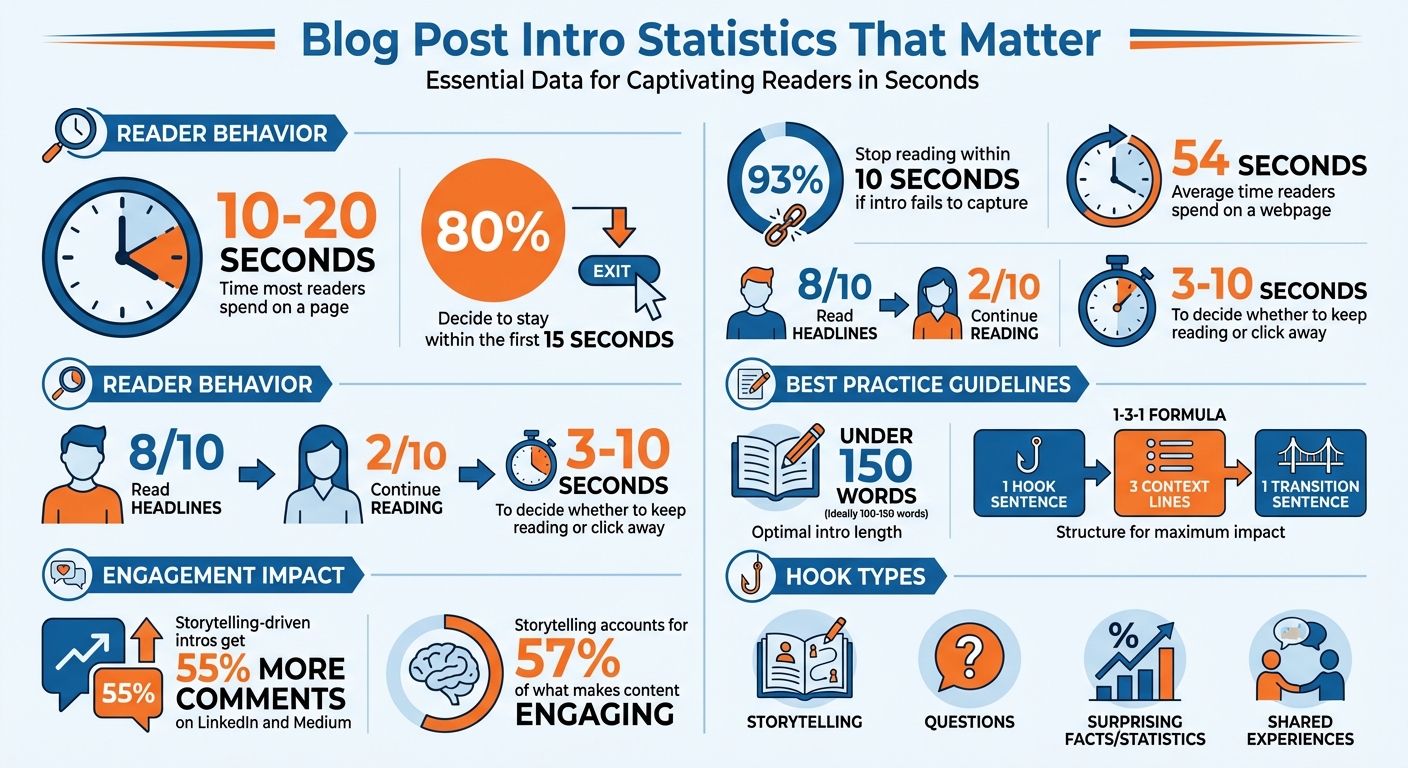
- Readers lose interest fast: Most people spend only 10–20 seconds on a page. If your intro doesn’t grab attention, they’ll move on.
- Weak intros hurt your content: Even with a great headline, a dull or generic opening can drive readers away.
- Good intros improve engagement: A strong start keeps readers on the page longer, which helps with SEO and reduces bounce rates.
To write a better intro:
- Avoid generic phrases like “In today’s world” or “It’s no secret that.”
- Speak directly to your reader’s problem to build trust.
- Keep it short – under 150 words – and avoid overwhelming details upfront.
- Use hooks like storytelling, questions, or surprising facts to draw readers in.
A well-crafted introduction not only grabs attention but also sets the tone for the rest of your blog post. Focus on clarity, relevance, and showing readers the value of your content right away.
Blog Post Introduction Statistics and Best Practices
Blog Post Intros To IMMEDIATELY Hook Visitors
sbb-itb-32359dc
Common Mistakes in Blog Post Introductions
Even experienced writers can stumble when crafting introductions. These missteps can lose a reader’s attention almost instantly. Knowing what not to do is just as critical as understanding what works.
Generic or Dull Openings
Kicking off with phrases like "In today’s world" or "It’s no secret that" screams generic content to readers. These bland starts fail to create a pattern interrupt – that moment when someone stops scrolling and pays attention.
Similarly, statements like "Here’s everything you need to know about…" don’t set your post apart from the sea of similar content. With readers spending an average of 54 seconds on a webpage, vague or uninspired openings make your article feel like a chore. If your intro doesn’t include a sharp hook or spark curiosity, readers have little reason to stick around.
Missing the Reader’s Problem
A major misstep is focusing on your own perspective instead of addressing your audience’s specific needs. If your introduction doesn’t speak directly to the reader’s challenges, they’ll quickly assume the content isn’t relevant to them. This disconnect can be hard to recover from.
Strong introductions identify the reader’s problem better than they can articulate it themselves, building immediate trust and connection. Skipping this step to dive into solutions or background details wastes the chance to show readers you truly understand their situation. Instead, start by highlighting their pain points before offering solutions.
Too Much Information Upfront
Packing your introduction with excessive details overwhelms readers before they’ve even committed to your content. If your opening stretches beyond 150 words or feels like a dense block of text, it’s likely too much.
Another red flag is stating the obvious – like telling seasoned sales professionals that "customers are important" – which can hurt your credibility. Save deeper explanations for your main content, organized under clear subheadings. Your introduction should tease value and spark curiosity, not deliver the entire message upfront.
Tested Strategies for Hooking Readers
Now that we’ve covered what to steer clear of, let’s dive into methods that actually grab attention. These four strategies can turn an ordinary introduction into one that pulls readers in right away.
Use Storytelling
Stories make abstract ideas feel real and relatable. Instead of lecturing, guide your audience with a narrative they can connect with. Start by sharing a moment when you faced the same problem your post addresses, or use a quick client anecdote that sets the stage and hints at a solution. For example, open with a scene grounded in time, like "In the early summer of 1976…" to make it feel authentic. No personal story? No problem. Use prompts like "Imagine this…" to create a vivid scenario your readers likely encounter daily. Posts with storytelling-driven intros get 55% more comments on platforms like LinkedIn and Medium compared to generic openings. In fact, storytelling accounts for around 57% of what makes content engaging.
Ask Questions That Matter
Questions are a great way to spark a mental conversation with your audience, especially when they address a frustration they might be dealing with. Use empathetic, curiosity-piquing questions that tap into their experiences, like "Don’t you just hate it when your dog barks all night?". Keep this hook short – one to three sentences – and make it feel personal by using "you." This approach fosters a one-on-one connection. Given that 80% of readers decide whether to stick around within the first 15 seconds, a well-placed question can be the difference between staying and bouncing. Pair this with a compelling statistic for even more impact.
Start with Surprising Facts or Statistics
Kicking things off with a striking statistic grabs attention and establishes your authority. Be precise – specific numbers like "340% increase" are far more engaging than vague terms like "huge improvement". For instance, in August 2025, Brian Dean of Backlinko opened his YouTube SEO guide by stating he used his strategies to grow his channel to 449,000 subscribers and over 22 million views. Highlighting potential losses or missed opportunities can also be powerful since people are often more motivated to avoid pain than to seek gains. To maximize impact, find your "golden statistic" – the one data point that perfectly captures your message – and lead with it.
Connect Through Shared Experience
Building trust starts with showing your readers that you understand their struggles. Mention common frustrations or situations they face regularly to create an instant connection. Align these shared experiences with the promise of your post to deepen that bond. Even a brief acknowledgment of a mutual challenge can establish the rapport you need to keep readers engaged from start to finish.
Refining Your Intro with BeLikeNative
Once you’ve drafted your intro, it’s time to polish it up. BeLikeNative makes this process effortless with tools that help you rephrase clunky sentences, adjust the tone to suit your audience, and even translate your hooks for a global readership. With its Chrome extension, you can refine your text in seconds using a simple clipboard shortcut – no need to switch between apps. This smooth workflow connects your creative ideas with precise, professional execution.
Adapting Hooks for a Global Audience
Editing isn’t just about fixing grammar; it’s about making your intro resonate with readers worldwide. BeLikeNative supports over 80 languages, enabling you to tailor your opening paragraph for diverse audiences – whether you’re targeting Spanish speakers in Mexico, French readers in Canada, or German professionals in Switzerland. Beyond language, you can also tweak the tone and style to align with regional preferences. For example, a casual tone that works well in the U.S. might feel too informal in Japan. This adaptability ensures your intro maintains its emotional pull while respecting cultural differences, helping you connect with readers wherever they are.
BeLikeNative Plans and Features Overview
BeLikeNative offers four pricing options, catering to a variety of writing needs and budgets. The Explorer plan is completely free, giving you 5 daily uses with a 500-character limit – ideal for quick edits. The Learner plan costs $4/month and increases your limit to 25 daily uses and 2,000 characters, making it a great choice for consistent bloggers. For more intensive editing, the Native plan at $6/month provides 50 daily uses, a 4,000-character limit, and priority access. At the top tier, the Premium plan costs $14/month, offering 125 daily uses, a 6,000-character limit, and exclusive partnership benefits, including potential equity after two years.
| Plan | Price | Uses per Day | Character Limit | Best For |
|---|---|---|---|---|
| Explorer | $0/month | 5 | 500 | Occasional grammar checks |
| Learner | $4/month | 25 | 2,000 | Regular blog editing |
| Native | $6/month | 50 | 4,000 | Professional content creators |
| Premium | $14/month | 125 | 6,000 | High-volume writers and partners |
Every plan includes essential features like multilingual grammar tools for spelling and grammar correction, clarity improvements, and access to all supported languages. Plus, BeLikeNative integrates seamlessly with tools like Google Docs, Notion, and WhatsApp Web, so you can refine your intros wherever you prefer to write.
Best Practices for Writing Concise Intros
When it comes to crafting introductions, every word counts. Readers often skim the opening, so your intro needs to grab attention and deliver value – fast. A focused, well-structured intro can make all the difference in keeping your audience engaged.
Use a Simple Intro Formula
A straightforward structure can help you create impactful introductions. One effective method is the 1–3–1 formula: start with one hook sentence, follow with three context-setting lines, and close with one transition sentence. This structure ensures your intro captures attention, provides essential background by outlining the problem and solution, and smoothly leads readers into the main content. Keep it concise, aiming for 100–150 words.
Another option is the four-part value formula: start with a compelling hook, highlight the problem your readers face, hint at the solution your article offers, and clearly outline the value they’ll gain. Both approaches work because they prioritize what matters most to your audience: relevance and value. Once the structure is in place, focus on using language that resonates with your readers.
Focus on Clarity and Reader Value
Clarity should always take precedence over cleverness. Use second-person pronouns like "you" and "your" to make your intro feel personal and relatable. Cut out filler words like "very", "really", and "literally" to keep your writing sharp. Steer clear of overused phrases like "In today’s modern digital age", as they add little to no value.
Address your reader’s main concern up front – ideally in the first paragraph. Make your value clear immediately, as 93% of blog readers stop reading within the first 10 seconds if the introduction doesn’t capture their interest. A concise, well-crafted intro not only grabs attention but also sets the tone for the actionable insights that follow. Every word should serve a purpose.
Conclusion: Key Takeaways for Writing Better Intros
Your blog post introduction is a make-or-break moment. Readers decide in just 3 to 10 seconds whether to keep reading or click away. That means your opening paragraph has to grab attention and prove its worth immediately.
The best introductions balance a strong hook, clear context, and an effortless transition into the main content. Whether you’re using the 1–3–1 formula or starting with a story, the goal is the same: show your reader you understand their problem and have the solution they’re looking for. Remember, while 8 out of 10 people might read your headline, only 2 out of 10 will continue reading. Your intro is the bridge that keeps them engaged.
"The introduction is an essential part of any compelling blog content. It hooks the reader in and makes them want to continue reading." – Dan Haverty, Senior Editorial Specialist, Brafton
To make your intro shine, focus on specifics. Avoid vague promises and instead use data, personal stories, or surprising facts to build credibility right away. Keep it concise – under 150 words – and write it last, so it aligns perfectly with the content. Speak directly to the reader using "you" language, address objections upfront, and clearly state the value your post offers. Every word should serve a purpose.
The techniques outlined – from skipping generic openings to incorporating storytelling – give you a framework to craft intros that work. Experiment with different approaches, track what clicks with your audience, and fine-tune your style. Your introduction sets the tone for the entire post, so make it count.
FAQs
How do I choose the best hook for my audience?
When crafting a hook, think about what will immediately capture your audience’s attention and connect with their interests. Techniques like storytelling, sharing a surprising fact, asking a thought-provoking question, or making a bold statement can work wonders. Keep in mind that many readers skim content quickly, so your opening needs to stand out right away. Try out different approaches to see which ones resonate most and keep your audience engaged from the very beginning.
What’s the fastest way to test if my intro works?
The fastest way to see if your introduction works is by testing whether it hooks readers within seconds. Try A/B testing on your blog or social media platforms and monitor how readers respond. If they stick around and move beyond the introduction, you’ve nailed it. You can also use tools that track bounce rates or engagement metrics to evaluate how well your intro performs.
Should I write the intro first or last?
When it comes to writing a blog post, it’s often best to tackle the introduction after you’ve finished the main content. Why? Because once the body is complete, you’ll have a clear understanding of the article’s key points. This allows you to craft an opening that not only grabs attention but also sets the perfect tone for what’s to come. Writing the intro last helps ensure it aligns seamlessly with your message and hooks readers right from the start.