
How To Write A Methodology Section With AI Assistance
Want to write a clear and precise methodology section for your research? AI tools can make the process faster and easier. Here’s how you can use AI effectively while ensuring your work remains accurate and ethical:
- Plan First: Outline your research design, participants, tools, procedures, and data analysis methods. AI works best when you provide detailed input.
- Use AI for Refinement: AI can help fix punctuation and grammar, sentence flow, tone adjustments, and formatting (e.g., citations in APA or MLA styles). It’s especially helpful for multilingual researchers needing translations.
- Avoid Misuse: Don’t let AI invent methods or data. Always validate AI-generated content to ensure accuracy and avoid academic misconduct.
- Key Areas for AI Use: Language refinement, structural organization, technical formatting, and multilingual support.
- Practical Tools: Platforms like BeLikeNative streamline drafting, translating, and polishing methodology sections.
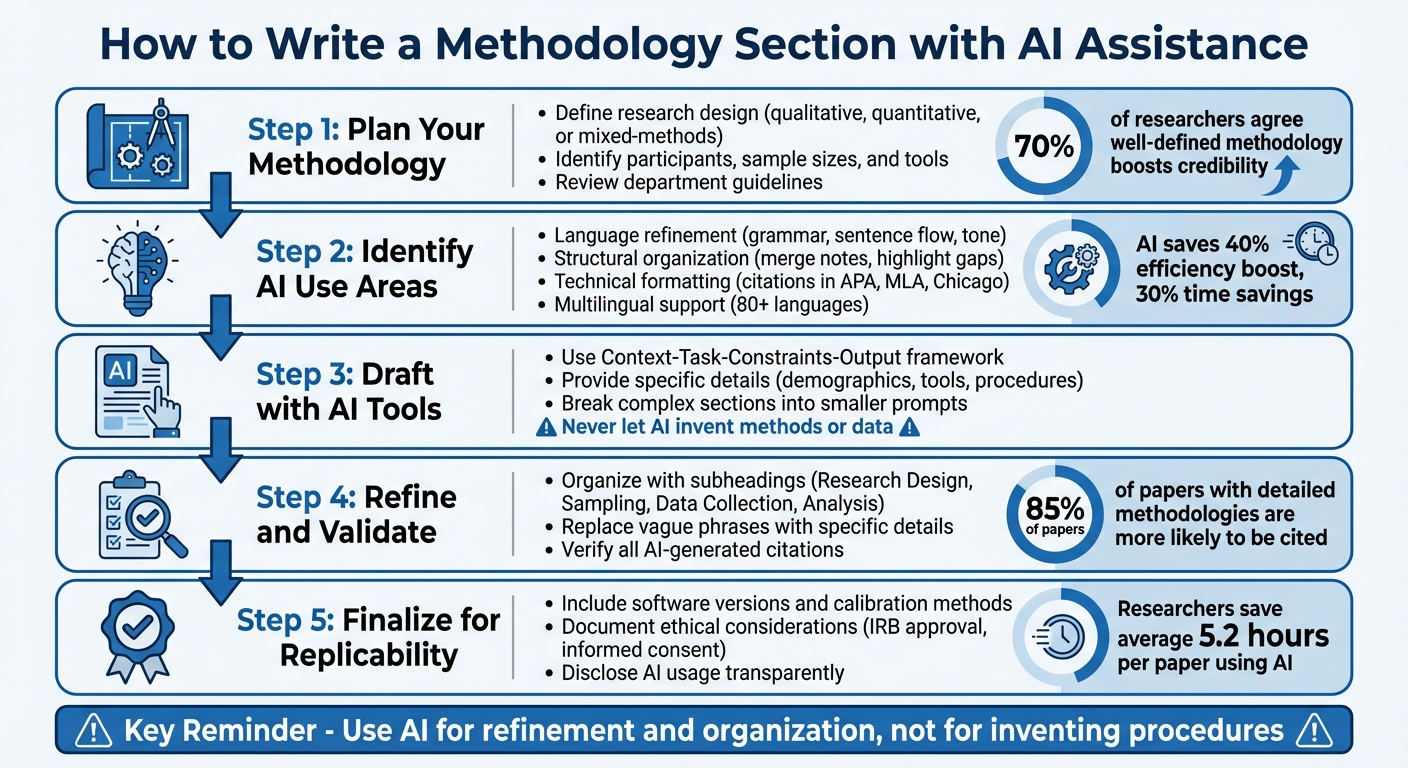
5-Step Process for Writing a Methodology Section with AI Assistance
Transform Any Text, On Any Site, In Seconds
Rephrase, translate, and improve text with one shortcut. Works everywhere you write.
Add to Chrome - It's Free!How to make /write a research paper using ANY AI for College or Journal | No AI, No plagiarism
sbb-itb-32359dc
Planning Your Methodology Section Before Using AI
Before involving AI in crafting your methodology, you need a clear plan. Think of your methodology as the blueprint for your research – if the foundation is shaky, AI can’t fix it. The key is simple: every decision you make should directly support your research question.
Lay out the essentials. Start by defining your research design – whether it’s qualitative, quantitative, or a mixed-methods approach. Identify your participants, sample sizes, and the tools or materials you’ll use. Be specific – mention software versions, measurement tools, and calibration methods if needed. This groundwork ensures that AI enhances your existing methods rather than creating new ones. Also, review your department’s guidelines and look at successful past theses in your field to understand the expected structure and length.
Next, determine how AI can assist. AI is excellent for refining grammar, improving sentence flow, and enhancing transitions. It can help flag lengthy sentences, correct inconsistent terminology, or adjust the tone to meet academic standards. For multilingual researchers, AI can handle precise translations or adapt dialects to meet journal requirements. It’s also a lifesaver for repetitive tasks like formatting citations in APA, MLA, or Chicago style, saving you hours of manual effort.
However, AI has its limits. It should never generate methods you didn’t actually conduct – that’s academic misconduct. Similarity-checking tools used by universities can flag AI-generated content for plagiarism, even if unintentional. Use AI for polishing and organizing, not for inventing procedures. Here’s a stat to consider: 70% of researchers agree that a well-defined methodology boosts credibility, and papers with detailed methodologies are 85% more likely to be cited.
Define the Core Components of Your Methodology
Before using AI, ensure your methodology includes nine key elements. Start with your research design and setting – whether you’re conducting qualitative interviews, quantitative surveys, or using a mixed-methods approach, be clear about the location and timing of your study. Define your participants, including demographic details, sample sizes, and inclusion/exclusion criteria.
List all tools and equipment, specifying software versions and calibration methods if applicable. Clearly define your variables – independent, dependent, and controlled – to maintain experimental rigor. Outline your procedures step-by-step, whether they involve surveys, interviews, or simulations, so another researcher could replicate your work.
Document your data analysis techniques – will you rely on statistical tests, coding frameworks, or validation algorithms? Ethical considerations are also crucial: mention institutional review board approvals, informed consent, and data protection measures. Finally, justify your methods by comparing them to alternative approaches.
"The methodology is the engine of your thesis or dissertation." – Proof-Reading-Service.com
Once these elements are in place, you can turn to AI for fine-tuning and streamlining.
Identify Areas Where AI Can Help
AI is particularly useful in four main areas: language refinement, structural organization, technical formatting, and multilingual support. For language refinement, AI can polish grammar, improve sentence flow, and simplify overly complex sentences. If your draft needs a more formal tone, AI can help align it with academic standards.
When it comes to structural organization, AI tools can help merge scattered notes, transcripts, and PDFs into a cohesive draft. Some platforms can even highlight missing details, such as gaps in validity, reliability, or ethical considerations.
Technical formatting is another time-saving area. Automated citation tools can handle over 1,000 styles, eliminating the hassle of manual reformatting. Given that about 75% of research papers use APA style, this feature is incredibly practical. AI can also ensure consistent terminology throughout your section, catching discrepancies like alternating between "participants" and "subjects."
| AI Task Category | Specific Assistance Areas |
|---|---|
| Wordsmithing | Grammar, sentence flow, transitions, and consistent terminology |
| Structural Planning | Summarizing notes, outlining sections, and brainstorming examples |
| Refinement | Adjusting tone for formal academic writing |
| Reference Support | Extracting data from sources and summarizing existing methodologies |
For multilingual researchers, AI can translate your methodology into over 50 languages or tailor dialects to meet journal requirements. However, always double-check technical terms and procedures, as AI might unintentionally "correct" them inaccurately. Think of AI as a tool for clarity and organization – it’s not a replacement for your research design.
Here’s a practical tip: if you’re using free AI tools with word limits (e.g., QuillBot’s free tier caps at 125 words), break your methodology into sections for processing. AI research assistants can boost efficiency by 40% and save up to 30% of your time – but only if you’ve done the groundwork yourself.
Using AI Tools to Draft Your Methodology
Once you’ve outlined the key elements of your research, it’s time to transform your notes into a polished draft. This step connects your detailed research plan to a well-structured academic narrative. Think of AI as a tool to assist with formatting and phrasing – not as a substitute for your content. You provide the specifics – such as the procedures, tools, and data you used – and AI refines them into formal academic language.
For instance, if you conducted interviews with 30 participants between January and March 2026, your notes might include details about participant demographics, consent procedures, and interview durations. By feeding this information into AI, you can generate formal paragraphs that maintain the integrity of your original details while presenting them in polished prose.
To guide the AI effectively, use a four-part framework – Context, Task, Constraints, and Output Specification. For example, you might instruct: "I am a PhD researcher in educational technology. Draft a methodology section based on these notes. Use past tense, passive voice, and avoid invented citations. Organize into sections like Research Design, Sampling, and Ethics." This approach helps ensure the AI stays grounded in your actual research and avoids introducing inaccuracies.
Write Clear Prompts for AI Input
The quality of your prompts directly impacts the quality of the draft. Broad or vague instructions like "help with my methodology" can lead to generic outputs that lack specificity. Instead, include precise details such as your research objectives, participant demographics, sampling criteria, the tools you used (including version numbers), and the steps you followed. For quantitative studies, add technical details like sample size calculations, variable types, and statistical methods to ensure the AI accurately reflects your analysis.
If your methodology is complex, break it down into smaller, focused prompts. Start with the research design, then move to sampling procedures, followed by data collection methods, and finally your analysis techniques. This modular approach ensures each section is detailed and easy to verify.
Set clear boundaries for the AI to follow. For example, specify: "Do not invent citations", "Do not interpret results", or "Do not add procedures I didn’t conduct." Experts agree that AI performs particularly well in drafting methods sections because they are procedural and factual, minimizing the risk of fabricated content as long as you provide thorough details.
Generate and Organize Your Draft with BeLikeNative
BeLikeNative simplifies the drafting process by integrating directly into your workflow. Instead of switching between platforms, you can refine your methodology section within your preferred writing tool – whether that’s Google Docs, Notion, or your university’s research portal. Its clipboard integration allows you to highlight rough notes, use a shortcut, and instantly convert the text into formal academic language.
For researchers working in multiple languages, BeLikeNative’s support for over 80 languages is especially helpful. If your research was conducted in Spanish but needs to be published in English, the tool can translate technical details while preserving precise terminology. You can also customize the tone and style to match the formal, past-tense voice required for academic writing. With character limits ranging from 500 to 6,000 depending on your plan, entire subsections can be processed efficiently.
Refine your draft iteratively by using follow-up prompts to address specific areas. For example, after drafting your sampling procedures, you might ask, "Review this section as a peer reviewer. Identify any gaps that could hinder replication." This allows you to catch issues like missing software details, unclear inclusion criteria, or absent ethics statements – problems that could otherwise delay publication.
Refining and Validating Your Methodology Section
Once you have an AI-generated draft, the next step is to refine and validate your methodology so it accurately represents your research process. The methodology section plays a critical role in showcasing the credibility, rigor, and reproducibility of your study. Studies show that 70% of researchers believe a well-defined methodology enhances a study’s credibility, while 85% of academic papers with detailed methodologies are more likely to be cited. With this in mind, focus on improving clarity and ensuring a logical structure in your draft.
Edit for Clarity and Logical Flow
Start by organizing your methodology with standard subheadings such as Research Design, Sampling Procedures, Data Collection, and Analysis Methods. Using this structured approach ensures you cover all essential areas and minimizes the need for extensive revisions later. Within each subsection, arrange steps in chronological order to make it easier for others to replicate your study without confusion.
Replace vague phrases with specific details. For example, instead of saying "participants engaged with material", write "participants completed a 12-item task over 15 minutes." Look out for unclear wording or gaps in logic. Use prompts like: "I am writing a methodology for educational technology research. Where are the gaps? What should I reorder?" This can help identify areas needing more explanation, such as justifying why you chose semi-structured interviews over surveys and linking those choices directly to your research question.
Align with Academic Guidelines and Ethical Standards
Your methodology also needs to meet academic and ethical standards. Check that it aligns with the specific requirements of your institution or target journal, as guidelines can vary widely. For example, some institutions now require full disclosure of AI involvement, while others prohibit AI-generated content in assessed work. Follow the "transparency principle", which suggests that if you can’t comfortably explain your AI usage to an advisor or reviewer, it might be worth rethinking your approach.
Verify all citations generated by AI. General AI models can sometimes create fabricated references that sound convincing but don’t exist. Check that each DOI resolves to a real paper and confirm that the cited work supports your claims. If you used AI to extract data – such as sample sizes or effect sizes from studies – manually verify at least 20% of the results against the original sources.
Be explicit about ethical safeguards in your methodology. Instead of vague assurances, detail how you obtained informed consent, protected participant privacy, and minimized data collection to what was absolutely necessary.
Many journals now require a disclosure statement regarding AI use. Include a clear statement, such as: AI tools were used for grammar checking and language refinement. All research content, analysis, and interpretations are solely the author’s work. Never use AI to fabricate research methods or data you didn’t actually conduct – this constitutes academic misconduct.
Improving Multilingual Accuracy with BeLikeNative
Once your draft is clear and well-organized, the next step is to fine-tune its multilingual accuracy. For non-native English speakers, combining technical precision with clear academic language can be tricky. That’s where BeLikeNative comes in. Supporting over 80 languages, this tool makes it easier to draft, refine, and translate methodology content with precision and confidence.
Tailor Tone and Style for Academic Writing
Academic writing has its own set of rules – it’s formal, objective, and a far cry from everyday conversational tone. BeLikeNative allows you to set tone and style preferences upfront, so your methodology is polished and professional without needing to tweak every sentence manually.
Here’s how it works: begin by drafting your methodology in the language you’re most comfortable with. Then, let BeLikeNative refine the tone. For instance, if you write, “we asked people questions,” the tool can elevate it to something like, “participants responded to structured interview questions.” This makes your writing sound more aligned with academic standards. Depending on your subscription, you can refine larger sections in one go – 2,000 characters per use with the Learner plan or up to 4,000 with the Native plan. After this, you can take advantage of its translation features to ensure that even the most technical details are conveyed accurately.
Achieve Precise Multilingual Translation
One of BeLikeNative’s standout features is its ability to handle translations with precision. Start by drafting your methodology in your native language to ensure your ideas are clearly expressed. Then, translate it section by section into English using the tool. This method helps retain the logical flow of your research design while ensuring critical terms like “stratified sampling” or “regression analysis” are translated correctly. This step-by-step approach ensures that your work maintains both accuracy and clarity across languages.
Finalizing and Validating Your Methodology Section
Once you’ve polished your draft, it’s time to finalize your methodology, ensuring it’s clear and easy to replicate. A well-documented methodology not only strengthens your research but also serves as a reliable guide for others to follow your steps.
Organize Content with Subheadings
Break your methodology into clear sections using subheadings like Research Design, Participants, Materials and Instruments, Procedures, Data Analysis, and Ethical Considerations. Arrange the steps in the order they were performed. This structure ensures your methodology is easy to navigate and sets the stage for a thorough replicability review.
Review Against Protocols for Replicability
Double-check that your methodology provides enough detail for another researcher to replicate your study precisely. Include specifics like software versions, calibration methods, or survey tools. For example, instead of saying "a survey was conducted", specify that "participants completed a 12-item Likert-scale survey administered via Qualtrics version 2024.3".
Make sure to explain why you chose certain methods over others. Highlight ethical measures, such as how you obtained informed consent or secured institutional review board approval, to build trust in your research. Studies show that 85% of academic papers with detailed methodology sections are more likely to be cited, proving the value of thorough and transparent documentation.
Conclusion
AI tools like BeLikeNative bring practical advantages to the research process, particularly when it comes to saving time and maintaining academic rigor. For instance, researchers save an average of 5.2 hours per paper by using AI for drafting tasks. These tools streamline structure and clarity, allowing you to focus on the specialized insights that define your discipline. Features like Retrieval-Augmented Generation also help reduce AI errors, such as hallucinations, by as much as 70%.
BeLikeNative supports over 80 languages, making it easier to draft in your native language and translate with accuracy. It ensures that technical terms and formal academic tone remain intact, no matter the language. By integrating structured AI inputs into your research workflow, you can strengthen your methodology at every stage – from planning to the final review.
AI assistance goes beyond grammar and organization. It helps identify gaps in validity, ensures citation accuracy, and supports replicable research practices. The key is to use these tools strategically: rely on AI for repetitive tasks while applying your expertise to the content itself. Always verify AI outputs against your research protocols and disclose any AI involvement to maintain transparency.
FAQs
What should I include in my methodology before using AI?
Before diving into AI tools, start by laying out the groundwork of your research process. Clearly explain your research design, detailing how you plan to investigate your topic. Outline the data collection methods you’ll use – whether surveys, interviews, experiments, or another approach – and describe how you’ll gather the information.
Next, address sample selection by explaining who or what you’re studying and why they were chosen. Be specific about the measurement procedures, such as the tools or metrics you’ll use to collect and quantify data. Finally, describe your analysis techniques, outlining how you’ll interpret the data to draw meaningful conclusions.
It’s also important to explain why these methods are the right fit for your study. Highlight how they align with your objectives and demonstrate reliability. This level of transparency not only strengthens your research but also creates a strong framework to build upon when incorporating AI tools later.
How do I prompt AI so it doesn’t add fake methods or citations?
To ensure accuracy and avoid fabricated methods or citations, it’s essential to use precise prompts that guide the AI to rely on verified information. For instance, you could instruct: "Create a methodology section using established research practices, ensuring no methods or citations are invented. Verify all references thoroughly."
Additionally, request the AI to highlight any information it isn’t confident about. Always take the time to carefully review and fact-check the output before considering it complete. This extra step ensures the final work maintains credibility and reliability.
How can I disclose AI use in my methodology ethically?
To maintain ethical transparency when disclosing AI use in your methodology, be upfront about how and where AI tools were integrated. For example, mention if they were used for tasks like conducting a literature review, analyzing data, or refining language. Clearly identify the specific tools utilized and highlight that AI served as a supportive aid rather than a substitute for your original analysis. This level of openness helps align your work with academic standards and safeguards research integrity, particularly for activities like managing citations or polishing language.
Related Blog Posts
- How to Simplify Any Text with AI – Best Tools & Tips for Clearer Writing
- How To Polish Your Writing With Chrome Ai Extensions
- Convert Informal Text To Formal With Ai For Professional Writing
- How AI Adjusts Writing Style for Multilingual Audiences
BeLikeNative fixes grammar, rephrases, translates, and simplifies text on any website in 1 second — just highlight and hit a keyboard shortcut. No tab switching. Try it free →