
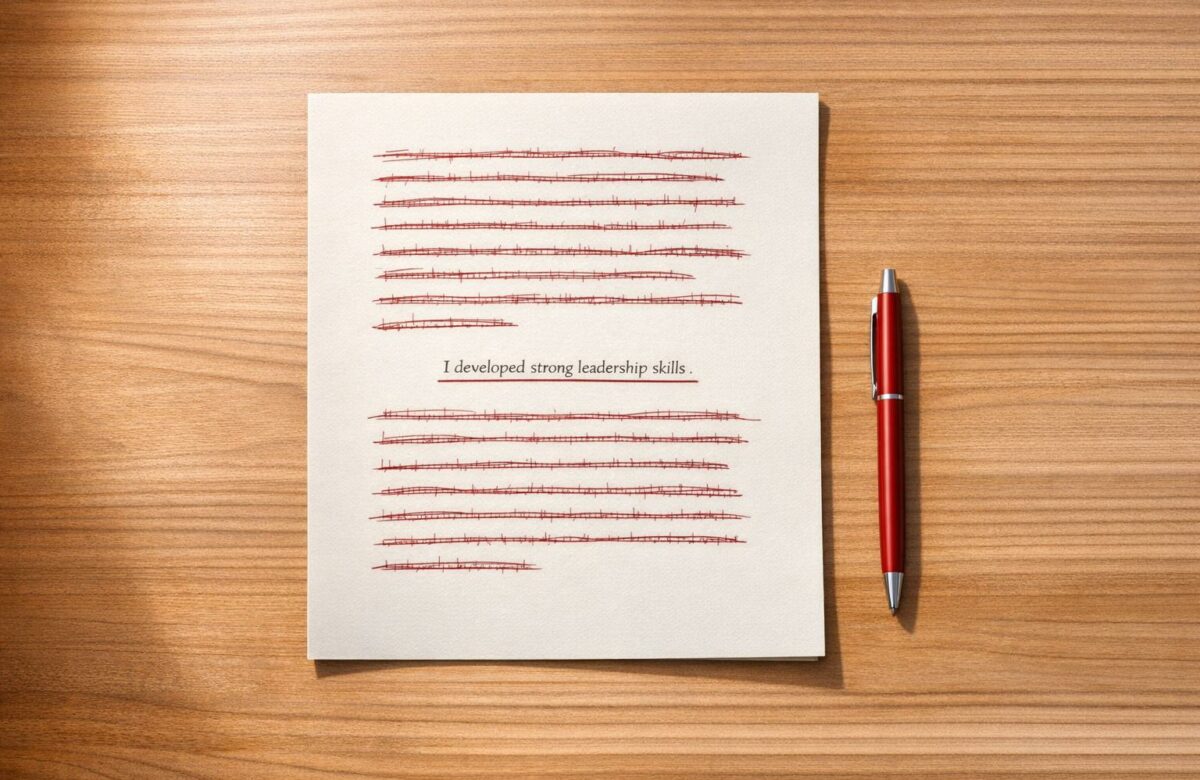
Fix “Wordiness” In College Admissions Essays
Your college essay has one job: stand out to admissions officers. Wordiness – like using "due to the fact that" instead of "because" – wastes space and buries your best ideas. With strict word limits (650 words for the Common App), every word must work hard to tell your story clearly and effectively.
Admissions officers read thousands of essays quickly. Long-winded phrases frustrate them and dilute your message. Instead, focus on clarity by cutting unnecessary words, filler phrases, and passive voice. For example, replace "I am a person who is passionate about" with "I’m passionate about."
Transform Any Text, On Any Site, In Seconds
Rephrase, translate, and improve text with one shortcut. Works everywhere you write.
Add to Chrome - It's Free!Quick Tips to Trim Wordiness:
- Read your essay out loud to spot awkward phrasing.
- Cut filler words like "really" or "basically."
- Use shorter, active phrases (e.g., "I decided" instead of "The decision was made by me").
- Replace verbose phrases with concise alternatives (e.g., "because" instead of "due to the fact that").
Clear writing shows you can think clearly. Tools like BeLikeNative can help rephrase sentences for better flow, but the key is reviewing each word to ensure it adds value. By focusing on brevity and purpose, you’ll craft a compelling essay that highlights your unique story without unnecessary fluff.
How Wordiness Damages Your College Essay
What Admissions Officers Experience
Admissions officers often read through thousands of essays in a single admissions cycle, spending just a few minutes on each one. When an essay is overly wordy, it forces them to wade through unnecessary language to find the core message. As Christine Hou from the University of California, Berkeley‘s Student Learning Center explains:
"While supplementary sentences or words can seem to add ‘smartness’ to an essay, unnecessary fluff can only frustrate a reader."
For example, phrases like "due to the fact that" instead of the simpler "because" make it harder for admissions officers to quickly grasp your point. This can lead to frustration, especially when they’re trying to understand your story and what you bring to their campus.
Complicated language or excessive jargon doesn’t impress admissions officers – it just clouds your message. As the Humanities LibreTexts notes:
"The most important goal of academic writing is not to sound smart – it is to communicate an argument or information clearly and convincingly."
In addition to wasting the reader’s time, overly verbose writing can weaken the clarity and focus of your essay.
How Clarity and Focus Get Lost
When your essay is packed with unnecessary words, your best ideas can get buried. For instance, saying "I am a person who is passionate about" instead of simply "I’m passionate about" adds extra words without adding value.
Similarly, passive phrasing can dilute your message. Instead of writing "The decision was made by me to volunteer", say "I decided to volunteer." The active version is not only shorter but also more direct and engaging. Wordy constructions force readers to re-read, which wastes time and detracts from your message.
Filler words like "really", "very", and "basically" don’t add substance. They just make your writing harder to follow. Long-winded introductions that delay your main point have the same effect. With word limits in place, every sentence spent on fluff is a missed opportunity to highlight your experiences, values, or goals.
sbb-itb-32359dc
How to Find and Remove Wordiness
Read Your Essay Out Loud
One of the best ways to catch wordiness in your writing is to read your essay out loud. When you read silently, your brain often skips over familiar words or interprets what you meant to say instead of what’s actually written. As Olivia Valdes from Zen Admissions puts it, "Reading the essay out loud shakes you out of your authorial daze."
Reading aloud forces you to notice every syllable, making it easier to spot awkward phrasing. If you find yourself running out of breath while reading a sentence, that’s a clear sign it’s too long. You might also hear overly formal words or phrases that sound unnatural in conversation, which could be clouding your main point.
Read slowly and clearly, as if performing for an audience. Mark any sections where you stumble, feel out of breath, or notice bulky phrasing. If a sentence feels too long or convoluted, consider breaking it into two or three shorter ones. Once you’ve identified these areas, focus on cutting unnecessary words and simplifying your language.
Cut Unnecessary Modifiers and Filler Words
After identifying awkward sentences, zero in on fillers and redundant modifiers. Words like "really", "very", "extremely", "basically", and "kind of" often add little value to your writing. Instead of "extremely angry", opt for "furious." A single precise word is usually more effective than several weaker ones.
Watch out for redundant phrases like "future plans" (just "plans"), "true facts" (just "facts"), or "each and every" (pick one). Similarly, if you describe something as "pink", there’s no need to add "in color." Streamlining prepositions can also help – for instance, change "the decision of the committee" to "the committee’s decision." Once fillers are gone, refine your writing further by replacing long-winded phrases with concise alternatives.
Use Shorter Phrases
Simplify multi-word expressions whenever possible. For example, replace "in order to" with "to", "due to the fact that" with "because", and "at this point in time" with "now."
Switching from passive to active voice is another effective way to shorten sentences. For example, "The decision was made by me to volunteer" becomes "I decided to volunteer", which is both shorter and clearer. Similarly, flip negative constructions into positive ones – turn "did not remember" into "forgot" for a more concise and direct statement.
Finally, trim padded verb phrases. For instance, "make a decision" can often just be "decide", and "come to a realization" can be reduced to "realize." These small adjustments can quickly add up, leaving you with clearer, more focused writing that highlights what truly matters in your essay.
ELEVATE YOUR COLLEGE APPLICATION ESSAY WORD CHOICE: what to watch out for, how to
Wordy Phrases and Their Shorter Versions
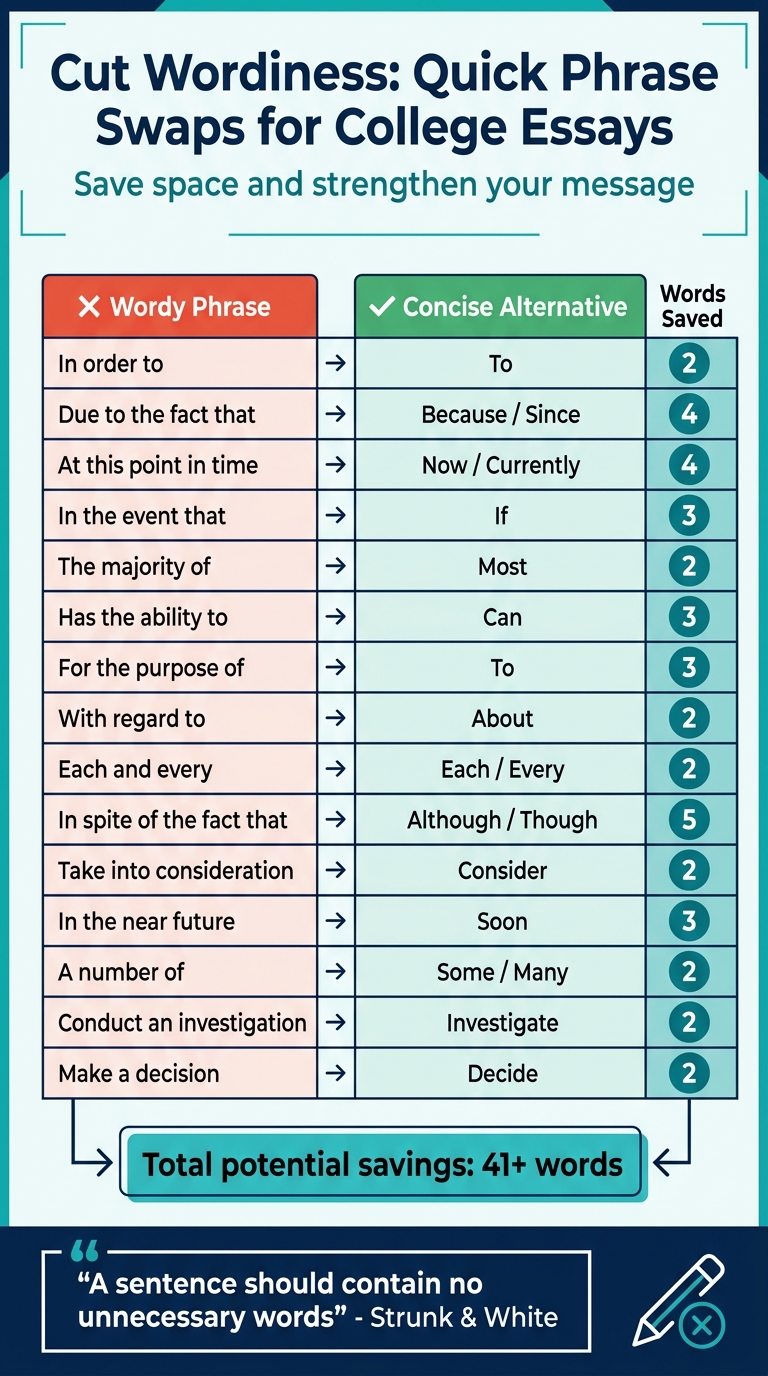
Wordy vs Concise Phrases for College Essays
Comparison Table: Long vs. Short Phrases
Cutting down on wordiness can make your writing sharper and more effective. Here’s a table that compares common verbose phrases with their shorter, more direct alternatives. These edits not only save space but also make your message clearer and more engaging.
| Original Phrase | Shorter Alternative | Word Count Savings |
|---|---|---|
| In order to | To | 2 words |
| Due to the fact that | Because / Since | 4 words |
| At this point in time | Now / Currently | 4 words |
| In the event that | If | 3 words |
| The majority of | Most | 2 words |
| Has the ability to | Can | 3 words |
| For the purpose of | To | 3 words |
| With regard to | About | 2 words |
| Each and every | Each / Every | 2 words |
| In spite of the fact that | Although / Though | 5 words |
| Take into consideration | Consider | 2 words |
| In the near future | Soon | 3 words |
| A number of | Some / Many | 2 words |
| Conduct an investigation | Investigate | 2 words |
| Make a decision | Decide | 2 words |
As William Strunk Jr. and E.B. White famously said, "A sentence should contain no unnecessary words, a paragraph no unnecessary sentences, for the same reason that a drawing should have no unnecessary lines and a machine no unnecessary parts."
These shorter alternatives not only enhance clarity but also keep your writing focused and to the point. For instance, swapping "due to the fact that" with "because" conveys the same meaning without the extra fluff. Admissions officers, who sift through countless essays, appreciate writing that gets straight to the point. By cutting out these wordy phrases, you’ll create a more polished narrative that allows your unique voice and strengths to shine through.
Writing Tools That Help You Edit
Once you’ve trimmed the excess from your essay, the next step is refining it with tools designed for editing. These programs help catch any lingering wordiness or awkward phrasing you might have missed. One standout option is BeLikeNative, known for its real-time rephrasing feature.
BeLikeNative for Rephrasing and Clarity
BeLikeNative is a Chrome extension that simplifies editing by rephrasing sentences on the spot. Instead of switching between tools, you can highlight a sentence directly in platforms like Google Docs or Gmail, press a shortcut, and instantly get a reworded version copied to your clipboard. This makes it especially handy for maintaining your writing flow.
For non-native English speakers, BeLikeNative is a game-changer. It supports over 80 languages and allows you to adjust the tone, ranging from casual to formal – perfect for essays that need polished, professional language, such as college admissions essays. The extension has earned a 4.6/5-star rating on the Chrome Web Store, with feedback from 256 users. While it offers a free plan with daily limits, paid plans range from $4 to $28 per month, depending on your usage and character needs.
Conclusion
Too much wordiness can dilute the impact of your college admissions essay. When sentences are packed with unnecessary words, admissions officers may struggle to follow your point, which could lead to a loss of interest. As Gina Rancaño from LanguageTool explains:
"Every word you use should have a purpose and progress the sentence. Wordiness weakens your writing because it clutters sentences".
To address this, a few simple adjustments can make a big difference. Reading your essay aloud is a great way to catch awkward phrasing. Cutting filler words like "really" or "very" helps tighten sentences, while replacing long-winded phrases – such as swapping "due to the fact that" for "because" – creates more room for your story to shine. By focusing on clarity, you can craft a narrative that not only grabs the reader’s attention but also reflects your authentic self. The University of North Carolina at Chapel Hill’s Writing Center reinforces this idea:
"Getting to the point promptly can help you become a clearer thinker and a more engaging writer".
While tools like BeLikeNative can assist with rephrasing, the most important step is carefully reviewing each paragraph to ensure it contributes meaningfully to your overall story.
FAQs
How do I cut words without losing my voice?
To say more with less, aim for clarity without sacrificing your personal tone. Cut out redundant phrases like "each and every" or "true and accurate" and swap weak words for ones that pack a punch. Make sure every word serves a purpose – ditch fillers and resist the urge to over-explain. By keeping it tight and to the point, you’ll preserve your voice while delivering your message effectively.
What’s the fastest way to spot wordiness?
To spot wordiness fast, keep an eye out for redundant phrases like "mutual agreement" or "reconsider again", and avoid qualifiers such as "really" or "extremely." These words usually add little to the meaning. Letting your draft sit for a while before revising can make it easier to catch unnecessary words. Aim for sentences that are clear and concise without losing their impact.
How can BeLikeNative help me revise my essay?
BeLikeNative helps refine your essay by guiding you on how to cut unnecessary words while keeping your message clear and engaging. It offers practical advice for spotting overly wordy phrases, swapping them out for shorter, sharper ones, and polishing your overall narrative. On top of that, BeLikeNative suggests editing tools to simplify the revision process, ensuring your essay stands out, gets straight to the point, and communicates your story effectively to admissions officers.
Related Blog Posts
- How to Shorten an Essay Without Losing Meaning – AI Hacks & Tools!
- 10 Tips for Concise Academic Writing
- How To Shorten Essays Online Without Losing Meaning
- How To Write A Grant Proposal With Better Vocabulary
BeLikeNative fixes grammar, rephrases, translates, and simplifies text on any website in 1 second — just highlight and hit a keyboard shortcut. No tab switching. Try it free →