

How To Expand Essay Word Count Without Adding Fluff
Expanding your essay without resorting to fluff is all about adding depth and clarity to strengthen your argument. Here’s how:
- Research More Thoroughly: Dive into academic sources like Google Scholar or JSTOR. Use multiple examples and address counterarguments to add layers to your points.
- Expand Main Ideas: Break down your arguments by asking "how" and "why." Define terms, analyze causes and effects, and include detailed explanations.
- Add Evidence: Support claims with specific data, case studies, or expert opinions. Use the Introduce-Quote-Analyze method to integrate evidence seamlessly.
- Refine Introduction and Conclusion: Provide relevant background in the introduction and suggest next steps or broader implications in the conclusion.
- Use Transitions: Improve flow with effective transition words, but avoid overusing them or adding filler.
- Leverage AI Tools: Use AI for sentence expansion, better word choices, and grammar checks, ensuring consistency and quality.
Focus on meaningful content that enhances your essay’s strength and credibility, rather than just meeting a word count target.
Transform Any Text, On Any Site, In Seconds
Rephrase, translate, and improve text with one shortcut. Works everywhere you write.
Add to Chrome - It's Free!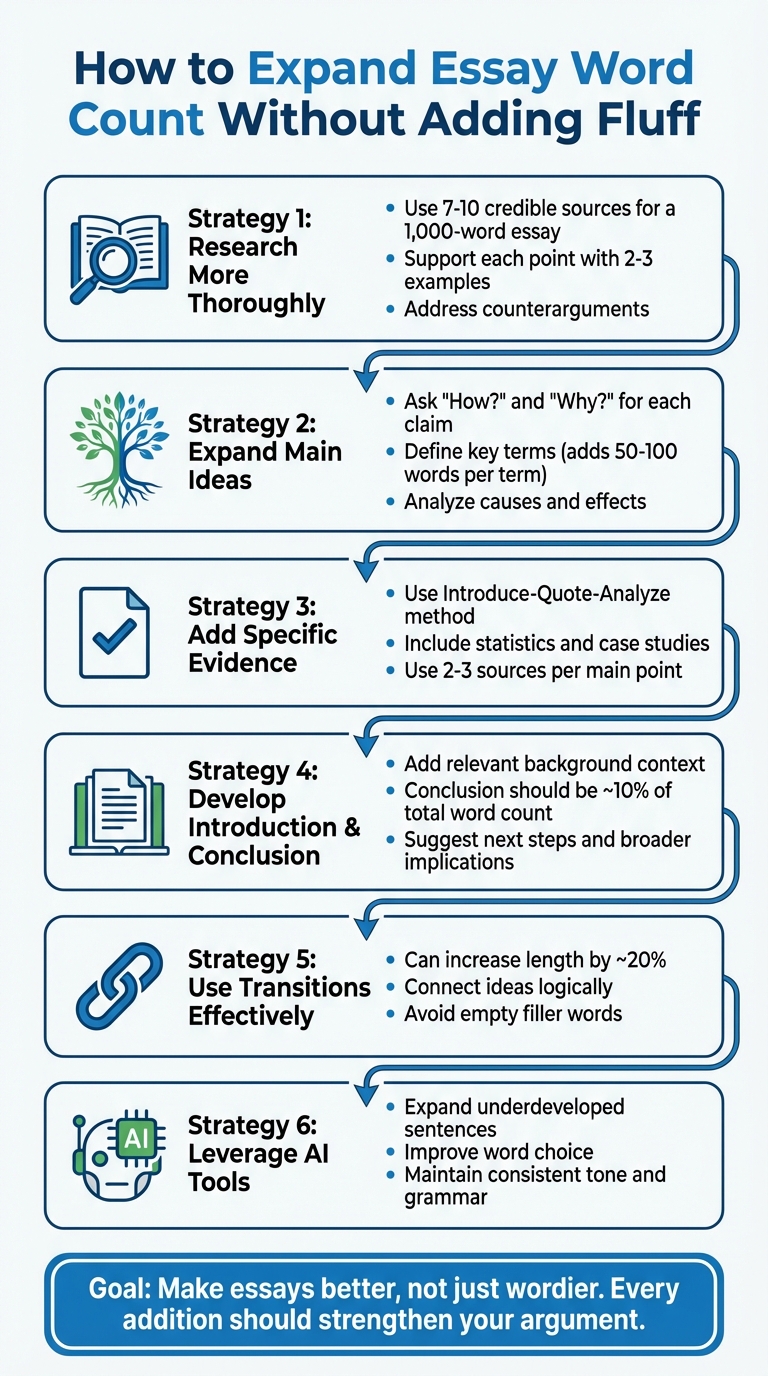
6 Strategies to Expand Essay Word Count Without Fluff
How to Get a Higher Word Count Without Adding Fluff
Research More Thoroughly to Add Depth
If your research only scratches the surface, your essay will too. Diving deeper into your topic helps you uncover stronger evidence, recent studies, and fresh perspectives that enhance your argument without resorting to filler content. The goal is to strengthen your points, not just inflate your word count.
When you dig into academic databases and explore diverse viewpoints, you’ll often find connections and insights you didn’t notice at first. This allows you to support each main point with 2–3 examples instead of relying on a single piece of evidence. For instance, rather than citing just one study, you could compare findings from multiple researchers to present a well-rounded argument.
Thorough research also equips you to address counterarguments effectively. By understanding opposing views, you can dedicate paragraphs to discussing them, showing critical thinking while adding depth to your essay. This approach isn’t about padding your content – it’s about demonstrating that you’ve engaged thoughtfully with the topic.
Use Academic and Trusted Sources
Academic databases should be your go-to for credible information. Platforms like Google Scholar, JSTOR, and university libraries offer peer-reviewed articles and authoritative material.
For a 1,000-word essay, aim to reference 7–10 credible sources to show you’ve done your homework. When evaluating sources, check the author’s credentials and whether they have a track record of publishing peer-reviewed work on your topic. Another trick? Skim the reference sections of high-quality articles – they often lead to more valuable primary and secondary sources.
To find precise data, use specific keyword combinations rather than broad terms. For example, searching "carbon footprint" + "veganism" will yield more targeted results than simply typing "environment". If you’re stuck, reference librarians can guide you to the best databases for your topic.
| Source Type | Author | Purpose | Examples |
|---|---|---|---|
| Scholarly | Scholars/Experts | Original research or deep analysis | Peer-reviewed journals, academic studies |
| Popular | Journalists | Inform or entertain the general public | Magazines, newspapers |
| Primary | Original Creator | First-hand evidence | Data sets, diaries, original studies |
| Secondary | Researchers | Interpret or analyze primary data | Literature reviews, textbooks |
Include Different Perspectives
Broadening your research also means considering multiple viewpoints. Incorporating expert opinions, case studies, and alternative perspectives enriches your content and naturally extends your essay. Instead of focusing on a single angle, show how different researchers or professionals approach the same issue. This demonstrates nuanced thinking and gives you more material to work with.
Use phrases like "According to [Author]…" or "While some argue…" to introduce contrasting perspectives seamlessly. After presenting each viewpoint, explain how it fits into your argument and why it’s relevant. This step ensures your essay doesn’t feel like a random collection of quotes but rather a cohesive analysis.
For example, a 2024 Stanford study by Bloom found that remote customer service representatives handled 13% more calls due to fewer office interruptions. On the other hand, a 2024 Microsoft study led by Chen revealed that software developers completed projects 25% faster when working remotely. These examples highlight how remote work affects different industries in distinct ways, offering a nuanced view on workplace productivity.
When presenting opposing views, dedicate a full paragraph to each one. This structure avoids confusing your readers with abrupt shifts and allows you to thoroughly explore each perspective before tying it back to your main thesis. By employing these research strategies, you not only extend your essay but also elevate its credibility and depth.
Expand Your Main Ideas and Arguments
Once you’ve gathered solid research, the next step is to build on your main points. The goal here isn’t to wander into unrelated topics but to deepen your analysis of what’s already on the page. By doing so, you keep your essay focused while naturally adding meaningful content.
Think of each main point as a seed. Instead of just stating a fact, dig into its layers. For instance, if you mention that global surface temperatures have risen by about 1.2°C since the late 19th century, don’t stop there. Explain the science behind it – how carbon dioxide traps heat in the atmosphere, how this disrupts ocean currents, and how these shifts impact food security in various regions. That single fact can grow into a well-rounded paragraph packed with insights.
A simple way to expand any argument is to ask yourself two questions: How? and Why? For example, if you claim that remote work boosts productivity, ask: How does it boost productivity? Why does this happen? Answering these questions forces you to explore deeper reasons, whether psychological, social, or economic. This method not only adds depth but also avoids unnecessary filler.
| Expansion Method | Purpose | Word Count Impact |
|---|---|---|
| Defining Terms | Makes jargon or concepts clearer for the reader | High (50–100 words/term) |
| Analyzing Causes | Explains the "why" behind a fact or trend | Medium to High |
| Addressing Counterarguments | Adds balance and demonstrates critical thinking | High (100+ words) |
| Spelling Out Contractions | Adds formality and slight length | Low (~5–10% to total count) |
After presenting evidence, always ask, What does this mean? For instance, if you cite research showing that 30 minutes of aerobic exercise reduces depression symptoms by 42%, don’t just stop there. Explain how this ties to neuroplasticity or the annual 2% growth in hippocampal volume. These connections not only add depth but also make your argument more compelling.
Define and Explain Key Terms
Another way to expand your essay is by clarifying and defining any technical terms you introduce. This ensures your writing is accessible to a broader audience while also laying a stronger foundation for the rest of your argument.
Take a close look at your draft for any specialized terms or industry language that might confuse readers. For example, instead of simply stating, "CRISPR technology raises ethical concerns", you could define CRISPR-Cas9 as a tool that acts like "molecular scissors", allowing scientists to edit DNA. Add context by mentioning its discovery in 2012 and its potential applications in medicine. Similarly, when discussing statistics – like how exercise increases hippocampal volume by 2% annually – explain what the hippocampus does, why its growth matters for memory and learning, and how this supports your overall argument. This three-step approach (introducing, defining, and linking) naturally expands your points while keeping them clear and relevant.
Analyze Causes and Effects
To add even more depth, explore the causes and effects behind your claims. This approach not only strengthens your argument but also makes it more engaging by showing the bigger picture. Structure your analysis by stating the core idea, providing evidence, and then explaining the consequences.
For example, if you argue that climate change threatens agriculture, break it down. Discuss how rising temperatures shift rainfall patterns, explain how these changes reduce crop yields in specific areas, and connect this to food prices and global trade. Covering both immediate and long-term effects gives your argument a well-rounded perspective. Using transitional phrases like "as a result", "this has led to", or "building on this" helps guide readers through the logic. By exploring these relationships, you naturally add length while making your essay more persuasive.
Address Opposing Views
To further expand your essay, incorporate counterarguments. Addressing opposing views not only adds depth but also strengthens your position by showing that you’ve thought critically about alternative perspectives.
Start by summarizing the counterargument in neutral terms, then follow with a detailed rebuttal that reinforces your original point. For instance, if someone argues that remote work reduces collaboration, acknowledge the concern but counter it with evidence of how digital tools like Slack or Zoom foster teamwork. Placing counterarguments right after the points they challenge ensures your essay flows smoothly. Use phrases like "Critics argue that", "Some may object that", or "On the other hand" to introduce these views. As writing scholar Nancy Sommers explains:
"At the heart of revision is the process by which writers recognize and resolve the dissonance they sense in their writing".
This “dissonance” – the push and pull between competing ideas – adds nuance and makes your essay more thorough. By addressing counterarguments, you not only add length but also demonstrate intellectual rigor, leaving your readers with a stronger impression of your work.
Add Specific Examples and Evidence
Adding specific examples and evidence is the backbone of crafting a convincing essay. Often, essays fall flat not because the ideas are flawed, but because they lack the details needed to make arguments persuasive. Including examples and data not only strengthens your claims but also boosts your word count in a meaningful way.
Think of your essay as a structured argument. You wouldn’t present a case without proof. Every claim should be backed by at least one piece of credible evidence – whether it’s a statistic, a case study, or an expert’s opinion. For example, instead of vaguely stating, "remote work improves productivity", you could specify that remote customer service representatives completed 13% more calls when working from home due to fewer interruptions. This takes a general statement and turns it into a solid, evidence-backed argument.
A great way to integrate evidence effectively is by using the Introduce-Quote-Analyze method. Start by introducing your source, then present specific data or a quotation, and immediately follow up with an analysis of its relevance. For instance, if you mention that teenagers check their mobile devices an average of 96 times daily, you should analyze how this behavior might disrupt their focus or sleep patterns. This method ensures that your evidence feels purposeful and not like it was randomly "dropped in."
Using multiple examples for each main point also shows that your argument reflects broader trends rather than isolated incidents. As academic writer Caleb S. puts it:
"One example proves that something is possible. Multiple examples prove it’s significant".
Find Statements That Need Support
Before adding evidence, identify areas in your essay where additional support is necessary. Look for surface-level observations – statements that seem plausible but lack depth. For example, if you write, "climate change threatens food security", ask yourself: How does it threaten food security? Where is this happening? What data supports this claim? These questions help pinpoint gaps in your argument.
Even common claims like "exercise improves mental health" need specifics. Instead of leaving it at that, add details such as, "30 minutes of aerobic exercise five times a week reduces depression symptoms by 42%". A statement’s strength often lies in whether you’ve addressed the "why" or "how."
Be cautious of vague language, too. Words like "many", "often", or "significant" can signal a lack of specificity. Instead of saying, "many companies saw productivity gains", clarify with something like, "software developers at Microsoft reported 25% faster project completion when working from home". This level of precision makes your argument more compelling while adding concrete details.
Use Primary and Secondary Sources
Once you’ve identified where evidence is needed, the next step is finding the right sources. Primary sources – like original research studies, historical documents, or firsthand accounts – offer direct evidence. Secondary sources – such as academic journals, meta-analyses, or expert commentary – help interpret and deepen your argument. Using both types of evidence creates a well-rounded essay.
Reliable evidence can be found through academic databases like Google Scholar, JSTOR, or your university library. Aim to use 2–3 sources per main point to substantiate your claims. For example, if writing about climate change, you might cite that global surface temperatures have risen by approximately 1.2°C since the late 19th century. Then, follow up with secondary sources that explore the economic or social effects of this warming.
Introduce, present, and analyze each piece of evidence. For instance, a 2024 meta-analysis published in a leading health journal found that 30 minutes of moderate aerobic exercise five times weekly can reduce depression symptoms by 42%. This supports the argument that physical activity should play a central role in mental health treatment, especially given the rise in anxiety and depression among young adults. By naturally weaving evidence into your writing, you reinforce your argument and keep your essay engaging and informative.
Develop Your Introduction and Conclusion
Once your research is solid and your arguments are well-developed, it’s time to focus on your introduction and conclusion. These sections are more than just bookends – they frame your argument and give your essay structure. It’s best to refine them after completing the body of your essay. This way, you can tie everything together while avoiding filler content that adds words without value.
Add Background to the Introduction
A compelling introduction does more than just present your thesis; it sets the stage for your argument. Adding relevant background information helps your reader understand why your topic matters. For example, if your essay is about cryptocurrency regulation, you might briefly explain blockchain technology and its 2009 origins. This context makes it easier for readers to grasp why regulatory systems are struggling to keep up.
Every detail in your introduction should serve a purpose. If it doesn’t deepen the reader’s understanding or support your argument, it’s likely unnecessary fluff. You might also enhance your opening with a relatable anecdote or a vivid example that smoothly transitions into your thesis.
Revisiting your introduction after drafting the body of your essay is key. As your understanding of the topic evolves, updating the introduction ensures it aligns with the depth and direction of your arguments. This approach not only provides consistency but also adds meaningful context and substance.
Strengthen the Conclusion with Next Steps
A strong introduction deserves an equally strong conclusion, and this is where you can tie everything together while looking ahead. Instead of merely summarizing your thesis, use the conclusion to discuss broader implications or suggest actionable next steps.
For instance, you could propose solutions to the issues you’ve analyzed or highlight gaps in current research that need attention. Take this example from a scholar who argued:
"turning away from historical legacies as complex and dangerous as those of enslavement and enfreakment keeps us from being able to understand them and to imagine different futures".
Here, the conclusion doesn’t just restate the argument; it emphasizes its relevance to ongoing discussions and future possibilities.
You can also connect your findings to current events or practical applications, showing the real-world significance of your work. This approach transforms your conclusion into more than just a summary – it becomes a thought-provoking end that leaves readers reflecting on the importance of your essay. As a guideline, aim for your conclusion to make up about 10% of the total word count.
sbb-itb-32359dc
Use Transitions to Connect Ideas
Once you’ve expanded your ideas with detailed evidence, transitions become the essential bridge that connects them. These are more than just decorative elements; they are the tools that clarify relationships between thoughts and guide readers through your argument. The Writing Center at the University of North Carolina at Chapel Hill emphasizes this point, stating that transitions "are not just verbal decorations that embellish your paper by making it sound or read better. They are words with particular meanings that tell the reader to think and react in a particular way to your ideas". Using transitions strategically can not only improve the flow of your writing but can also increase its length by about 20%.
Here’s how you can use transitions effectively to create writing that feels both concise and connected.
Effective Transition Words and Phrases
The key to using transitions well is choosing ones that clearly reflect the relationship between your ideas. For example:
- Addition transitions: "furthermore", "moreover", and "additionally" help expand on a point.
- Contrast transitions: "however", "nevertheless", and "conversely" signal a shift or counterpoint.
- Cause and effect transitions: "therefore", "consequently", and "as a result" show how one idea leads to another.
It’s important to match the transition to the specific connection you’re trying to convey. For instance, use "consequently" to emphasize a result, but "nevertheless" when introducing a contradiction. Vary your vocabulary to keep your writing fresh – swap in phrases like "on the other hand" or "alternatively" instead of overusing "however."
A useful technique is the "Known-New" Contract, where you begin a sentence with a concept already familiar from the previous sentence before introducing new information. This approach strengthens the connection between ideas and ensures a smoother reading experience.
Avoid Empty Filler Words
Transitions should add clarity, not clutter. Words like "very", "really", "basically", and "actually" often add little to no value and can make your writing feel bloated. Replace phrases such as "this is very important" with more direct alternatives like "this is crucial."
Be cautious of redundant transitions that overcomplicate sentences. For instance, phrases like "however, but" stack unnecessary words together. To refine your writing, highlight all transition words during revision. If they appear in nearly every sentence, remove those that don’t add anything new or where the connection is already clear from context. Justin Wong, Head of Growth at Jenni.ai, puts it well: "a transition is not decoration, it is evidence that you have thought carefully about how your ideas connect". Overusing transitions can overwhelm readers, making your writing feel overly explained rather than naturally cohesive.
Use AI Writing Tools for Better Efficiency
Bringing AI writing tools into your workflow can complement the research and structured arguments you’ve already developed. These tools don’t just pad your essay with extra words – they help expand your ideas while keeping your voice intact. By analyzing your content, AI tools suggest ways to deepen your arguments, clarify explanations, or smooth out transitions. As Fredrick Eghosa, AI Content Expert at CoWriter.ai, puts it:
"Making an essay longer isn’t about writing complex sentences; it’s about adding more details and clarity to make your ideas in-depth or comprehensive".
Tools like BeLikeNative offer features like rephrasing and improved word choices, ensuring your tone and style stay consistent even as you expand your content. The secret is to use AI as a tool to refine and strengthen your writing, not as a shortcut. For instance, AI can pinpoint weak sections in your essay and suggest improvements, such as adding a counterargument for balance or an analogy to make a concept clearer. Some tools have shown that strategic use of AI can provide both measurable word count increases and a richer overall essay.
Use Sentence Expanders Carefully
Sentence expanders can be incredibly useful, but only when applied thoughtfully. Focus on specific paragraphs that feel underdeveloped. For example, if you’ve written, “Climate change poses serious risks,” an AI tool might expand it to: “Climate change poses serious risks, including rising sea levels that endanger coastal communities and an increased frequency of extreme weather events that disrupt agriculture.” This kind of targeted expansion adds substance rather than fluff.
The key is to guide the tool toward meaningful elaboration. Ask it to dive into the “how” and “why” of your statements, ensuring the suggestions logically extend your ideas. Always review and refine the AI-generated additions to make sure they align with your essay’s tone and purpose.
Improve Word Choice with AI Suggestions
AI tools are also great for upgrading your word choices. They can replace repetitive or vague phrases with sharper, more precise language. For instance, instead of saying “very important,” the tool might suggest “critical” or “essential.” Similarly, it could refine “a lot of people” to “a significant portion of the population,” making your writing more polished and professional.
These tools can also help adjust your tone. For academic writing, AI might replace contractions like “don’t” with “do not” or “can’t” with “cannot,” which not only increases word count but also maintains a formal style. With tools like BeLikeNative, you can tailor the tone and style of your writing to specific needs, whether you’re aiming for an academic or conversational approach.
Keep Content Consistent with Grammar Checkers
Once you’ve expanded your essay, it’s crucial to ensure the new content flows seamlessly with the original. AI-powered grammar and fluency checkers can help with this. They catch errors, flag awkward transitions, and highlight redundant phrases. Many grammar tools also offer specialized modes, like Formal or Academic, to ensure your revisions match the tone of your essay.
While these tools are helpful, don’t rely on them entirely. Review flagged sections yourself to make sure the suggestions fit naturally within your essay. This final step ensures that your expanded content feels cohesive and stays true to your voice.
Review and Edit for Quality
Taking time to review your expanded essay is what transforms a collection of words into a polished, compelling argument. This process ensures that every addition adds value, rather than making the essay feel unnecessarily stretched. As Caleb S., an academic writer at 5staressays.com, puts it:
"The goal isn’t making essays wordier, it’s making them better. Every strategy below improves essay quality while adding length".
This step isn’t just about fixing typos or grammar errors. It’s about making sure every word, sentence, and paragraph serves your thesis and meets the expectations of your readers.
Check for Logical Flow and Relevance
One of the first steps is applying the "So What?" test to your expanded paragraphs. Ask yourself: Does this section clarify or strengthen my argument? If a sentence or paragraph doesn’t pass this test, it might be unnecessary fluff that needs reworking or cutting.
Another helpful tool is reverse outlining. Summarize each paragraph in a single sentence to create a quick overview of your essay’s structure. This method helps you identify areas where you’ve veered off-topic or repeated ideas. If two paragraphs make the same point, consider combining them to streamline your argument.
Reading your essay aloud is also a great way to spot logic gaps or transitions that feel clunky. Sometimes, what looks fine on paper doesn’t flow naturally when spoken. This technique ensures smoother transitions and a logical progression of ideas throughout your essay.
Match Writing Style and Tone
Consistency in tone and style is crucial. If you’ve added new sections, make sure they align with the formal academic voice of the rest of the essay. For instance, decide whether to use contractions or avoid them entirely, and stick with that choice throughout.
Where possible, use active voice to make your writing more direct and engaging. For example, instead of saying, "The experiment was conducted over three months by researchers at Stanford", opt for, "Researchers at Stanford conducted the experiment over three months".
Lastly, ensure that your expansion is evenly distributed across all sections of your essay. Avoid overloading one part while leaving others underdeveloped. A balanced approach creates a cohesive piece that flows naturally and maintains depth from start to finish.
Conclusion
Crafting a more detailed and meaningful essay isn’t about padding it with unnecessary words – it’s about adding depth and substance. This guide has walked you through strategies like conducting thorough research, exploring the "how" and "why" behind your arguments, including specific examples, and addressing counterarguments. These techniques don’t just help you meet word count requirements – they make your essay more compelling and well-rounded.
Think of word count goals as an opportunity to showcase your expertise. By defining key terms, explaining evidence thoroughly, and using smooth transitions to connect ideas, you can naturally extend your essay’s length by around 20% while improving its quality.
Tools like BeLikeNative can make this process even more seamless. It helps refine clunky phrasing, suggests ways to expand underdeveloped points, and ensures your essay maintains a consistent tone. Plus, with support for over 80 languages and integration with platforms like Google Docs and Notion, it’s designed to keep your focus on strengthening your arguments.
As you expand your essay, remember to apply the "So What?" test – every addition should either clarify your thesis or introduce valuable new evidence. When done right, a well-developed essay grows naturally, reflecting a deeper understanding of your topic rather than simply ticking off a word count requirement.
FAQs
How can I use AI tools to expand my essay while keeping my unique writing style?
Using AI tools can be a smart way to add depth to your essay while keeping your personal style intact. The key is to choose reliable platforms that help refine your writing by suggesting meaningful additions, like expanding on key ideas or offering relevant examples. These tools are great for sparking ideas, but the magic happens when you make those suggestions your own.
For the best results, guide the AI by asking it to improve specific sections – like adding evidence or clarifying a tricky point. However, steer clear of using it to pad your essay with unnecessary content. Always take the time to review and tweak the AI-generated text to ensure it matches your tone and flows naturally with the rest of your writing.
When you balance AI’s capabilities with your personal touch, you can create essays that feel richer and more engaging, all while staying true to your original voice.
How can I add more depth to my essay without using unnecessary filler?
To make your essay richer and more engaging without padding it with unnecessary fluff, focus on expanding key points by diving into the how and why behind them. For instance, if you’re arguing a point, back it up with clear examples or evidence to give your claims more weight and credibility.
You can also revisit your introduction and conclusion. Try weaving in some of the most compelling ideas or examples from the body of your essay. This not only reinforces your argument but also ties everything together in a way that feels cohesive and purposeful. By taking this approach, you’ll add depth and clarity to your writing while naturally increasing its length.
How can I use counterarguments to make my essay stronger?
Including counterarguments in your essay isn’t just about ticking a box – it’s a way to show you’ve genuinely considered other perspectives. Start by identifying any opposing viewpoints that challenge your thesis. Present these perspectives clearly and fairly, without bias, so your readers see you’re approaching the topic with an open mind.
Once you’ve laid out these counterarguments, respond to them with solid evidence or reasoning. Show why your stance holds up better under scrutiny. This not only strengthens your argument but also reveals your ability to think critically and engage with complex ideas.
By addressing counterarguments, you give your essay more depth and credibility. It’s an opportunity to expand on your main points, include compelling examples, and create a discussion that feels balanced yet persuasive. The key is to thoughtfully engage with opposing views while showcasing the strength of your position.
Related Blog Posts
- How to Shorten an Essay Without Losing Meaning – AI Hacks & Tools!
- Ai Tools To Shorten Essays Without Losing Meaning
- How To Shorten Essays Online Without Losing Meaning
- Best Essay Extender To Increase Word Count
BeLikeNative fixes grammar, rephrases, translates, and simplifies text on any website in 1 second — just highlight and hit a keyboard shortcut. No tab switching. Try it free →