
Fix “False Friends” In Portuguese To English Translation
False friends are words in Portuguese and English that look or sound similar but have different meanings. These can cause confusion and lead to translation errors, especially in professional or high-stakes settings. For example, the Portuguese word pasta means "folder", not "pasta" (the food), and pretender means "to intend", not "to pretend."
To avoid mistakes:
- Double-check familiar-looking words like atualmente (currently), assistir (to watch), and parentes (relatives).
- Use context and dictionaries to confirm meanings.
- Track common false friends and review them regularly.
- Leverage translation tools like BeLikeNative for quick checks, but don’t rely on them entirely.
74 False Friends | Portuguese vs English
sbb-itb-32359dc
Common Portuguese-English False Friends and Their Real Meanings
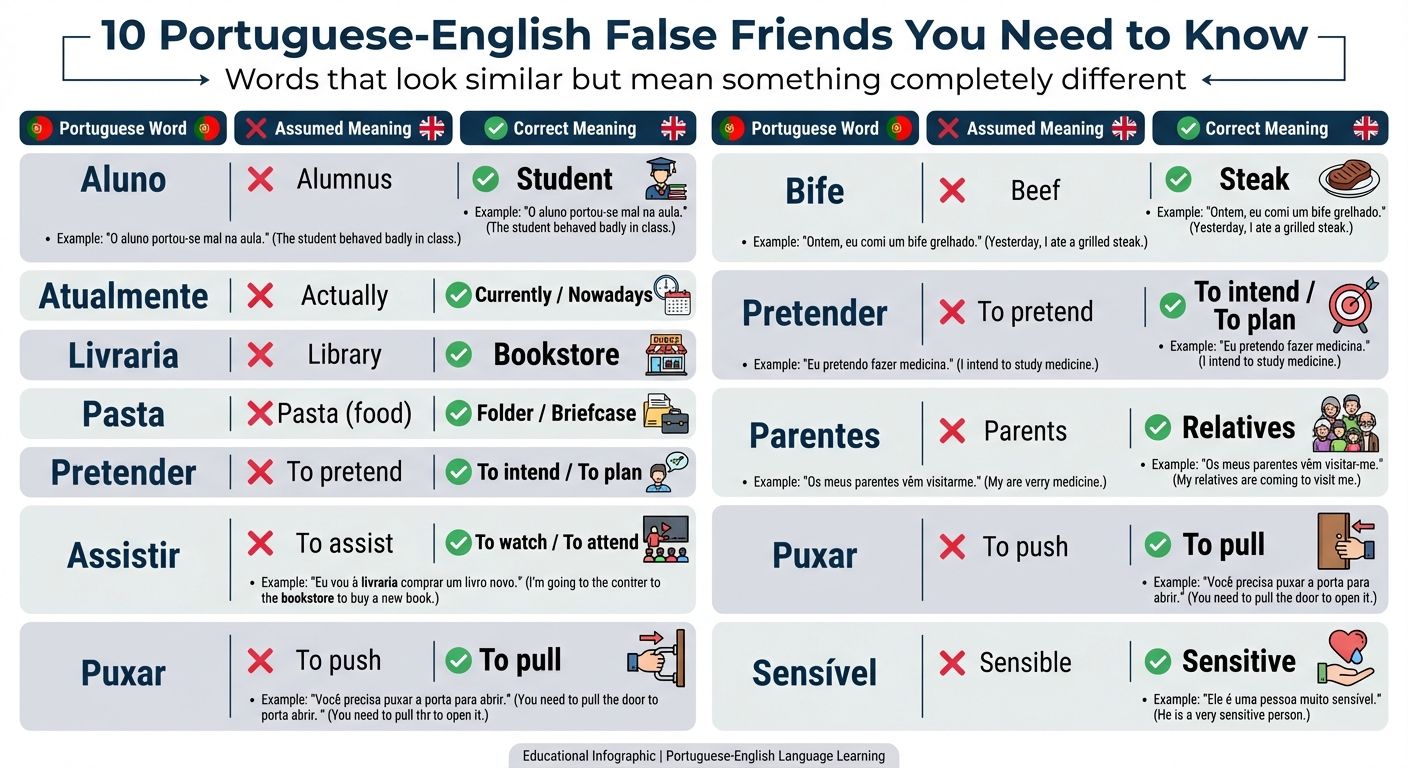
10 Common Portuguese-English False Friends and Their Correct Meanings
Now that we’ve defined false friends, let’s dive into some specific examples that often confuse translators. These misleading word pairs can cause chaos in casual chats, business discussions, or even medical settings – situations where accuracy is absolutely critical.
10 Portuguese-English False Friends You Need to Know
Here’s a table of ten commonly misunderstood words. Notice how their meanings differ from what you might assume at first glance:
| Portuguese Word | Assumed English Meaning | Correct English Meaning | Example Sentence |
|---|---|---|---|
| Aluno | Alumnus | Student | O aluno portou-se mal na aula. (The student misbehaved in class.) |
| Bife | Beef | Steak | Ontem, eu comi um bife grelhado. (Yesterday, I ate a grilled steak.) |
| Atualmente | Actually | Currently / Nowadays | Atualmente, eu estudo em casa. (Currently, I study at home.) |
| Livraria | Library | Bookstore | Eu vou à livraria comprar um livro novo. (I’m going to the bookstore to buy a new book.) |
| Pasta | Pasta (food) | Folder / Briefcase | Ela guardou os documentos na pasta. (She kept the documents in the folder.) |
| Pretender | To pretend | To intend / To plan | Eu pretendo fazer medicina. (I intend to study medicine.) |
| Assistir | To assist | To watch / To attend | Vamos assistir ao filme hoje à noite. (We are going to watch the movie tonight.) |
| Parentes | Parents | Relatives | Os meus parentes vêm visitar-me. (My relatives are coming to visit me.) |
| Puxar | To push | To pull | Você precisa puxar a porta para abrir. (You need to pull the door to open it.) |
| Sensível | Sensible | Sensitive | Ele é uma pessoa muito sensível. (He is a very sensitive person.) |
Notice a recurring pattern: Portuguese -mente adverbs, like atualmente, look like English -ly adverbs but can have very different meanings. Similarly, workplace verbs like assistir or everyday nouns like pasta can create confusion, especially in professional environments where precise communication is crucial.
Some false friends are particularly awkward. For example, constipado means "having a cold", not "constipated", and preservativo translates to "condom", not "food preservative" (the correct term is conservante). These aren’t minor slip-ups – they’re the kind of misunderstandings that can completely derail a conversation.
Interestingly, while there are about 200 false cognates between Portuguese and English, there are also roughly 1,600 true cognates that make translation easier. In fact, around 30% of an English-Portuguese text consists of these helpful cognates. The real challenge lies in telling the helpful ones apart from the tricky ones. Mastering this distinction is a key skill, and we’ll dig deeper into how to handle it next.
How to Spot and Fix False Friends in Translation
Once you’re familiar with the most common false friends, the next step is to set up strategies to catch them before they lead to errors. The trick lies in blending careful manual checks with the smart use of translation tools.
Manual Methods for Spotting False Friends
When you encounter a Portuguese word that looks identical to an English word, always double-check its meaning within the context. Words like atualmente or pretender might seem straightforward, but their actual meanings can be quite different. Take a moment to ask yourself if the English equivalent fits the sentence.
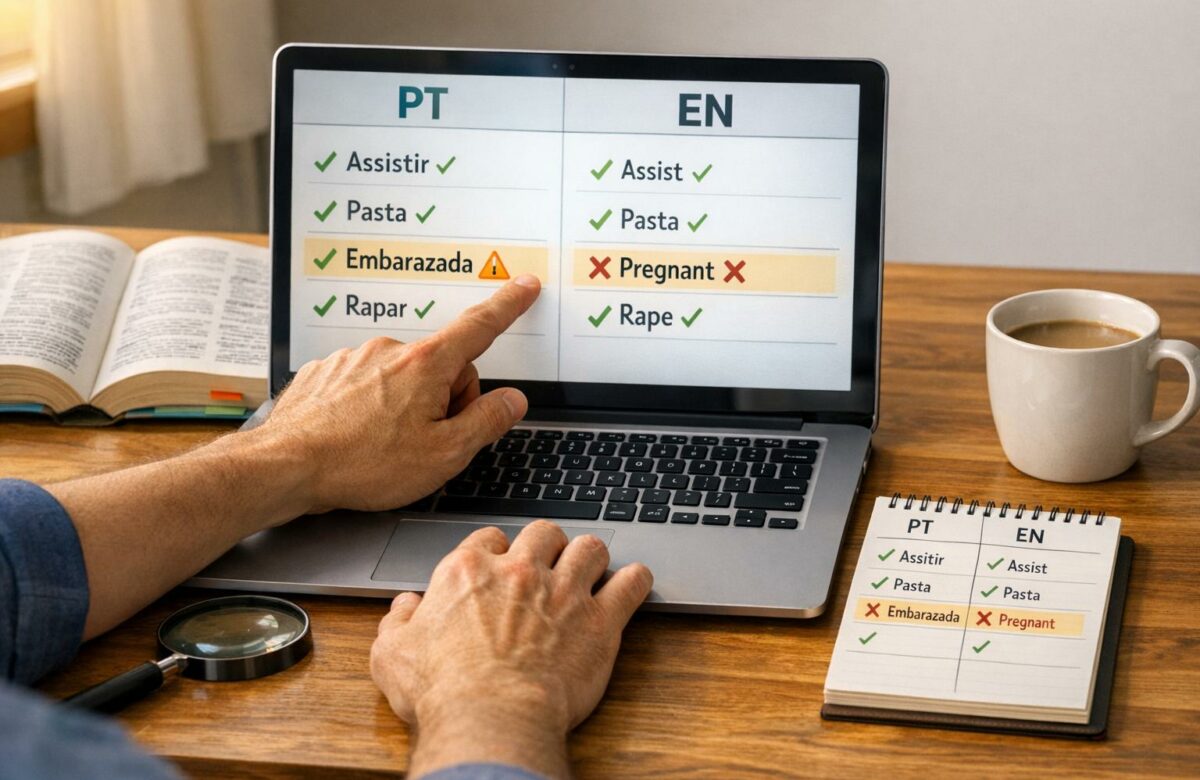
A great way to stay on top of these tricky words is to create a three-column lexicon: one column for the Portuguese word, another for the assumed English meaning, and a third for its correct translation. Reviewing this list daily with flashcards can reinforce your memory. For words that are particularly confusing – like puxar (which means "to pull", not "to push") – visual aids, such as sketches of a door with a pull arrow, can make learning easier.
Another essential step is consulting reliable bilingual dictionaries like Priberam or Michaelis. Don’t just skim the first definition – dig into the examples to understand how the word is used in different contexts. As Janis Palma, a Federally Certified Judiciary Interpreter, emphasizes:
"Researching words should be an everyday habit for interpreters… because it is in our best interest to continue to learn at every opportunity."
By combining these manual methods with translation tools, you can catch errors more effectively.
Leveraging Translation Tools for Error Detection
While manual techniques are invaluable for building expertise, translation tools can provide quick, real-time checks. Tools like BeLikeNative integrate directly with your clipboard, enabling you to refine translations instantly with just a shortcut. Supporting over 80 languages, this tool even lets you adjust tone settings, which is especially useful for false friends like assistir (meaning "to watch", not "assist") that could otherwise lead to misunderstandings.
These tools are excellent for flagging potential errors on the spot. However, despite their capabilities, human judgment is still critical. BeLikeNative works across platforms like Google Docs, Notion, and WhatsApp Web, making it practical for both casual and professional use.
That said, Carol Pinheiro from The Language Club offers a word of caution:
"Do not rely on your translation apps, rather use a good dictionary and read the definitions to make sense of the word."
While translation tools are a helpful safety net, they can’t always account for subtle nuances or the intent behind a message. Use them as a support system, not as your primary resource.
5 Steps to Avoid False Friend Mistakes
Building on the manual and tool-assisted methods already outlined, these five steps can help you systematically avoid false friend errors while improving translation accuracy and clarity.
Your Action Plan for Better Translation Accuracy
A structured approach is essential to avoid embarrassing translation errors. By cultivating habits that encourage thorough verification, you can sidestep pitfalls, even when a word seems deceptively familiar.
Step 1: Flag Words That Appear "Too Easy"
If a Portuguese word looks identical or similar to an English word, take it as a red flag. Words like pasta, pretender, and atualmente might seem straightforward but often carry different meanings. Always pause and double-check these terms to ensure accuracy.
Step 2: Verify Using Context and Dictionaries
Context is everything. For example, translating pasta as "pasta" might lead to nonsensical outcomes like "eating a folder." To avoid such errors, examine multiple examples of the word in use and consult specialized bilingual dictionaries to confirm its meaning within the sentence.
Step 3: Leverage Tools Like BeLikeNative
translation tools in teams can be lifesavers for quick checks. BeLikeNative, for instance, integrates with platforms like Google Docs and WhatsApp Web, offering real-time verification across 80+ languages. Its customizable tone settings make it especially useful for spotting false friends and ensuring consistency.
Step 4: Seek Feedback From Native Speakers
Native speakers bring invaluable insights into nuances and regional expressions that dictionaries might overlook. Whether through casual conversations or professional consultations, their feedback can highlight false friends and refine your translation.
Step 5: Maintain a Personal Log of Mistakes
Keep track of every false friend you encounter, noting both your initial interpretation and the correct meaning. Regularly reviewing this log will reinforce your learning and reduce the chances of repeating the same mistakes.
Manual Translation vs. Tool-Assisted Translation
When deciding between manual methods and tools, consider the strengths and limitations of each approach.
| Feature | Manual Methods | Tool-Assisted (BeLikeNative/CAT) |
|---|---|---|
| Effectiveness | Excels at capturing subtle intent and deeper meaning. | Great for quick lookups and identifying repetitive mistakes. |
| Time Requirements | Involves detailed research and verification. | Provides instant results and automated checks. |
| Accuracy | Relies on human judgment and expertise. | Effective for literal matches but may miss contextual subtleties. |
| Best Use Case | Ideal for legal, medical, or highly creative texts. | Perfect for drafting, technical documents, or vocabulary building. |
Conclusion: Improving Your Portuguese-English Translation Skills
By building on the strategies and tools discussed earlier, you can tackle common translation challenges with greater confidence.
False friends are one of the trickiest hurdles in Portuguese-English translation. These misleading word pairs often exploit our instinct to rely on familiar patterns, which can lead to overconfidence and, ultimately, mistakes. For instance, it’s easy to confuse constipado (meaning "having a cold") with "constipated" or pretender (meaning "to intend") with "pretend." These errors can be embarrassing, but they’re entirely avoidable with the right approach.
The good news? False friends are manageable. While they can trip you up, true cognates far outnumber false ones. Focusing on a small set of problem words – like atualmente, assistir, parentes, and pasta – can significantly reduce mistakes. In fact, this small group accounts for about 80% of learner confusion.
Key Takeaways
When a Portuguese word looks "too easy" or identical to an English word, pause and double-check. This quick habit can prevent miscommunication. Keeping a personal log of false friends, along with their correct meanings, is another effective way to reinforce proper usage. Writing these down helps cement the knowledge better than just reading about them.
Pair these habits with real-time translation tools for even better results. For example, BeLikeNative supports translations in over 80 languages and can catch false friends as you write. Whether you’re drafting an email in Google Docs or chatting on WhatsApp Web, its customizable tone settings ensure your translations are accurate and fit the context – whether professional or casual.
FAQs
How can I quickly tell a false friend from a true cognate?
False friends are words that resemble English terms in appearance or sound but carry entirely different meanings in another language. To steer clear of misunderstandings, it’s helpful to learn commonly encountered false cognates. Use trustworthy bilingual dictionaries to double-check meanings, and always consider the context in which a word appears. With practice and exposure, you’ll become adept at spotting false friends and differentiating them from true cognates – words that align in both form and meaning.
Which Portuguese false friends cause the most serious misunderstandings?
Some Portuguese words can be tricky for English speakers because they look familiar but mean something entirely different. For example, “constipado” refers to having a cold, not constipation. Similarly, “atual” means current, not actual. Then there’s “decepção”, which translates to disappointment, not deception. And don’t forget “chefe”, which means boss, not chef. These false friends can easily lead to misunderstandings, so it’s important to familiarize yourself with them to communicate clearly in both professional and social settings.
What’s the best way to build a personal false-friends study list?
Start by diving into the world of Portuguese-English false cognates – those tricky words that look alike but carry different meanings. These "false friends" can easily trip you up, so it’s worth taking the time to study them carefully. Use trusted resources like bilingual dictionaries, language learning apps, or reputable online guides to identify these words.
Keep a notebook or a digital document handy to jot down each false cognate, its correct translation, and example sentences. For instance, “actual” in English means “real,” while atual in Portuguese translates to “current” or “up-to-date.” Writing examples like this will help you remember the differences more effectively.
Make it a habit to review and update your list regularly as you encounter new words. This consistent practice will sharpen your skills and help you avoid common misunderstandings. Tools like Google Translate or language-specific apps can also assist in verifying meanings, but always double-check with reliable sources to ensure accuracy.