Fix German To English Translation Errors In Professional Emails
When translating professional emails from German to English, even minor mistakes can harm your credibility and lead to misunderstandings. Common issues include literal translations, incorrect word order, mismatched tone, and cultural differences in business communication. For example, translating "GmbH" as "Ltd." can cause legal confusion, and German’s formal tone can feel too rigid for U.S. audiences. Missteps like these can damage trust and professionalism.
Key tips to avoid errors:
- Avoid word-for-word translations; focus on clarity and natural phrasing.
- Adapt German’s formal tone to a more polite yet relaxed U.S. style.
- Correct common errors like capitalization, false friends (e.g., "bekommen" vs. "become"), and date formats (e.g., 2/6/2026 for February 6, 2026).
- Use tools like BeLikeNative for accurate, polished translations, but always proofread manually for tone and context.
Translation is more than just swapping words – it’s about ensuring your message is clear, professional, and culturally appropriate. By refining your approach, you can create emails that build trust and strengthen international business relationships.
German Reacts to Translation Fails – Signs, Menus & What a Native Would Say (A2–C1)
sbb-itb-32359dc
Common German-to-English Translation Errors
Common German to English Translation Errors and Corrections
Avoiding common translation mistakes is crucial for maintaining a polished and professional image.
Literal Translations and Word Order Problems
Some of the most frequent errors stem from translating German phrases directly into English without considering differences in sentence structure and word order.
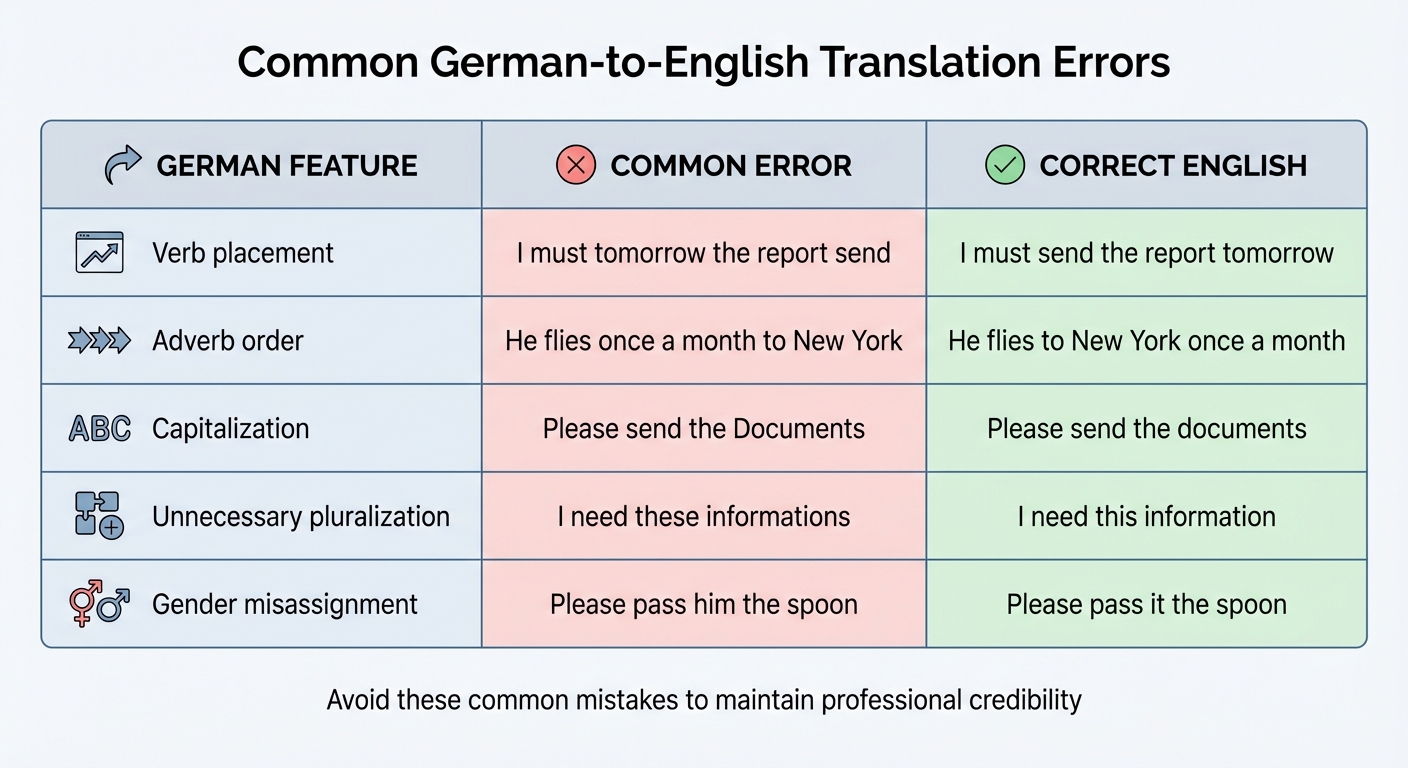
Word-for-word translations often sound unnatural in English. For example, German sentences place verbs at the end of a clause, while English follows a Subject-Verb-Object structure. A literal translation like "I must tomorrow the report send" should instead be "I must send the report tomorrow".
Adverb placement also trips up many translators. German uses a "Time-Manner-Place" order, but English prefers "Place-Manner-Time." For instance, the sentence "He flies once a month to New York" is better written as "He flies to New York once a month". In English, keeping the verb and its object together is key for clarity.
False friends – words that look similar in both languages but have different meanings – can cause confusion. For example, "bekommen" translates to "get", not "become." Misinterpreting "bekommen" as "become" could lead to misunderstandings. Similarly, "muss nicht" means "doesn’t have to", not "mustn’t", and "Gift" translates to "poison", not "gift".
Capitalization errors are another common issue. While German capitalizes all nouns, English reserves capitalization for proper nouns. A literal translation like "Please send the Documents to the Manager by Friday" looks unprofessional. The correct phrasing is "Please send the documents to the manager by Friday".
Formality and Tone Problems
Structural errors aside, mismatched tone and formality can also create issues in translation.
German business communication tends to be highly formal, but directly applying this tone in English may come across as overly rigid or outdated. As Prashant Zare explains:
German email etiquette is strict. These rules aren’t suggestions. Break them and you’ll immediately mark yourself as unprofessional or culturally unaware.
Punctuation after greetings is another area where differences arise. In German, a greeting ends with a comma, and the next line starts with a lowercase letter. In US English, the first word after the greeting should be capitalized, even when a comma is used. For example, "Dear Mr. Smith, thank you for your email" follows English conventions.
Contractions should be used carefully. Avoiding them entirely can make your writing sound stiff, while overusing them might seem too casual in formal settings. Striking the right balance is essential.
Academic titles are treated with particular respect in German culture. Titles like "Dr." or "Prof." are often included in formal greetings, and omitting them may be seen as impolite. When translating to English, it’s best to retain these titles in formal contexts, even though they are often dropped after the initial exchange in the US.
Compound Words and Noun Gender Issues
German’s approach to compound words and noun genders often leads to mistakes when translating into English.
Compound words in German, such as "Zugfahrkarte" (train ticket), can result in unnecessary hyphenation in English. For example, "train-ticket" should simply be "train ticket", and "technical-terms" should be "technical terms".
Uncountable nouns are another stumbling block. German speakers might incorrectly pluralize words like "information", "homework", or "advice", writing "informations", "homeworks", or "advices." In English, these nouns remain singular.
Gender misassignment happens when translators apply German’s gendered pronouns to English. For instance, saying "Please pass him the spoon" instead of "Please pass it the spoon" can confuse readers, as English does not assign gender to inanimate objects.
| German Feature | Common Error | Correct English |
|---|---|---|
| Verb placement | "I must tomorrow the report send" | "I must send the report tomorrow" |
| Adverb order | "He flies once a month to New York" | "He flies to New York once a month" |
| Capitalization | "Please send the Documents" | "Please send the documents" |
| Unnecessary pluralization | "I need these informations" | "I need this information" |
| Gender misassignment | "Please pass him the spoon" | "Please pass it the spoon" |
Cultural and Idiomatic Differences Between German and English
When translating emails from German to English, it’s not just about structure – it’s also about understanding the cultural nuances that shape how messages resonate with a US audience. German expressions often don’t translate directly, and the norms for multilingual email etiquette can vary widely between the two languages.
Idioms and Figurative Language
German idioms can be tricky when translated word-for-word. Take, for example, "Ich verstehe nur Bahnhof", which literally means "I only understand train station." To make sense to an English-speaking audience, you’d want to use something like "It’s all Greek to me" or simply "I don’t understand." Similarly, "Das ist mir Wurst" (literally, "That is sausage to me") would be better expressed as "I don’t mind" or "It doesn’t matter" in a professional context.
Some idioms translate more smoothly. For instance, "Er hat den Nagel auf den Kopf getroffen" aligns perfectly with "He hit the nail on the head." However, others require a bit of creativity. A term like "Handschuhschneeballwerfer", which describes someone who criticizes from behind a screen, can be effectively rendered as "keyboard warrior" for an English-speaking audience.
The key is to focus on meaning rather than direct translation. For example, "Freundschaftsbeweis" works better as "an act of friendship" or "a gesture of goodwill" rather than the literal "proof of friendship." Similarly, a phrase like "Ich freue mich auf Ihre Antwort" feels more natural in English as "I look forward to hearing from you" rather than the overly formal "I look forward to your answer."
But idiomatic translation is only part of the equation – adapting the overall tone is just as important.
Business Communication Expectations in the US
In addition to idioms, the tone of your emails needs to align with US business norms. American emails tend to favor a softer, more polite approach, where phrases like "please" and "thank you" are used frequently to balance clarity with courtesy.
Sentence structure also plays a role. Since the average English sentence is about 14 words long, breaking down lengthy German clauses into shorter, more digestible sentences can significantly improve readability.
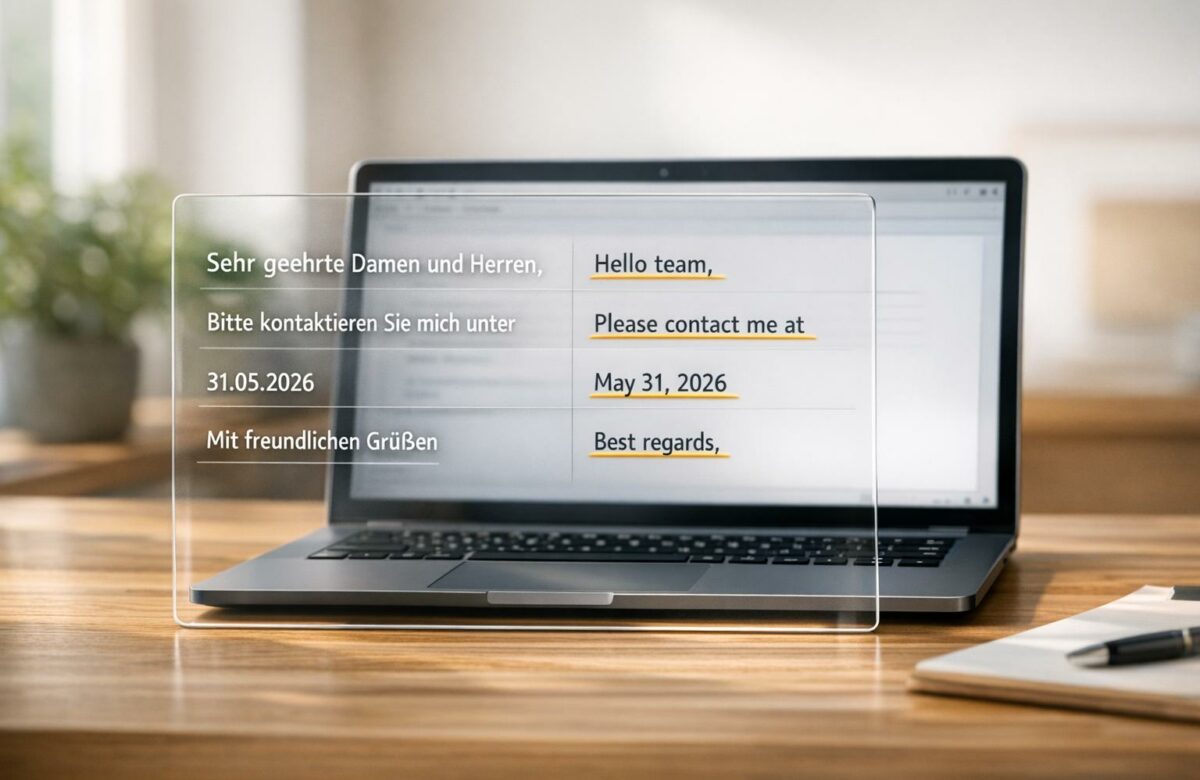
Even standard closings need adjustment. While a German email might end with "Mit freundlichen Grüßen", a more suitable closing for US audiences would be "Best regards" or "Kind regards", typically followed by a comma before the sender’s name.
Adapting both idiomatic expressions and the tone ensures that your emails feel natural and professional to US recipients. These thoughtful adjustments help bridge the cultural gap and make your communication more effective.
Using Tools to Fix Translation Errors
When dealing with the challenges of cultural and linguistic differences, AI grammar fixers can make fixing translation errors faster and more accurate. While manual proofreading remains important, these tools can save time and ensure precision – especially for professional emails that need to align with US business standards.
BeLikeNative Features Overview
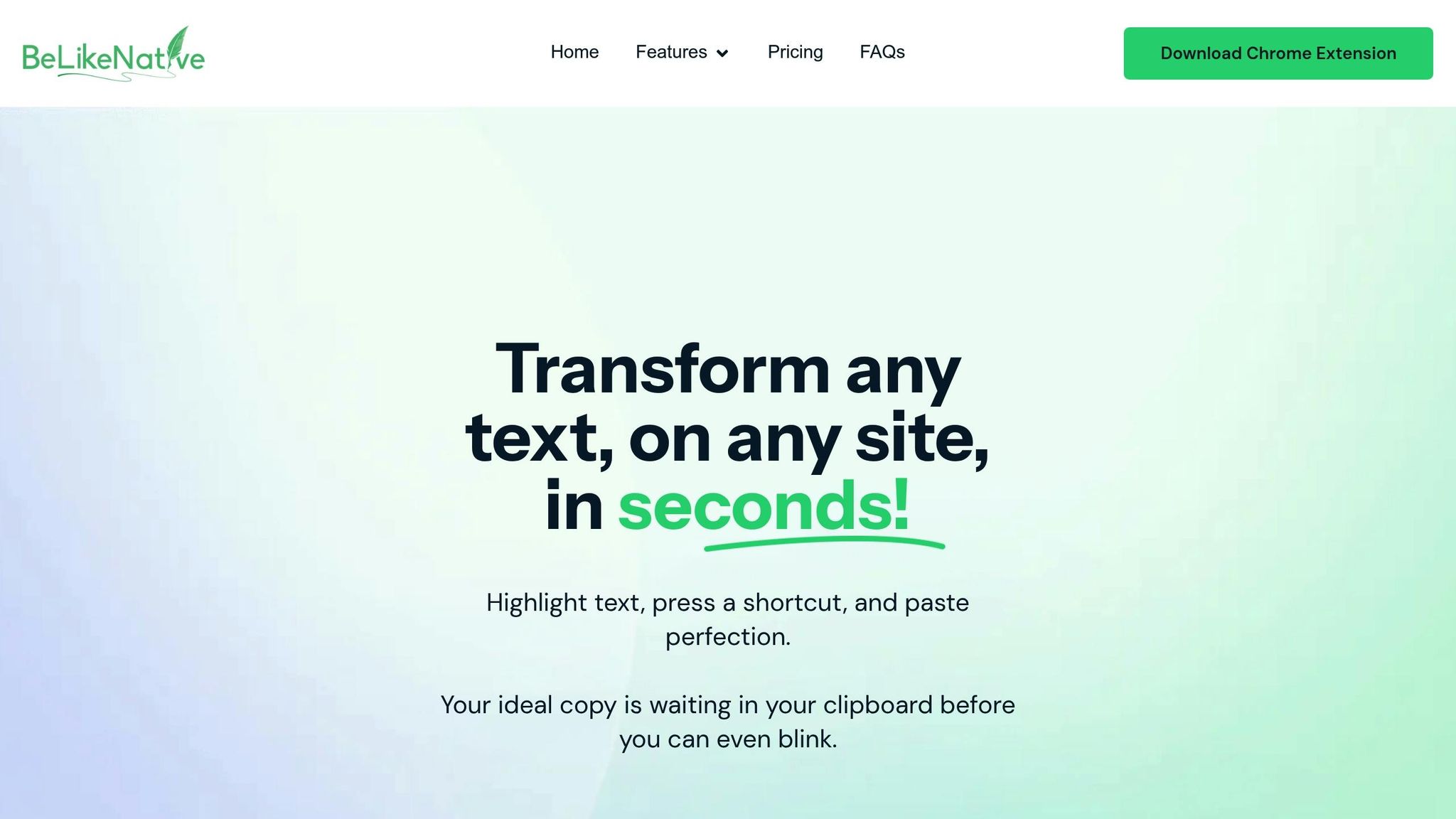
BeLikeNative is a Chrome extension designed to refine writing in 80+ languages, including German and English. Unlike basic translation tools, it aims to make your text sound natural and suitable for your audience. It integrates directly into your browser, allowing smooth editing within platforms like Gmail and Outlook Web.
The extension offers three main functions: rephrasing, translating, and improving text quality. For example, if you’re crafting a German-to-English email, you can highlight your text, press a keyboard shortcut, and instantly trigger translation or refinement. The updated version is automatically copied to your clipboard, ready to paste into your email. This feature eliminates the hassle of switching between windows or apps.
You can also customize the tone and style of your text – whether you need a formal tone for business emails or a casual one for internal messages. This flexibility is also found in the best AI grammar tools for multilingual chats. This is especially useful for adapting German’s formal structure to the more relaxed style often preferred in American business communication. According to user feedback, the tool can boost productivity by 66% and save over 85 hours per month by cutting down on editing and delays.
Once you’re familiar with the features, you can explore the subscription plans to find one that fits your workflow.
BeLikeNative Pricing and Plans
BeLikeNative offers four subscription options to suit a range of needs and budgets. All plans include support for 80+ languages, spelling and grammar correction, and secure data handling.
| Plan | Price | Daily Uses | Character Limit | Best For |
|---|---|---|---|---|
| Explorer | $0/month | 5 | 500 | Occasional use or testing the tool |
| Learner | $4/month | 25 | 2,000 | Professionals with moderate email volume |
| Native | $6/month | 50 | 4,000 | Daily users managing multilingual emails |
| Premium | $14/month | 125 | 6,000 | Teams or heavy users with high workloads |
You can easily upgrade or downgrade your plan through the dashboard. If you’re just starting with German-to-English email translation, the Learner plan should meet the needs of most professionals. For those handling multiple emails daily, the Native plan offers better value.
How to Use BeLikeNative for Professional Emails
Now that you know the features and pricing, here’s how to use BeLikeNative to create polished, professional emails.
Start by installing the Chrome extension and setting your target language to US English for regional accuracy. Write your email in German (or a rough English draft), highlight the text, and press the shortcut to refine or translate it. The improved version will automatically save to your clipboard for easy pasting.
Before finalizing your email, double-check the tone setting to ensure it fits your audience. For example, select "Formal" mode for client or executive communications, and "Casual" mode for quick notes to colleagues. The tool will adjust word choice, sentence structure, and levels of politeness accordingly. For instance, it might suggest "Best regards" or "Kind regards" as a polished alternative to a literal translation of "Mit freundlichen Grüßen."
Pay attention to idiomatic expressions and compound words to ensure your email sounds natural. For longer messages, work section by section rather than translating the entire text at once. This method helps maintain consistency in tone and allows you to address any context-specific nuances the tool might miss.
Step-by-Step Guide to Proofreading Translated Emails
After refining your email with BeLikeNative, it’s essential to take a final pass to manually proofread your message. This step ensures your translation is accurate and aligns with cultural norms. Considering that 91% of employees rely on email to communicate with clients, precision is key to maintaining your professional reputation.
Review Syntax, Grammar, and Tone
Start by reading your email aloud or using text-to-speech software to catch any awkward phrasing. Pay close attention to pronoun references like "it" or "they", and replace them with specific nouns if there’s any ambiguity.
Look for common errors, such as mixing up "there", "their", and "they’re", or using "a" and "an" incorrectly. Watch out for repeated words and aim for active voice whenever possible – for instance, write "Our team completed the report" instead of "The report was completed by our team."
Now, put yourself in the recipient’s shoes. Does the tone feel professional, or could it be interpreted as too blunt or even unfriendly? As George Orwell once advised, "Never use a long word where a short one will do". Emails written at a simpler reading level tend to get better responses, so avoid overly complicated language.
Once the email reads smoothly, shift your focus to meeting US business standards.
Check for US Business Standards
Make sure your email follows US conventions for dates (month/day/year, e.g., 2/6/2026) and that any currency conversions from Euros to Dollars are accurate. Double-check time zones for meetings to avoid confusion.
Review your greeting and closing to ensure they meet US business norms. For example, end with phrases like "Best regards" or "Kind regards" instead of direct translations of closings from other languages. Include a professional signature with your title, phone number, and email address to make your communication clear and complete.
Your subject line should be straightforward and to the point. Avoid overly creative or vague phrasing, and stick to sentence-style capitalization (capitalizing only proper nouns and trademarks). Steer clear of emojis, slang, or colloquialisms. Breaking up long paragraphs into smaller sections – ideally under 100 words – also helps improve readability. Using a one-sentence paragraph occasionally can emphasize key points.
Once you’ve ensured the email meets these standards, move on to the final touches.
Final Proofreading Tips
Before hitting "send", take a short break to refresh your perspective. This can help you catch any lingering mistakes you might have missed earlier. For critical emails, consider drafting your message in a word processor first to avoid sending it prematurely.
Use your computer’s search function to check for recurring mistakes, like double spaces after periods or frequent typos. Eliminate filler words like "just", "kind of", or "actually" to maintain a strong, professional tone. Opt for more precise verbs – write "sprinted" instead of "ran swiftly."
Finally, confirm that all links, attachments, and names are accurate. As Brigid Farrell, Owner of AllTalk Training, wisely points out:
A grammatically perfect email without a clear message will cost more time and draw more attention to your level of English than an email that clearly conveys your message.
Prioritize clarity over perfection. Since 61% of employees favor email as their primary communication method, investing extra effort in proofreading can make a big difference in how your message is received.
Conclusion
Translating professional emails from German to English involves more than swapping words; it requires attention to syntax, tone, and cultural nuances. German business communication often emphasizes efficiency and formality, while in the U.S., a direct yet professionally relaxed tone is preferred. Missing these subtle differences can lead to misunderstandings or even harm your professional image.
To ensure your emails connect with American recipients, focus on these essentials: avoid literal translations, handle compound words carefully, adapt date formats (e.g., 2/6/2026 instead of 6/2/2026), and select appropriate greetings. Always prioritize clarity over perfection. As Sharon Schweitzer, JD, Founder of Access to Culture, wisely points out:
Conducting due diligence in email communication will build trust, inspire respect and build long-lasting relationships in a globalized world.
BeLikeNative simplifies this process with tools for real-time corrections, tone adjustments, and rephrasing – all just a keyboard shortcut away.
Pairing BeLikeNative’s AI tools with your own careful proofreading ensures your emails meet U.S. business standards. By eliminating filler words and focusing on clarity, your communication will stand out. With over 250 billion emails sent every day, dedicating time to crafting precise and culturally aware messages will help you build stronger international business relationships. Start applying these strategies today to elevate your email communication.
FAQs
How can I avoid awkward translations in German-to-English professional emails?
To write natural-sounding German-to-English emails, aim to convey the intended meaning rather than translating word-for-word. German and English differ significantly in grammar, expressions, and tone, so a direct translation often feels awkward or out of place.
A good approach is to replace German idioms with English equivalents. For instance, instead of translating "Ich verstehe nur Bahnhof" literally, use phrases like "I don’t understand anything" or "It’s all Greek to me." Similarly, German sentences with lengthy subordinate clauses should be restructured into shorter, clearer sentences in English for improved readability.
Tools like grammar checkers or style guides can help refine your writing, but don’t rely on them entirely. Always review the translation to ensure it matches the professional tone and context of your email. Building familiarity with common expressions and sentence patterns in both languages will go a long way in making your emails feel smooth and natural.
What are the key cultural differences between German and US business communication?
German and US business communication stand apart in their formality, tone, and approach.
In Germany, professionalism leans heavily on formal language, structured formats, and a clear respect for hierarchy. For example, German emails often begin with formal salutations like Sehr geehrte/r and use the pronoun Sie – particularly during initial interactions or when addressing senior colleagues. This level of formality reflects the importance placed on respect and structure in German business culture.
On the flip side, business communication in the US tends to be more informal and straightforward. Americans commonly use casual greetings such as Hi or Hello and are quick to address colleagues by their first names, even in professional environments. Emails are usually short, friendly, and geared toward getting things done efficiently.
Grasping these cultural differences can help you adjust your communication style, ensuring not only clarity and professionalism but also building stronger cross-cultural connections.
How does BeLikeNative ensure accurate and professional translations?
BeLikeNative delivers precise and professional translations by combining linguistic accuracy with a deep understanding of cultural subtleties – key elements for effective communication. Its tools fine-tune tone and formality to align with the recipient’s expectations, ensuring translations are accurate and culturally aligned.
Supporting over 80 languages, BeLikeNative enhances email communication by rephrasing and adapting messages to meet professional standards. By emphasizing clarity, tone, and cultural sensitivity, it minimizes the chances of miscommunication and elevates the quality of multilingual emails.