
Fix Hindi To English Tense Confusion In Emails
Writing emails in English as a Hindi speaker can lead to common tense mistakes. These errors often stem from direct translations between the two languages, which have different grammar structures. For example, phrases like "I am knowing the answer" or "I will be go tomorrow" are incorrect but frequently appear because of differences in how Hindi and English handle verb forms, time markers, and sentence structure.
Key Takeaways:
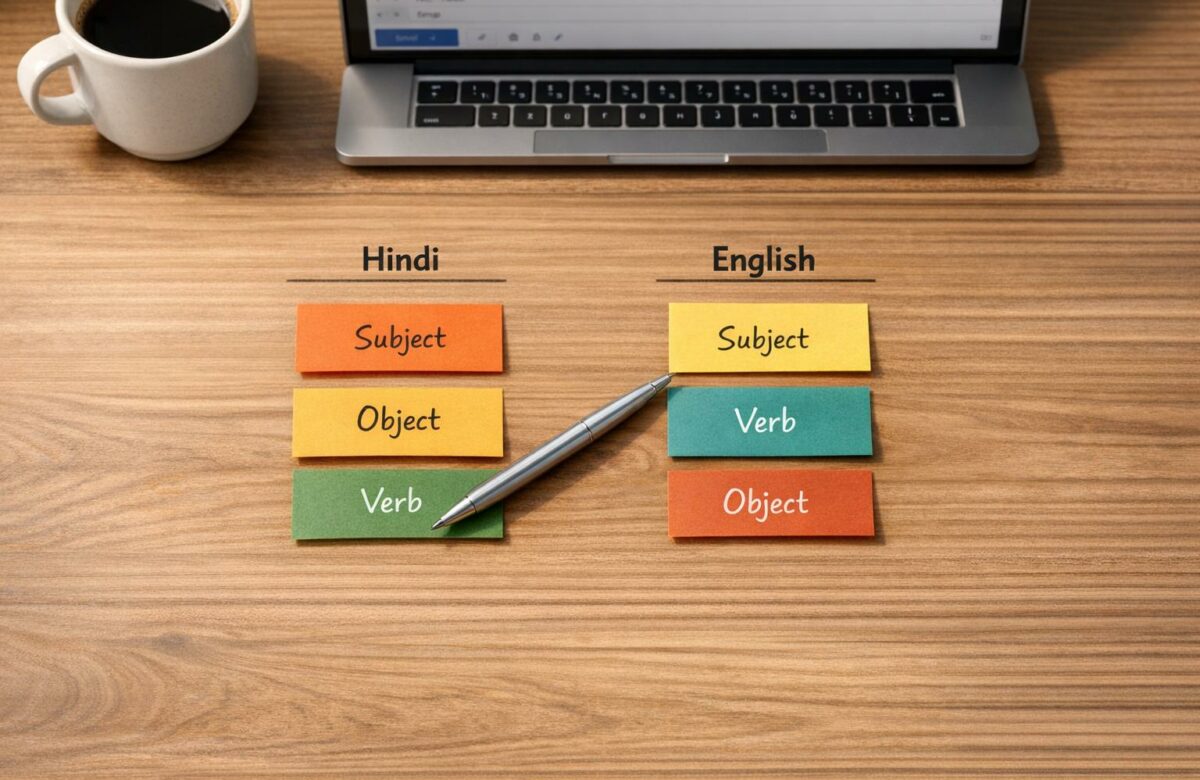
- Hindi uses a Subject-Object-Verb (SOV) structure, while English follows Subject-Verb-Object (SVO).
- Common errors include mixing up present and past tenses, overusing the continuous tense, and incorrect future tense structures.
- Misusing stative verbs (e.g., "I am understanding" instead of "I understand") is another frequent issue.
- Mistakes like "I didn’t received" or "I am waiting since 2 hours" can confuse readers and harm your professional image.
Quick Fixes:
- Use the base verb (V1) after "did" or "didn’t" (e.g., "I didn’t receive").
- Avoid "-ing" forms with stative verbs like know, need, or believe.
- Learn the difference between "since" (specific time) and "for" (duration).
- Practice writing emails using templates and AI grammar tools to refine your skills.
Mastering tense usage is a key step to sound more professional in business emails and ensure clear communication. With consistent practice and attention to common patterns, you can avoid confusion and improve your writing.
Tense सीखने में 5 Mistakes | How to learn Tense correctly| Tense kese sikhe
sbb-itb-32359dc
Common Tense Errors Hindi Speakers Make
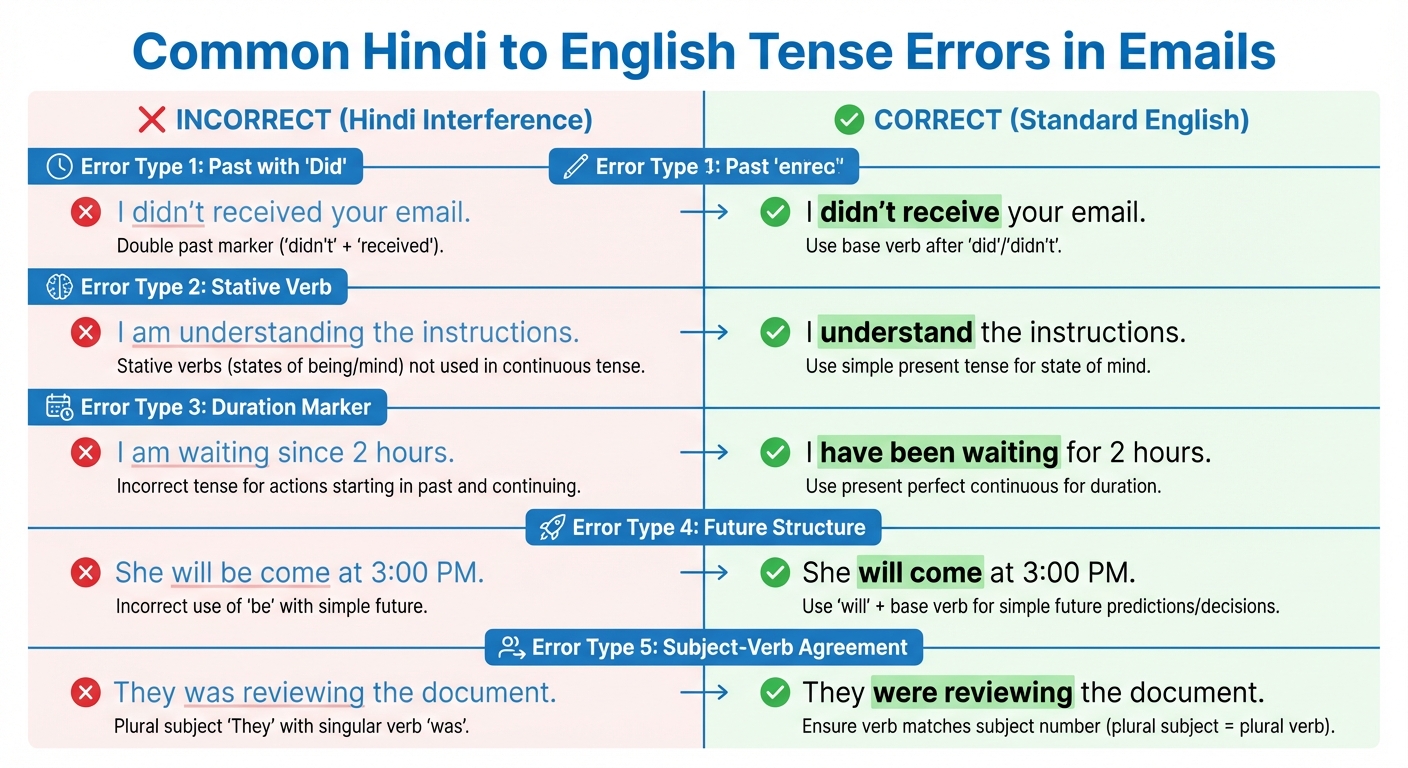
Common Hindi to English Tense Errors and Corrections for Email Writing
Understanding why tense confusion occurs is just the first step. The next is recognizing the most frequent errors. These mistakes often follow predictable patterns, and identifying them can help in addressing them effectively. Let’s look at the specific issues Hindi speakers face with present/past, continuous, and future tenses.
Mixing Up Present and Past Tenses
One common mistake involves using the wrong verb form after "did" or "didn’t." For example, it’s incorrect to use the past tense after "did." This happens because Hindi’s past tense structure lacks a direct equivalent to English auxiliary verbs. The rule here is simple: always use the base form (V1) of the verb after "did" or "didn’t", not the past tense form (V2).
Another frequent error is mixing tenses within a single sentence, which can create confusion about when the actions occurred. For instance, "I went to the store and I will buy milk" is inconsistent. The correct version is "I went to the store and bought milk." This error often stems from literal translations that disrupt the logical flow of time in English.
Overusing Continuous Tense
Hindi speakers sometimes overuse the "-ing" form, even with verbs that describe states rather than actions. This results in sentences like "She is understanding the project" instead of "She understands the project." The confusion arises because Hindi uses "raha hai/tha" (continuous markers) more broadly than English employs the continuous tense.
Stative verbs – such as know, believe, want, own, need, and seem – describe conditions or mental states, not actions. These verbs should not take the "-ing" form in English. Additionally, the continuous tense should not be used for habitual actions. For example, "I am going to the office every day" is incorrect; the proper phrasing is "I go to the office every day." The simple present tense is the right choice for routines and habits.
Getting Future Tense Wrong
Future tense errors often involve unnecessary words or incorrect structures. A typical mistake is "I will be go tomorrow" instead of "I will go tomorrow." This happens when simple future and future continuous forms are mixed, or when Hindi’s future marker "ga/ge/gi" is translated too literally, leading to extra auxiliary verbs. The correct simple future structure is straightforward: use will or shall followed by the base form of the verb. Only use "be" or "-ing" when describing ongoing actions in the future.
| Error Type | Incorrect | Correct |
|---|---|---|
| Past with "Did" | I didn’t received your email. | I didn’t receive your email. |
| Stative Verb | I am understanding the instructions. | I understand the instructions. |
| Duration Marker | I am waiting since 2 hours. | I have been waiting for 2 hours. |
| Future Structure | She will be come at 3:00 PM. | She will come at 3:00 PM. |
| Subject-Verb Agreement | They was reviewing the document. | They were reviewing the document. |
How to Fix Tense Confusion
Getting a handle on tense usage is key for writing clear and professional emails, especially for Hindi speakers transitioning to English. The great thing is, tense confusion isn’t a permanent hurdle. With focused effort, you can master accurate tenses that make your emails sound polished and professional. By understanding Hindi-to-English patterns, using helpful tools, and practicing regularly, you can improve quickly. Let’s dive into practical ways to address these common tense challenges.
Learn Hindi-to-English Tense Patterns
A good starting point is understanding how Hindi tense markers shift into English structures. Hindi follows a Subject-Object-Verb (SOV) order, while English uses Subject-Verb-Object (SVO). For instance, "I school go" in Hindi becomes "I go to school" in English.
Another important tip is to place time indicators naturally in English sentences. For example, write "I will send the report tomorrow" instead of "Tomorrow I will send the report."
Pay close attention to the difference between "since" and "for" – a common area of confusion. Use "since" when referring to a specific point in time, like "I have been waiting since 9:00 AM" or "since Monday." On the other hand, use "for" to indicate duration, such as "I have been waiting for two hours" or "for three days."
Avoid word-for-word translations. For example, instead of saying "He is very fast" to praise someone’s intelligence, use "He is very sharp." Direct translations often miss the nuances of English phrasing.
Use Grammar-Checking Tools
Once you’ve grasped the basics, grammar-checking tools can help you refine your writing further. These tools catch tense-related errors as you type, making them invaluable for improving your emails. For example, BeLikeNative‘s Chrome extension can identify tense mistakes directly in your email drafts. Beyond simple corrections, it can rephrase entire sentences to make them sound more natural and professional. Plus, it integrates with popular email platforms, so you can use it without any extra hassle.
When a tool suggests a correction, take a moment to read the explanation provided. Understanding why a change was necessary helps build stronger long-term writing skills.
Practice with Examples and Templates
After learning the rules and using tools, practice is the next step. One effective method is to read professional emails regularly. Pay attention to how tenses are used in different parts of the email – introductions, main content, and closings. For example, notice phrases like "I am writing to inform you…" for current actions or "I have attached the document" for completed actions that are still relevant.
Another helpful exercise is translating Hindi sentences into English while adhering to the SVO structure. For instance, "मैंने कल रिपोर्ट भेजी" should become "I sent the report yesterday" instead of a literal translation like "Yesterday I the report sent."
You can also practice converting casual phrases into professional ones. For example:
- Change "I want leave" to "I would like to request leave."
- Replace "My head is paining" with "I have a headache."
These exercises retrain your brain to think in English rather than relying on direct translations.
Finally, commit to writing at least one professional email every day. Even if it’s just to a friend or colleague for feedback, this daily habit will sharpen your skills. Before hitting send, read your email out loud to catch any awkward phrasing or tense issues. Also, aim to include polite language, like "Could you please…" or "I would appreciate…", to maintain a professional tone.
Examples: Fixing Tense Errors in Emails
Before and After: Corrected Email Examples
Seeing how small tense adjustments can refine your emails is key to improving clarity and professionalism. Below are examples of common mistakes made by Hindi speakers, paired with their improved versions.
Example 1: Leave Request
Before: "Respected Sir, I am needing leave for tomorrow. Kindly grant me. I will be grateful."
After: "Dear Sir, I would like to request leave for tomorrow. Kindly grant me permission. I would be grateful."
The original email misuses the continuous tense with "needing", which is incorrect for a stative verb. The revised version uses "would like to request", which is both polite and professional.
Example 2: Follow-Up Email
Before: "I have sent the email yesterday. Please check and revert back."
After: "I sent the email yesterday. Please check and let me know."
Present Perfect tense ("I have sent") should not be used with specific time markers like "yesterday." The corrected version uses Past Simple ("I sent") for proper grammar.
Example 3: Introduction Email
Before: "Myself Ramesh Kumar, I working in IT. I have completed my project last week."
After: "I am Ramesh Kumar, and I work in IT. I completed my project last week."
The revised email begins with "I am Ramesh Kumar", which is the correct way to introduce oneself. It also uses "I completed" to clearly indicate a past event.
Example 4: Meeting Request
Before: "I will be finished the report by Friday. We can discuss then."
After: "I will have finished the report by Friday. We can discuss then."
Here, the Future Perfect tense ("will have finished") is used to describe an action that will be completed before a specific future time.
"One small grammar mistake in a business email can lead to a big misunderstanding – or worse, damage your credibility." – Prof. Scott Mendoza
These examples illustrate how precise tense usage can make your emails clearer and more professional.
Email Templates for Practice
To further strengthen your skills, use these templates that highlight correct tense usage. Templates not only save time but also help you internalize proper grammar patterns.
Meeting Request Template
Subject: Request for Meeting – Monday at 10:00 AM
Dear [Name],
I hope you are doing well. I am writing to request a meeting to discuss our upcoming project. Please let me know your availability for Monday at 10:00 AM. If this time is not convenient, kindly suggest an alternative.
Looking forward to your response.
Best regards,
[Your Name]
This template uses Present Continuous ("am writing") to explain the purpose of the email, which is standard in professional communication. For actions that started in the past and continue now, understanding the present perfect continuous tense is equally important.
Follow-Up Template
Subject: Follow-up: Invoice #1234
Dear [Name],
I have sent the invoice; please confirm you received it. Please let me know if you need more information.
Best regards,
[Your Name]
Here, "I have sent" emphasizes a recently completed action, while "received" refers to a specific completed event.
Leave Request Template
Subject: Request for Leave on March 15, 2026
Dear [Manager’s Name],
I request leave for March 15, 2026, due to a family commitment, and will complete all pending tasks beforehand.
Please let me know if you require any further details.
Best regards,
[Your Name]
This template avoids the common error "I am needing leave", using the polite phrase "I request leave" instead.
Conclusion: Improving Your English Tense Usage
Getting a handle on English tenses can transform unclear emails into polished, professional communication. For example, the difference between "I sent the report yesterday" and "I have sent the report" might seem minor, but it changes how your message is perceived. Tenses act as a timeline for your reader, showing whether tasks are done, still in progress, or planned for later.
These details matter. Poor grammar can take a toll on your professional image. In workplaces where emails often double as official documentation, mistakes can lead to misunderstandings, eroding trust and potentially causing costly errors.
To improve, start with the practical tips shared in this article. Align your tense with the time frame you’re talking about, and use clear time markers like "yesterday" or "by Friday". Tools like the BeLikeNative Chrome extension can also help you catch errors before you hit send.
But tools alone aren’t enough – practice matters. Write one professional email daily, study business templates, and note useful phrases to expand your vocabulary. Use the email templates and exercises provided here to strengthen your skills. Over time, using the correct tense will feel natural.
Every email you send reflects on you. By using the strategies, examples, and templates outlined in this article, you can ensure your communication is clear, confident, and professional. With consistent effort, you’ll master the techniques needed to make every message count.
FAQs
When should I use “I sent” vs “I have sent” in an email?
Use “I sent” when referring to actions completed at a specific moment in the past. For example: “I sent the email yesterday.”
Use “I have sent” to emphasize recent actions or those still relevant to the present. For example: “I have sent the documents you requested.”
For actions completed before another event in the past, use “I had sent”. For example: “I had sent the report before the meeting started.”
How do I know if a verb should not use “-ing” (like “know” or “need”)?
To figure out if a verb shouldn’t use the “-ing” form, see if it’s a stative verb. Stative verbs express states, emotions, ownership, or mental processes and generally avoid the continuous “-ing” form. Examples include verbs like “know,” “need,” “believe,” and “like.” These are most often used in the simple present tense instead of continuous forms.
Which tense sounds most professional for requests and follow-ups?
The present perfect tense, like "I have sent", is ideal for professional requests and follow-ups. It emphasizes actions that are recent or still relevant, making your communication clear and polished. This tense also reflects respect and precision, which are key in maintaining a professional tone.