

Fix “Run On Sentences” In Student Essays
Run-on sentences are a common issue in student writing. They occur when two or more independent clauses are improperly joined, making the text unclear. These errors come in two forms: fused sentences (no punctuation or conjunctions) and comma splices (using only a comma to link clauses).
Here’s how to fix them:
- Split with periods: Break sentences into two separate ones.
- Use semicolons: Connect closely related ideas.
- Add coordinating conjunctions: Use words like and, but, or with a comma.
- Use subordinating conjunctions: Words like because, although, since clarify relationships.
Run-ons hurt clarity, especially in academic writing. Tools like BeLikeNative can help identify and fix these errors, streamlining the editing process. With practice and attention to sentence structure, you can improve your writing and avoid run-ons altogether.
Run-ons & Comma Splices in English | How to Identify & Fix Run-on Sentences
sbb-itb-32359dc
What Are Run-On Sentences?
A run-on sentence happens when two or more independent clauses are combined incorrectly. An independent clause includes a subject and a verb and can stand alone as a complete thought. The issue with run-on sentences lies in how they’re structured, not their length. For instance, a short sentence like "I ran he fell" is a run-on, while a much longer sentence – say, 200 words – can be perfectly fine if punctuated correctly.
"A run-on sentence is one in which two or more complete, independent clauses are joined without a word or punctuation mark that identifies them as complete." – The Blue Book of Grammar and Punctuation
Run-on sentences come in two main forms. A fused sentence connects independent clauses without any punctuation or linking words. On the other hand, a comma splice uses only a comma, which isn’t strong enough to separate two complete thoughts unless paired with a coordinating conjunction.
How Run-On Sentences Affect Writing Clarity
Run-on sentences can make your writing harder to follow by blurring the boundaries between ideas. When readers can’t tell where one thought ends and another begins, your argument loses impact. This lack of clarity is especially problematic in academic writing, where precision is key. Even strong points can become muddled, and your intended meaning might get lost.
Common Run-On Sentence Examples
Here are some examples to illustrate the problem and how to fix it:
| Type | Example | Why It’s Wrong |
|---|---|---|
| Fused Sentence | The flowers are beautiful they brighten the room. | No punctuation separates the two independent clauses. |
| Comma Splice | The flowers are beautiful, they brighten the room. | A comma alone isn’t enough to separate two complete thoughts. |
| Correct (Period) | The flowers are beautiful. They brighten the room. | Each independent clause is a separate sentence. |
| Correct (Semicolon) | The flowers are beautiful; they brighten the room. | A semicolon properly links two related independent clauses. |
| Correct (Comma + Conjunction) | The flowers are beautiful, and they brighten the room. | A comma with a coordinating conjunction connects the clauses correctly. |
To catch run-on sentences, try the "stand alone" test. Break the sentence into parts and see if each part has a subject and verb and could work as a complete sentence. If so, check how they’re connected. If there’s only a comma – or no punctuation at all – you’ve likely found a run-on.
Recognizing these errors is the first step toward fixing them. Next, we’ll look at practical ways to correct run-ons and make your writing clearer.
4 Techniques to Fix Run-On Sentences
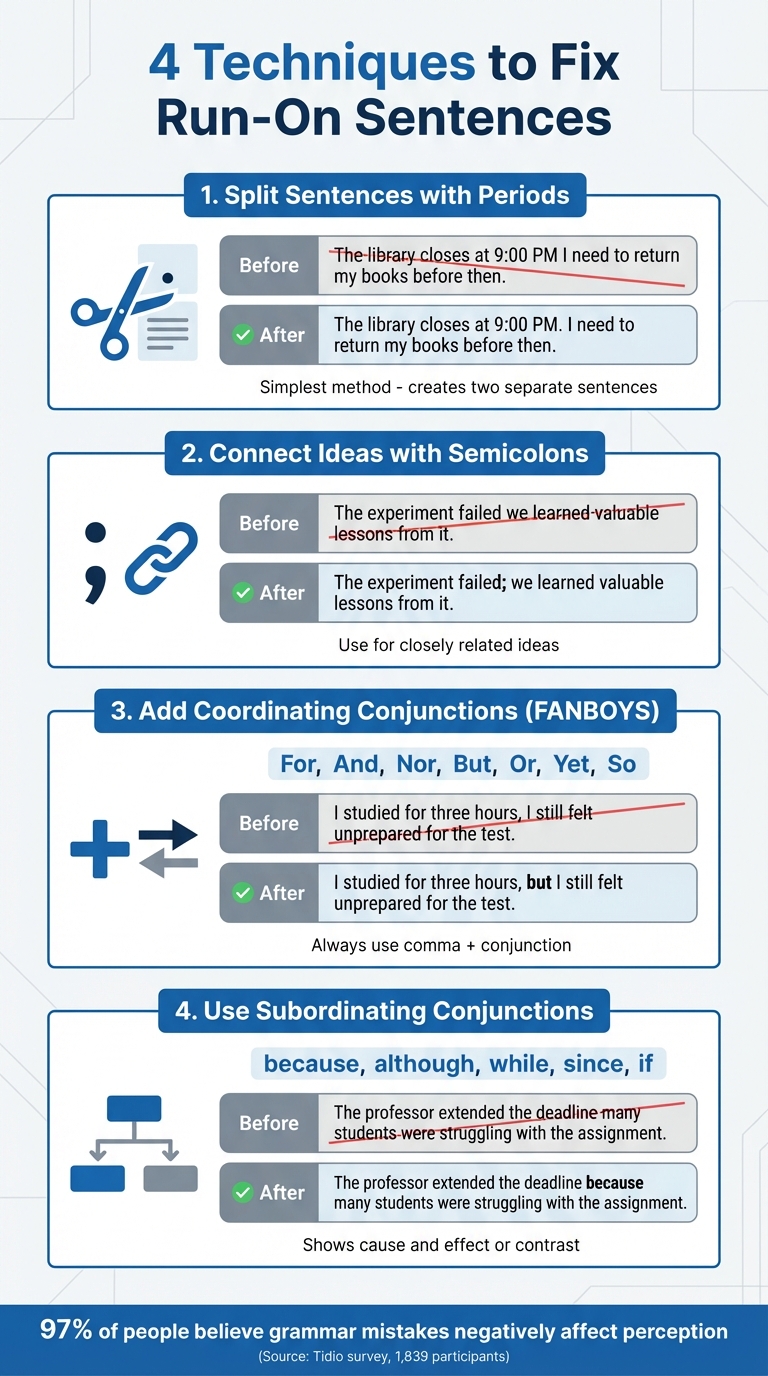
4 Techniques to Fix Run-On Sentences in Student Writing
Run-on sentences can make your writing confusing, but fixing them is easier than you might think. The best method depends on how your ideas connect. Here are four practical ways to fix run-ons, each designed to create clarity and improve the flow of your writing.
1. Split Sentences with Periods
The simplest way to fix a run-on is to divide it into two sentences. Add a period after the first clause and capitalize the next sentence. This works well when your ideas are distinct or when a sentence gets too long to follow easily.
"Adding a period will correct the run-on by creating two separate sentences. This allows the reader to absorb the ideas one at a time." – Snow College
Before:
The library closes at 9:00 PM I need to return my books before then.
After:
The library closes at 9:00 PM. I need to return my books before then.
A Tidio survey of 1,839 participants revealed that 97% of respondents believe grammar mistakes negatively affect their perception of a person or company.
However, overusing periods can make your writing feel choppy. To keep it engaging, combine this method with others.
"Often, this is best achieved through short sentences." – Northwestern University Writing Place
2. Connect Ideas with Semicolons
If two independent clauses are closely related, a semicolon can link them while maintaining proper structure. Unlike a period, which creates a full stop, a semicolon shows the second idea flows naturally from the first.
Before:
The experiment failed we learned valuable lessons from it.
After:
The experiment failed; we learned valuable lessons from it.
Before using a semicolon, make sure both parts can stand alone as complete sentences. If they can’t, or if the ideas aren’t strongly connected, stick with a period. While semicolons add variety, using them too often can make your writing feel dense.
| Method | Grammatical Function | Effect on Writing Style |
|---|---|---|
| Period | Separates independent clauses into two sentences | Can feel abrupt if overused |
| Semicolon | Joins closely related independent clauses | Maintains flow and emphasizes connection between ideas |
| Conjunction | Joins clauses with a comma and a connector word (FANBOYS) | Clearly defines the relationship between thoughts |
3. Add Coordinating Conjunctions
Coordinating conjunctions – for, and, nor, but, or, yet, so (FANBOYS) – can join two independent clauses of equal importance. Always include a comma before the conjunction when connecting complete thoughts.
Before:
I studied for three hours, I still felt unprepared for the test.
After:
I studied for three hours, but I still felt unprepared for the test.
This method explicitly defines the relationship between ideas. For example, "and" adds information, "but" shows contrast, and "so" indicates a result. Be careful not to overuse conjunctions, as they can lead to overly long or tangled sentences.
"One of the most common causes of run-ons? The overuse of conjunctions like and, but, and so. These tiny words are easy to lean on when you’re trying to say a lot, but without proper structure, they create long, tangled sentences that just don’t work." – Prof. Scott Mendoza
4. Use Subordinating Conjunctions
When coordinating conjunctions aren’t enough to clarify the relationship between clauses, subordinating conjunctions like because, although, while, since, and if can help. These words turn one independent clause into a dependent clause, showing how the ideas are connected.
Before:
The professor extended the deadline many students were struggling with the assignment.
After:
The professor extended the deadline because many students were struggling with the assignment.
If the dependent clause comes first, add a comma. If it follows the main clause, no comma is needed.
Dependent clause first:
Because many students were struggling with the assignment, the professor extended the deadline.
Dependent clause last:
The professor extended the deadline because many students were struggling with the assignment.
This approach is great for showing cause and effect or contrast in a way that feels natural.
Each technique offers a unique way to fix run-on sentences. The key is choosing the one that best matches the relationship between your ideas and the tone of your writing. Up next, see how BeLikeNative can help refine these techniques to make your essays polished and error-free.
How BeLikeNative Helps Fix Run-On Sentences

Fixing run-on sentences manually can be a hassle, but BeLikeNative simplifies the process by identifying and correcting errors while you write. This Chrome extension works seamlessly on platforms like Google Docs, Notion, and WhatsApp Web. It scans your text for improperly connected independent clauses, ensuring your writing is polished and professional. The integration of error detection and correction naturally leads us to practical editing tips in the next section.
Detecting Run-On Sentences with BeLikeNative
BeLikeNative focuses on common run-on sentence errors by analyzing subject-verb patterns to pinpoint improperly linked clauses.
The extension highlights run-ons in red, and hovering over them provides instant suggestions for fixes. For sentences that stretch beyond 40 words, it recommends breaking them into shorter, more readable ones. Its AI-powered rephrasing tool can restructure sentences with dependent clauses or proper conjunctions, improving clarity and flow. Additionally, the "Shorten" feature trims unnecessary words and repetitive phrases that often create overly complex run-ons, making your writing more concise and direct.
Features for Students
BeLikeNative is particularly useful for students, offering plans tailored to different writing needs.
The Explorer plan is completely free, allowing up to 5 daily uses with a 500-character limit per correction. It provides spelling and grammar checks, clarity improvements, and supports over 80 languages – ideal for quick edits or shorter assignments.
For more intensive writing tasks, the Learner plan costs $4 per month and increases the daily limit to 25 uses with 2,000 characters per correction. This plan includes all Explorer features plus editable functions and customizable shortcuts, making it easier to manage longer essays or multiple assignments.
BeLikeNative Pricing Plans
BeLikeNative offers flexible pricing options to match different workloads:
| Plan | Monthly Price | Daily Uses | Character Limit | Best For |
|---|---|---|---|---|
| Explorer | $0 | 5 | 500 | Quick grammar checks and short paragraphs |
| Learner | $4 | 25 | 2,000 | Regular essay writing and assignments |
| Native | $6 | 50 | 4,000 | Heavy writing workload with priority support |
| Premium | $14 | 125 | 6,000 | Advanced users needing maximum capacity |
Every plan includes essential tools for fixing run-on sentences, such as red-underlined error detection, one-click corrections, and AI-driven rephrasing suggestions, making it easier to produce clear and error-free writing.
Editing Checklist for Run-On-Free Essays
Making sure your essay is free of run-on sentences takes a thorough review process. These three steps will help you refine your work, whether you’re polishing a short paragraph or revising a lengthy research paper.
Step 1: Read Your Essay Aloud
Start by reading your essay out loud. If you find yourself running out of breath before reaching a natural pause, chances are you’ve stumbled upon a run-on sentence. Pay attention to where your voice naturally wants to pause – if there’s no punctuation at that spot, you may have a fused sentence that needs fixing. Clear and well-structured sentences are a cornerstone of academic writing.
Once you’ve identified potential run-ons, take a closer look at how the clauses in those sentences are connected.
Step 2: Examine Clause Connections
Break down each sentence into its clauses. A clause with its own subject and verb can stand alone as a sentence. If two independent clauses are in the same sentence, make sure they’re joined properly. A comma by itself isn’t enough – it creates a comma splice, one of the most common run-on errors. To fix this, pair the comma with one of the FANBOYS coordinating conjunctions: For, And, Nor, But, Or, Yet, So.
Alternatively, you can use a semicolon to connect closely related ideas or restructure the sentence with subordinating words like because, although, since, or while to turn one clause into a dependent idea.
After you’ve ensured all clauses are properly connected, move on to the final step.
Step 3: Finalize Your Review with BeLikeNative
Once you’ve manually proofread your essay, use BeLikeNative to catch any lingering run-ons. The tool highlights run-ons in red and flags sentences over 40 words, making it easy to spot overly complex structures. You can hover over errors for correction suggestions or use the AI tools to simplify sentences and improve clarity. The Shorten feature is especially helpful for trimming unnecessary words that contribute to run-ons, ensuring your draft is clear and concise.
This checklist works alongside other editing techniques to help you produce polished, easy-to-read academic writing.
Conclusion
Fixing run-on sentences doesn’t require major overhauls – just a few targeted tweaks. The four main strategies – breaking sentences with periods, linking clauses with semicolons, adding coordinating conjunctions, or using subordinating conjunctions – provide straightforward ways to address run-ons. As Phoenix Bunke, an editor at Wordtune, explains:
"Avoiding run-on sentences is easy, you just need a bit of practice".
This advice aligns perfectly with the practical steps outlined in this guide.
Practice makes all the difference. By consistently using the three-step checklist – reading your essay aloud, checking how clauses connect, and polishing your edits with BeLikeNative – you’ll gradually develop a natural sense for proper sentence structure. Over time, these adjustments become automatic, cutting down the need for heavy revisions or using AI tools to shorten essays to maintain focus.
BeLikeNative’s tools fit right into this process. The platform streamlines editing by flagging run-ons and offering immediate suggestions. Whether you’re on the Explorer plan for basic grammar support or the Native plan for more advanced editing, the tool is a reliable companion. Its AI-powered rephrasing and text improvement features are especially helpful for students who tend to overcomplicate their sentences.
FAQs
How can I tell a run-on sentence from a long sentence?
A run-on sentence happens when two or more independent clauses are combined incorrectly – either with no punctuation at all or with incorrect punctuation. On the other hand, a long sentence can still be correct as long as the clauses are properly linked using punctuation or conjunctions. Common signs of run-ons include fused sentences (where there’s no punctuation) or comma splices (where only a comma is used). If a sentence feels overwhelming or hard to follow, there’s a good chance it’s a run-on.
When should I use a semicolon instead of a period?
Using a semicolon can effectively link two closely related independent clauses, creating a smoother flow and emphasizing their connection. This technique is especially useful in persuasive or explanatory writing, where clarity and coherence are key. For instance, instead of separating two stand-alone sentences, you can combine them to highlight their relationship: "The project was a success; it exceeded all initial expectations." This not only strengthens the message but also makes the writing more engaging and fluid.
How do I avoid creating new run-ons while revising?
To avoid creating new run-on sentences during revisions, make sure independent clauses are connected appropriately. You can do this by:
- Splitting overly long sentences into two shorter ones.
- Placing a semicolon between related clauses for clarity.
- Using a comma alongside a coordinating conjunction (like "and", "but", or "so").
Take the time to review each sentence to ensure it communicates a single, clear idea, steering clear of comma splices or fused clauses.