How To Paraphrase Quotes For Research Papers Without Plagiarism
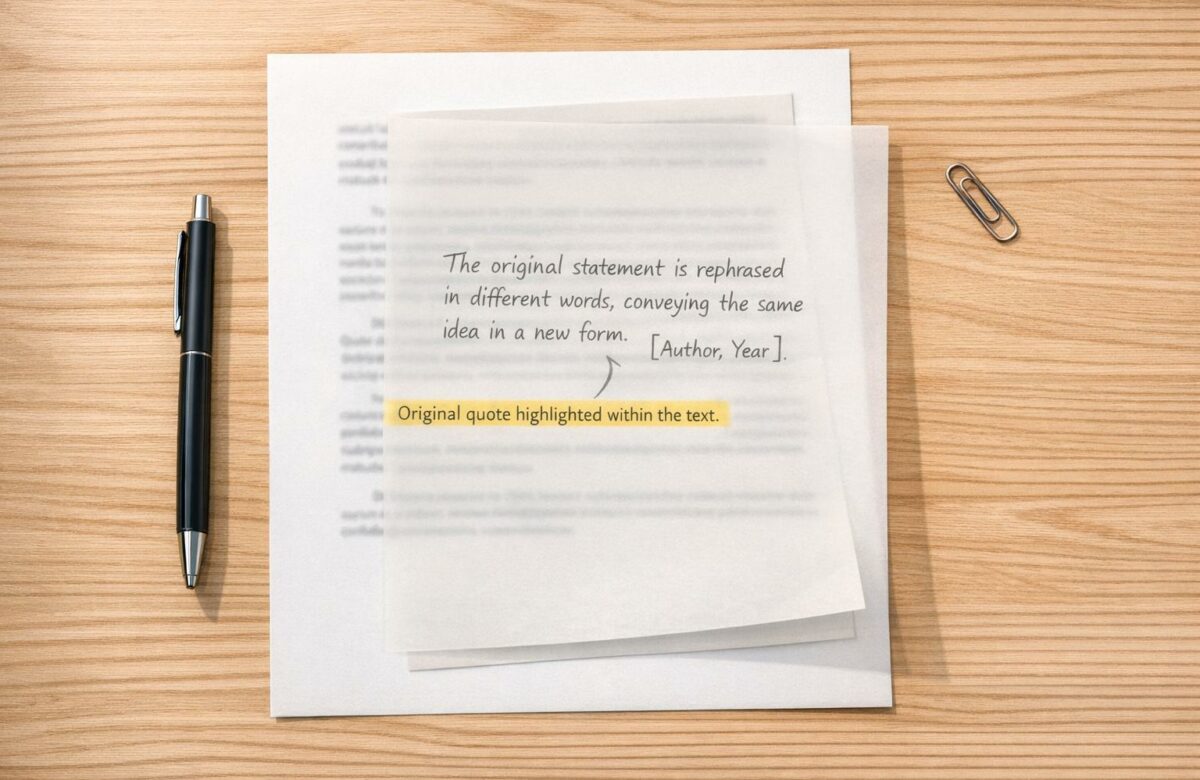
Avoiding plagiarism while paraphrasing is simpler than you think. The key is to fully understand the original text, rewrite it in your own words and structure, and always credit the source. Paraphrasing helps you integrate external ideas into your research while maintaining academic integrity. Here’s how you can do it effectively:
- Understand the source material: Read the original text multiple times until you can explain it without looking.
- Rewrite with new words and structure: Close the source, and rephrase the idea using different vocabulary and sentence patterns.
- Check accuracy: Compare your paraphrase with the original to ensure the meaning is the same but the wording is different.
- Cite your sources: Even when paraphrased, the idea still belongs to the original author.
Common mistakes to avoid:
Transform Any Text, On Any Site, In Seconds
Rephrase, translate, and improve text with one shortcut. Works everywhere you write.
Add to Chrome - It's Free!- Simply swapping words for synonyms.
- Forgetting to include citations.
- Using unique phrases without quotation marks.
Tools like BeLikeNative can help simplify the process by providing instant rephrasing while maintaining the original meaning. With features like tone adjustments and clipboard shortcuts, it’s a practical solution for academic writing.
Paraphrasing is a skill that not only helps you avoid plagiarism but also strengthens your research by showing a deeper understanding of the material.
How to Paraphrase in a Research Paper (to Avoid Plagiarism) 📚🔍
sbb-itb-32359dc
How to Paraphrase Quotes: A Step-by-Step Process
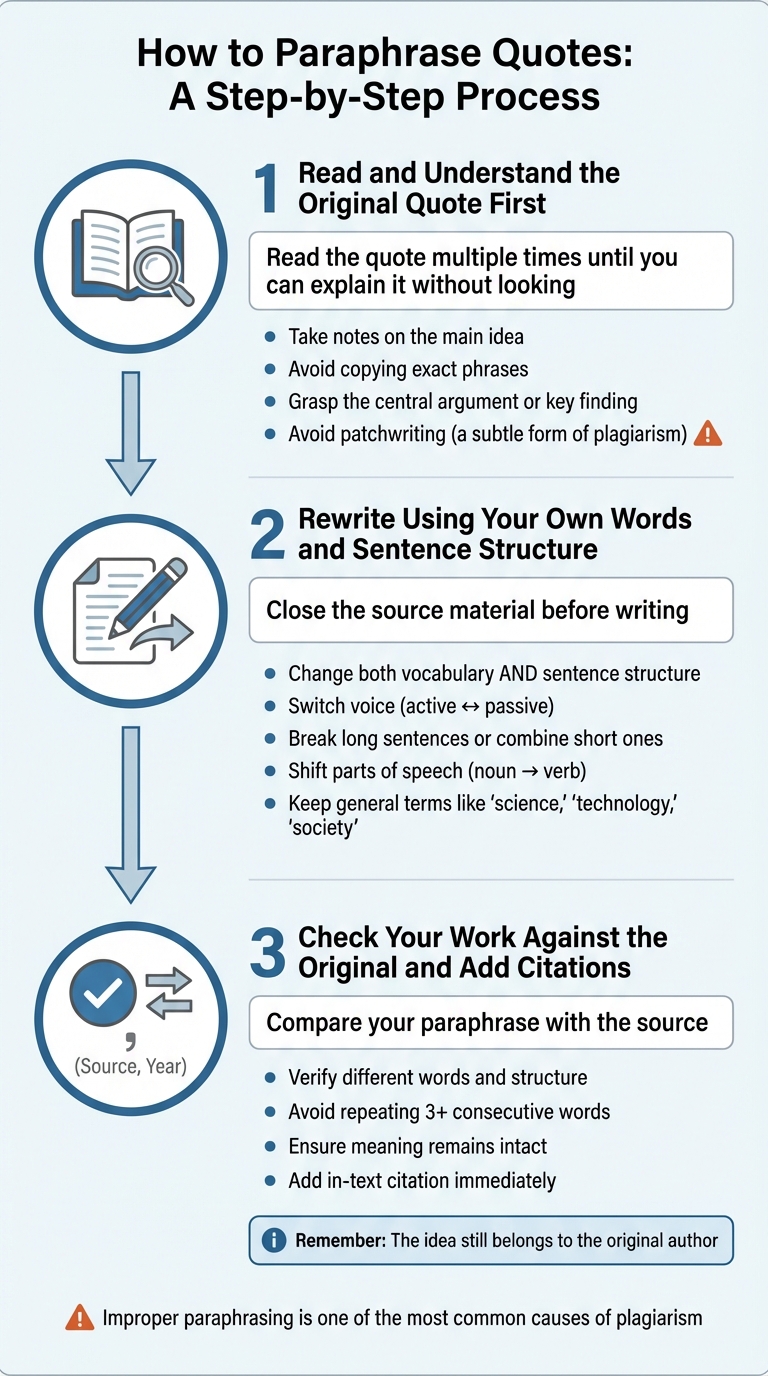
3-Step Process for Paraphrasing Quotes Without Plagiarism
Paraphrasing takes a thoughtful approach to ensure you reflect the original meaning while using your own words. Here’s how to do it effectively.
Read and Understand the Original Quote First
Start by reading the quote multiple times until you can explain the concept to someone else without referring back to the text. If you can’t articulate the idea clearly, you risk misrepresenting the original meaning.
"Never attempt to paraphrase content you don’t fully understand. If you cannot explain a concept in your own words without the source in front of you, you haven’t comprehended it sufficiently." – Custom University Papers
Take notes on the main idea, but avoid copying exact phrases. Your goal is to grasp the central argument or key finding, not to memorize specific wording. This helps you avoid patchwriting, which is a subtle form of plagiarism. For those working in collaborative environments, following a guide to plagiarism prevention in teams can help maintain collective academic integrity.
Rewrite Using Your Own Words and Sentence Structure
Once you fully understand the quote, close the source material before writing. This forces you to rely on your understanding rather than unintentionally mimicking the original phrasing.
Rewrite the idea in your own words, making changes to both vocabulary and sentence structure. For example, if the original uses active voice ("The researchers found…"), you might switch to passive voice ("It was discovered…"). Break long sentences into shorter ones, or combine shorter sentences for variety. You can also shift parts of speech – turn a noun like "analysis" into a verb like "analyzed."
Keep general terms like "science", "technology", or "society" as they are, as forcing synonyms for these can make your paraphrase awkward or unclear. However, replace unique words or phrases with appropriate synonyms that fit the context.
After completing your rewrite, move on to the next step to ensure accuracy.
Check Your Work Against the Original and Add Citations
Once you’ve written your paraphrase, compare it directly with the source. Check that your version uses different words and structure while keeping the meaning intact. Be cautious of unintentionally repeating three or more consecutive words from the original, as this can trigger plagiarism detection.
Make sure your paraphrase accurately reflects the original meaning without adding your own interpretation or leaving out critical details. After verifying this, immediately include an in-text citation. Even though the wording is now yours, the idea still belongs to the original author. Studies show that improper paraphrasing is one of the most common causes of plagiarism.
Common Mistakes to Avoid When Paraphrasing
When paraphrasing, it’s easy to make mistakes that can lead to plagiarism or weaken your credibility. Being mindful of these errors is key to maintaining academic integrity and producing quality work.
Replacing Words With Synonyms Without Changing Structure
One of the most frequent errors is swapping out words for synonyms while keeping the original sentence structure intact. This approach doesn’t show a deep understanding of the material and can lead to issues with plagiarism detection software like Turnitin, which flags text patterns and structural similarities.
To avoid this, focus on reworking the sentence structure before you even think about synonyms. Start your paraphrase at a different point than the original text. Consider breaking long sentences into shorter ones or combining shorter sentences into a more complex structure. This not only reduces similarity scores but also demonstrates your ability to process and reinterpret the information independently.
Forgetting to Cite the Source
Even when you’ve rephrased an idea in your own words, the original concept still belongs to the author. Failing to cite the source of a paraphrased passage is a serious mistake – it’s still considered plagiarism.
Always include an in-text citation and a full reference in the required format. To avoid accidental omissions, add the citation immediately after paraphrasing, even if the rephrased content spans multiple sentences or paragraphs.
Using Unique Phrases Without Quotation Marks
Sometimes, the original text may include a distinctive phrase or technical term that’s difficult to rephrase. If you use such language without quotation marks, it might appear as though you’re taking credit for the author’s exact wording.
However, not every term requires quotation marks. Common technical terms, standard industry phrases, or bias-free language like "persons with disabilities" don’t need to be quoted. But if the phrase is particularly unique or memorable, it’s essential to enclose it in quotation marks within your paraphrase.
Using BeLikeNative for Plagiarism-Free Paraphrasing
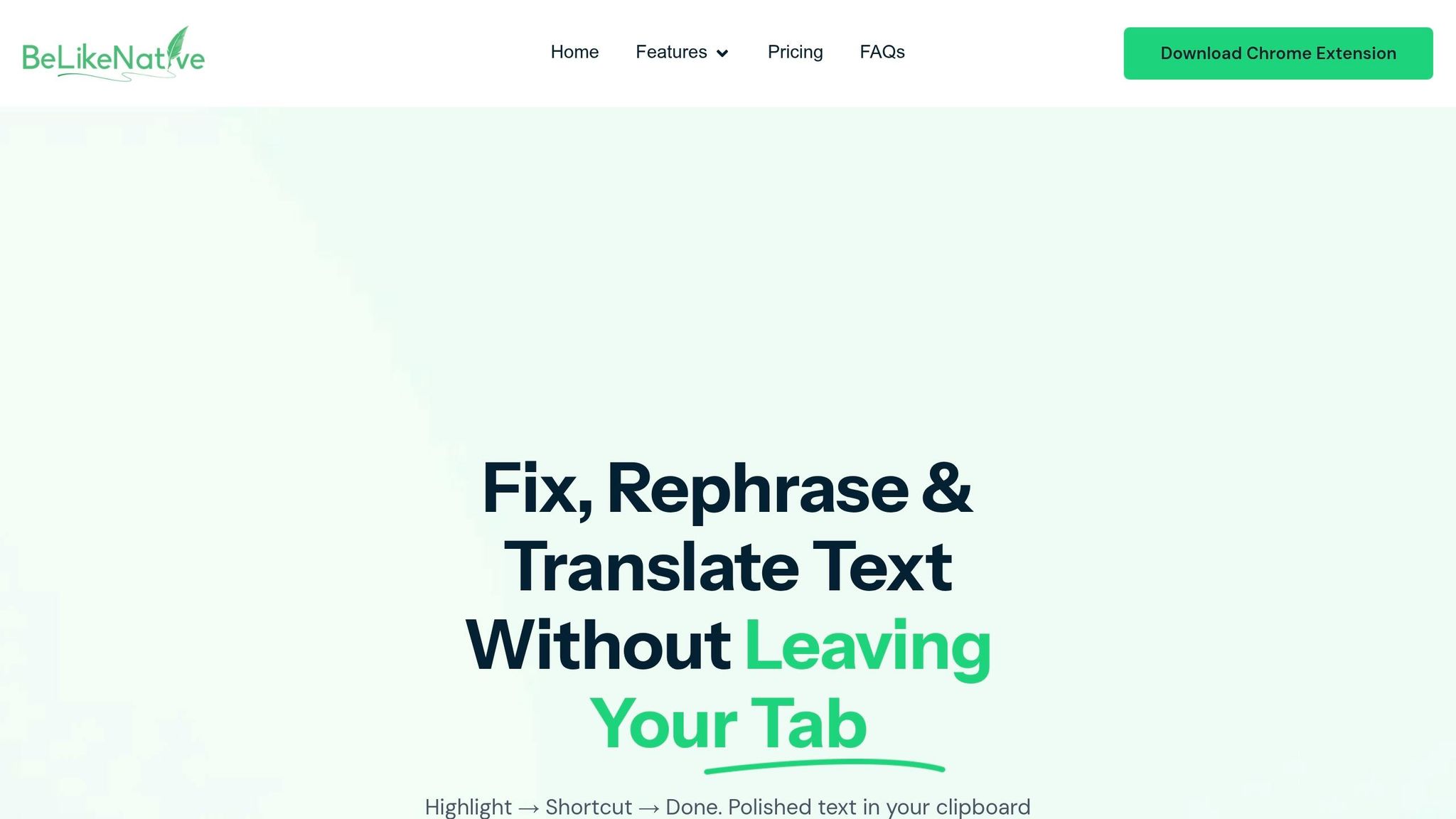
How BeLikeNative Makes Paraphrasing Easier
Paraphrasing effectively can be tricky, especially when originality is key. That’s where tools like BeLikeNative come in. This rephrasing tool helps restructure sentences without altering their meaning, making it ideal for academic writing that needs to pass plagiarism checks.
One of its standout features is its clipboard functionality. You can copy a quote, and the tool will rephrase it instantly – no need to switch between applications. This keeps you focused on your research while ensuring your content remains unique. The algorithm is designed to create reworded text with minimal similarity to the original, helping you sidestep issues flagged by systems like Turnitin.
Adjusting Language, Tone, and Style With BeLikeNative
Academic writing demands a formal tone, which can be hard to achieve when rephrasing content from informal or jargon-heavy sources. BeLikeNative allows you to tweak the language, tone, and style of your paraphrased text, ensuring it aligns with academic standards.
This feature is especially helpful when working with non-English sources or technical material. Supporting over 80 languages, the platform makes it easy to rephrase content while maintaining clarity and consistency in your research. These customization options ensure your paraphrased text integrates smoothly into your paper.
Adding BeLikeNative to Your Research Workflow
BeLikeNative’s clipboard shortcuts simplify the process, letting you activate its rephrasing function directly from your writing software. This makes it a practical tool for daily research.
The platform offers two affordable plans. The Learner plan, priced at $4/month, provides 25 uses per day with a 2,000-character limit. For larger projects, the Native plan offers 50 uses daily and a 4,000-character limit for $6/month. Both plans include editable features and customizable shortcuts, making it easy to tailor the tool to your workflow needs.
Conclusion: Main Points for Paraphrasing Without Plagiarism
Review of Paraphrasing Techniques
To paraphrase effectively, you need to fully understand the source material. A great strategy is the "set aside" method – read the content, internalize it, and then rewrite from memory. This helps avoid patchwriting, where chunks of the original text are reused without much change.
When rephrasing, focus on reworking the sentence structure and vocabulary entirely. Don’t just replace words with synonyms. Instead, consider altering the voice (e.g., active to passive), reordering sentences, or modifying parts of speech, like turning adjectives into adverbs.
After paraphrasing, always compare your version to the original to ensure it’s distinct. If you need to use unique phrases or technical terms, put them in quotation marks. Remember, direct quotes should make up no more than 10% of your work, emphasizing the importance of strong paraphrasing skills.
Combining these techniques with modern tools can take your writing to the next level.
How BeLikeNative Supports Your Academic Writing
BeLikeNative simplifies paraphrasing by providing instant rephrasing through clipboard shortcuts, so you don’t have to switch between apps while working. It also adjusts language, tone, and style to meet academic standards, making it especially useful for technical content or non-English sources across its 80+ supported languages.
The platform offers affordable plans tailored to different needs. The Learner plan costs $4/month and includes 25 daily uses with a 2,000-character limit. The Native plan, priced at $6/month, provides 50 daily uses and a 4,000-character limit. Both options come with customizable shortcuts that integrate seamlessly into your workflow, helping you save time while ensuring your paraphrased content is original and formatted for academic purposes.
FAQs
When should I paraphrase instead of quoting directly?
When the focus is on the author’s ideas rather than their exact wording, or if rephrasing enhances clarity and readability, paraphrasing is the way to go. It’s most effective when the original wording isn’t crucial or particularly distinctive. To paraphrase well, ensure you thoroughly understand the main ideas so you can restate them in your own words without altering their meaning.
How can I tell if my paraphrase is still too close to the original?
To determine if your paraphrase differs enough from the original, examine the wording and sentence structure carefully. Good paraphrasing involves expressing the same ideas in a fresh way, using your own language and tone. If your version feels too close to the source, rework it further to steer clear of accidental plagiarism and ensure it stands on its own.
Do I need to cite a source even if I paraphrase it completely?
Yes, you need to cite a source even if you completely paraphrase it. Paraphrasing means putting someone else’s ideas into your own words, but the original source still deserves credit. According to APA guidelines and academic standards, proper citation is essential for paraphrased material. This not only helps avoid plagiarism but also upholds ethical research practices and demonstrates respect for the original work.
Related Blog Posts
- How To Paraphrase In Apa Format With Step-by-step Examples
- How To Paraphrase And Reference In Apa Without Plagiarism
- Everything You Need To Know About Apa Paraphrasing And Citation
- How To Paraphrase Academic Papers Without Plagiarism
BeLikeNative fixes grammar, rephrases, translates, and simplifies text on any website in 1 second — just highlight and hit a keyboard shortcut. No tab switching. Try it free →