
How To Shorten An Abstract To Meet Word Count Limits
Want to make your abstract concise without losing its meaning? The key is focusing on clarity, cutting unnecessary words, and highlighting your main findings. Here’s how you can do it:
- Avoid excessive background details: Skip lengthy context or literature reviews – save those for the full paper.
- Streamline methods and results: Only include the essentials; leave out software versions or extra data.
- Use active voice: Replace passive constructions like "was conducted by" with "we conducted."
- Cut redundant phrases: Simplify wordy expressions (e.g., "in order to" becomes "to").
- Eliminate hedge words: Words like "seems" or "appears" dilute your message and add bulk.
Tools like BeLikeNative can simplify this process by identifying wordy sections and suggesting concise alternatives. Whether you’re working with a 150-word limit or 300, these strategies ensure your abstract is clear, impactful, and ready for submission.
Transform Any Text, On Any Site, In Seconds
Rephrase, translate, and improve text with one shortcut. Works everywhere you write.
Add to Chrome - It's Free!10 Tricks to Reduce Your Word Count in Academic Writing
sbb-itb-32359dc
Why Abstracts Go Over Word Limits
Abstracts often exceed word limits because authors include too much background information. Lengthy summaries of prior research or over-explaining established concepts, which belong in the introduction, end up taking over the abstract instead. This focus on "what’s already known" leaves less room to showcase actual findings.
Another common issue is including excessive detail about methods and results. Listing software versions, approval processes, or additional findings clutters the abstract and distracts from the main points. These specifics are better suited for the main body of the paper, where readers can explore them if needed.
Word limits are also inflated by repetitive and passive phrasing. Redundancies, such as unnecessary introductory clauses or passive constructions, add extra words. For instance, "Three-hundred and forty-five patients were enrolled" can be shortened to "We enrolled 345 patients". Writing in the active voice helps streamline sentences.
Using AI for professional writing can sometimes worsen the problem in drafts by producing repetitive phrases, excessive adjectives, and overly complex sentences. Even without AI, writers tend to repeat ideas or use wordy expressions like "estimated to be approximately" instead of simply "approximately."
Key Parts of an Abstract
The IMRaD structure – Introduction, Methods, Results, and Discussion – offers a clear framework for organizing abstracts. Each section has a specific role: the Introduction sets up the research question, Methods explain the approach, Results present the findings, and Discussion interprets their importance. Sticking to this structure ensures that critical details are prioritized.
IMRaD also helps prevent background information from overshadowing results. Readers are more interested in discoveries than in extensive context. Allocating more space to Results and Discussion, while keeping Introduction and Methods concise, helps balance the abstract and keeps it within the word count.
Finding Redundant Information
Once the abstract is structured, the next step is to cut out redundant language.
Start by identifying filler phrases that add no real value. Phrases like "it is widely accepted that", "it has been shown that", or "it should be noted that" are often unnecessary. Claire Bacon, an Advanced Professional Member of CIEP, points out that such phrases only inflate word counts without adding substance.
Look for repeated content where the same idea appears in multiple sentences or is implied by the title. Avoid redundant descriptors, such as using "the EMT process" when "EMT" alone is sufficient.
Here are a few examples of wordy phrases and their concise alternatives:
| Wordy Construction | Concise Alternative |
|---|---|
| In order to | To |
| Due to the fact that | Because |
| At this point in time | Now |
| Reached a peak | Peaked |
| The sequencing of the microbiome | Microbiome sequencing |
Simplifying these phrases can save space without losing clarity. Replace multi-word transitions with single words, cut hedge phrases like "seems to" or "appears to", and choose shorter alternatives like "conduct" instead of "carry out" or "examine" instead of "look at".
How to Shorten an Abstract
If your abstract feels too lengthy, it’s time to trim it down. The goal is to keep every sentence clear and focused while preserving the essence of your research.
Rewrite for Shorter Sentences
Switch to an active voice to make sentences more concise. For instance, instead of saying, "Pituitary cells were grown in dishes", say, "We grew pituitary cells in dishes." These small adjustments cut down on unnecessary words.
Replace lengthy phrases with stronger, single-word alternatives. For example, "measurements were made" becomes "measured", and "carry out" becomes "conduct." Here’s a quick reference table:
| Wordy Phrases | Concise Replacement |
|---|---|
| A comparison was performed | The groups were compared |
| The measurements were made | The soil was measured |
| carry out | conduct |
| look at | examine, analyze |
| talk about | discuss, explain |
Eliminate phrases like "there is" or "there are" by restructuring your sentences. For example, "There is a key that opens the lock" becomes "A key opens the lock." Similarly, phrases such as "It was found that" or "The results show that" can often be removed without losing meaning.
Condense Methods and Results
Once you’ve tightened your sentence structure, focus on simplifying descriptions of methods and results.
Keep methodology details brief unless the method is central to your research or particularly novel. Information like software versions or ethical approvals belongs in the full Methods section, not the abstract.
Group numerical data to save space. For example, instead of writing, "The value of A was 8.9 and B was 1.2", say, "Values for A (B) were 8.9 (1.2)."
Highlight only your main findings. As Wordvice emphasizes:
"The best abstracts include all essential information well before reaching word limit."
If a detail doesn’t contribute to understanding the significance of your research, it’s likely safe to cut.
Remove Hedging and Extra Explanations
To further refine your abstract, remove qualifiers and redundant explanations that weaken your statements.
Avoid hedging words like "seems", "appears", or "estimated to be approximately." These words dilute your message and add unnecessary length. Use either "estimated" or "approximately" – not both. Similarly, cut adverbs that are implied by the verb. For example, "slowly and carefully dissected" can simply be "dissected", as careful dissection is already implied.
Transition words like "moreover", "furthermore", or "additionally" are often unnecessary and can be removed without changing the meaning. As Wordvice HJ notes:
"Moreover can virtually always be removed from a sentence without altering the meaning."
Tools That Help Shorten Abstracts
When you’re up against a tight word count, having the right tools can save you hours of manual editing. Digital writing assistants can simplify the process by identifying overly wordy sections, using AI tools to shorten essays while suggesting concise alternatives, and ensuring the final version remains polished and natural.
BeLikeNative offers a standout option with its Free Essay Shortener tool, specifically designed for trimming academic and professional content. Simply paste your abstract into the editor, and the platform quickly reduces the word count while keeping the meaning intact. Its "humanize" feature is particularly useful, ensuring the tone remains professional and avoids the robotic feel that often comes with aggressive text shortening.
The platform is incredibly fast, processing text in about 1 second. This speed is a game-changer for those making multiple revisions to meet strict word limits. With a Chrome Extension, you can also edit directly in Google Docs, submission portals, or other online editors, making it even more convenient to refine your abstract efficiently.
BeLikeNative Features for Shortening Abstracts
BeLikeNative offers a range of features tailored to the challenges of condensing abstracts. Its rephrasing and grammar correction tools streamline the process by eliminating redundancies in seconds, catching issues that might slip through manual edits. With support for over 80 languages, it’s also a helpful resource for multilingual researchers.
The platform’s customizable settings let you control how much text is shortened and ensure the tone aligns with academic standards. Once your abstract is condensed, the humanize function smooths out any rough edges, so the final version sounds polished rather than overly simplified. Shortcut tools further speed up the process, allowing you to apply changes quickly without breaking your workflow.
BeLikeNative Pricing Plans
BeLikeNative’s pricing plans are designed to meet a variety of academic needs, offering flexibility for different levels of use.
| Plan | Price | Daily Uses | Character Limit | Best For |
|---|---|---|---|---|
| Explorer | $0/month | 5 | 500 | Testing the tool or shortening brief abstracts |
| Learner | $4/month | 25 | 2,000 | Graduate students working on multiple abstracts |
| Native | $6/month | 50 | 4,000 | Researchers submitting to several journals monthly |
| Premium | $14/month | 125 | 6,000 | Faculty or professionals managing high volumes of writing |
The Explorer plan is free but limited to 500 characters per use, making it best for short abstracts or testing the tool. At $4/month, the Learner plan increases the limit to 2,000 characters, accommodating most conference abstracts in one go. For longer journal abstracts or frequent revisions, the Native plan offers 4,000 characters per use and up to 50 daily attempts, making it ideal for researchers with heavy workloads. If you’re dealing with high volumes of academic writing, the Premium plan provides even greater flexibility with 6,000 characters and 125 daily uses.
8 Steps to Shorten Your Abstract
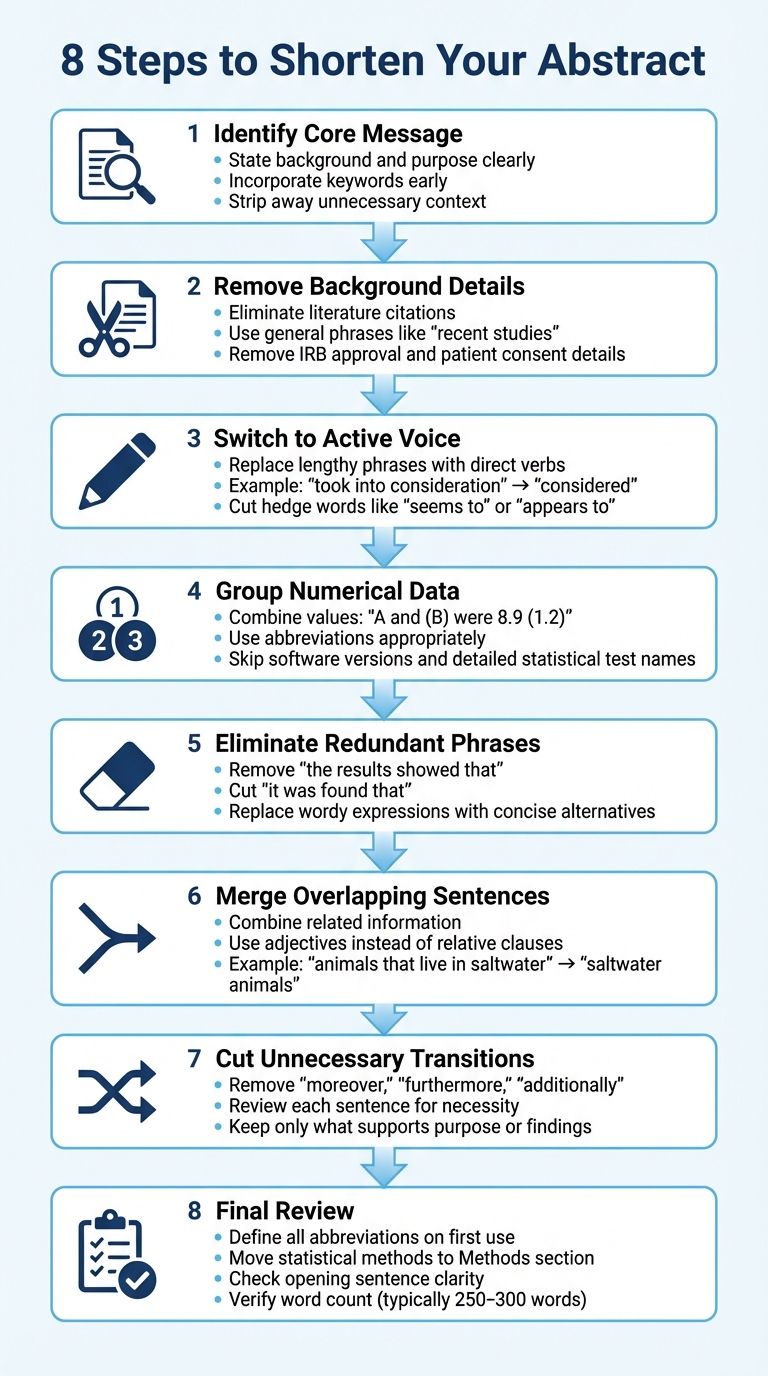
8-Step Process to Shorten Academic Abstracts Within Word Count Limits
Here’s how to keep your abstract concise while ensuring it remains engaging and meets word count limits.
Step-by-Step Reduction Process
Start by identifying your abstract’s core message – the essential purpose and conclusions your readers need. Your opening sentence should clearly state the background and purpose, incorporating keywords early on to boost discoverability. Once the main message is clear, strip away unnecessary context and citations (though you can use an AI Chrome extension for APA citations later for your full manuscript).
Remove background details and references to other studies. Abstracts don’t need literature citations or detailed context. If background is essential, use general phrases like "recent studies" rather than citing specific works. Avoid including details about IRB approval, patient consent, or supplemental results – these belong in the Methods section of your full manuscript.
Switch to active voice and cut unnecessary words. Replace lengthy phrases with direct verbs. For example, use "considered" instead of "took into consideration". Eliminate hedge words like "seems to" or "appears to" for a sharper, more concise tone.
Group numerical data and use abbreviations. Instead of writing out each value separately, combine them. For instance, say "The values of A and (B) were 8.9 (1.2)". Skip detailed descriptions of methods unless they’re novel and central to your study – readers don’t need software versions or exhaustive statistical test names in the abstract.
Eliminate redundant phrases. Phrases like "the results showed that" or "it was found that" can often be removed without losing meaning. Refer to concise alternatives to replace wordy expressions.
Merge overlapping sentences. If one sentence explains the tool used and another mentions magnification, combine them into a single, streamlined statement. Simplify relative clauses by using adjectives – for example, replace "animals that live in saltwater" with "saltwater animals."
Cut unnecessary transitions. Words like "moreover", "furthermore", and "additionally" often add bulk without adding value. Review each sentence carefully: if it doesn’t directly support your purpose or findings, it’s likely unnecessary.
Final Review Checklist
Once you’ve trimmed your abstract, review it for clarity and consistency.
- Define all abbreviations on first use and ensure no literature citations remain in the abstract.
- Move statistical methods and IRB approval details to the Methods section of your full manuscript.
- Check your opening sentence to ensure it clearly states the background and purpose, and verify active voice is used throughout.
- Align your abstract with the final numbers and findings in your manuscript. Any inconsistencies can raise concerns during peer review.
Finally, confirm your abstract meets the journal’s word count – most limits range from 250 to 300 words, though some descriptive abstracts may need to be as short as 100 to 200 words.
Conclusion
Meeting word count limits for an abstract doesn’t mean compromising its quality – it’s about honing in on the essential message. Concentrate on the key elements: the background, main purpose, and primary findings that convey the core of your work. Leave out extras like extensive literature citations or intricate statistical details; those belong in the full manuscript.
The methods discussed – using active voice, cutting hedge words, eliminating redundancies, and combining data points – help streamline your abstract while making it more impactful.
"Omit needless words."
This timeless advice from William Strunk, Jr. and E. B. White remains the foundation for crafting a clearer, more engaging abstract.
These techniques pair well with digital tools designed to improve writing efficiency. For instance, BeLikeNative simplifies this process by trimming unnecessary words, identifying passive voice, and suggesting concise alternatives in over 80 languages. Check the Tools section above for more on its features and pricing.
Keep in mind, word limits are a ceiling, not a goal. The most effective abstracts often stay well below the limit while still delivering all the critical points. Aim to make every word count, ensuring your research’s significance is immediately clear and inviting readers to explore further. Focus on what matters most, and you’ll create an abstract that both informs and engages.
FAQs
What should I cut first to meet a strict word limit?
To stick to a strict word limit, focus on trimming unnecessary details and repetitive phrases. Simplify long sentences, use concise verbs, and prioritize key points. Abbreviations can also help reduce word count without sacrificing clarity. This approach ensures the core message remains intact while meeting the limit.
How short can my methods section be without hurting clarity?
When writing your methods section, the key is clarity over length. You don’t need to aim for a specific word count – what matters is making sure your procedures are easy to follow and understand.
Here’s how to keep it concise:
- Use precise, straightforward language to describe your methods.
- Avoid unnecessary details or overly technical jargon unless absolutely required.
- If your methods are complex, consider including additional details in supplementary materials or referencing prior work.
In most cases, a paragraph or two is enough to explain your approach. Focus on providing enough information for others to understand and replicate your process without overwhelming them with excessive detail.
How do I shorten my abstract without losing key results?
To make your abstract shorter while retaining key results, aim for clear and concise language. Swap out wordy phrases for shorter alternatives (e.g., "The measurements were made" becomes "The measurements were taken"). Focus on the most critical findings, eliminate repetitive details, and limit the use of abbreviations or acronyms – defining them clearly when used. Simplify sentences to preserve the main message without losing essential information.
Related Blog Posts
- How to Shorten an Essay Without Losing Meaning – AI Hacks & Tools!
- 10 Tips for Concise Academic Writing
- Ai Tools To Shorten Essays Without Losing Meaning
- How To Shorten Essays Online Without Losing Meaning
BeLikeNative fixes grammar, rephrases, translates, and simplifies text on any website in 1 second — just highlight and hit a keyboard shortcut. No tab switching. Try it free →