
Simplify Complex Legal Text For Easier Reading
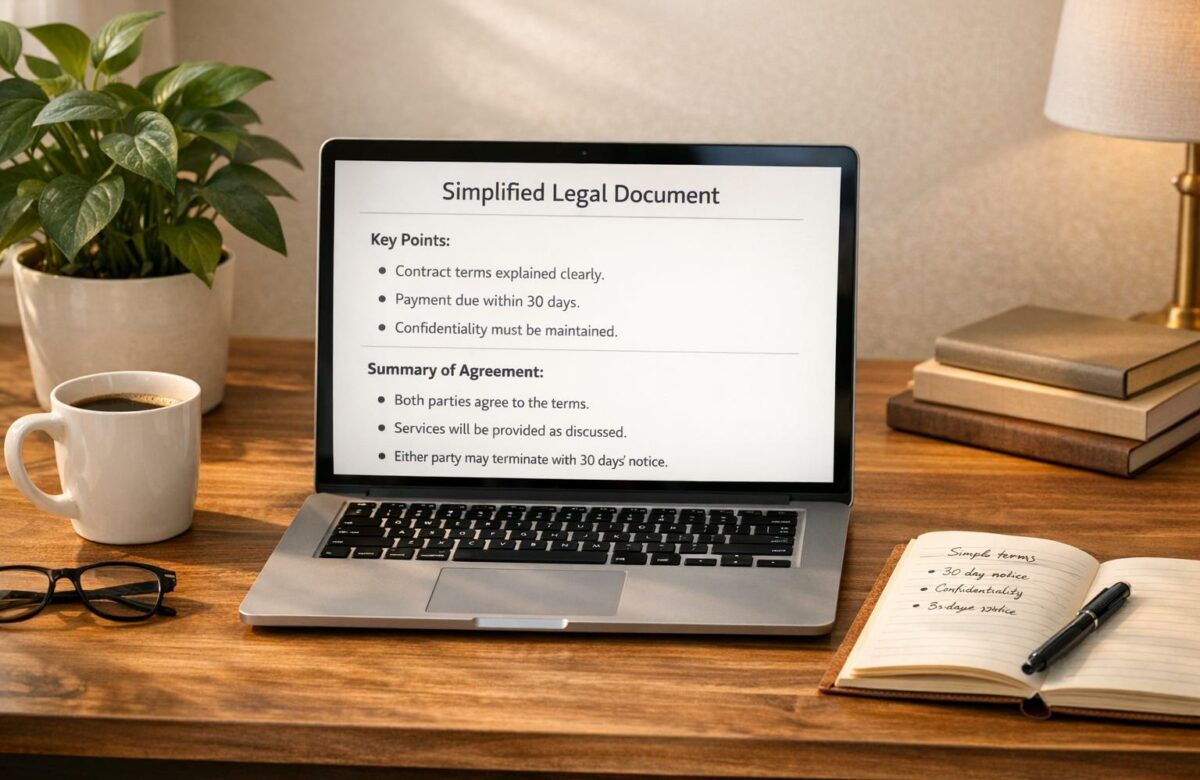
Legal documents are hard to read, but they don’t have to be. Complex terms, long sentences, and passive voice make legal text confusing. By simplifying language, breaking down sentences, and using clear formatting, you can make contracts, terms of service, and other legal documents easier to understand.
Key Takeaways:
- Replace legal jargon with plain words. For example, use "before" instead of "prior to" or "use" instead of "utilize."
- Stick to active voice for clarity. Example: "The tenant must sign the contract" is clearer than "The contract shall be signed by the tenant."
- Break long sentences into shorter ones and remove redundant phrases like "any and all" or "cease and desist."
- Use headings, bullet points, and tables to organize information for quick reading.
- Tools like BeLikeNative can automate simplifications, offering rephrased legal text in seconds.
Simplifying legal text empowers people to understand their rights and obligations, builds trust, and saves time. Whether you’re a lawyer, business owner, or everyday reader, clear legal writing benefits everyone.
Legal Jargon Made Simple
Replace Legal Jargon with Plain Language
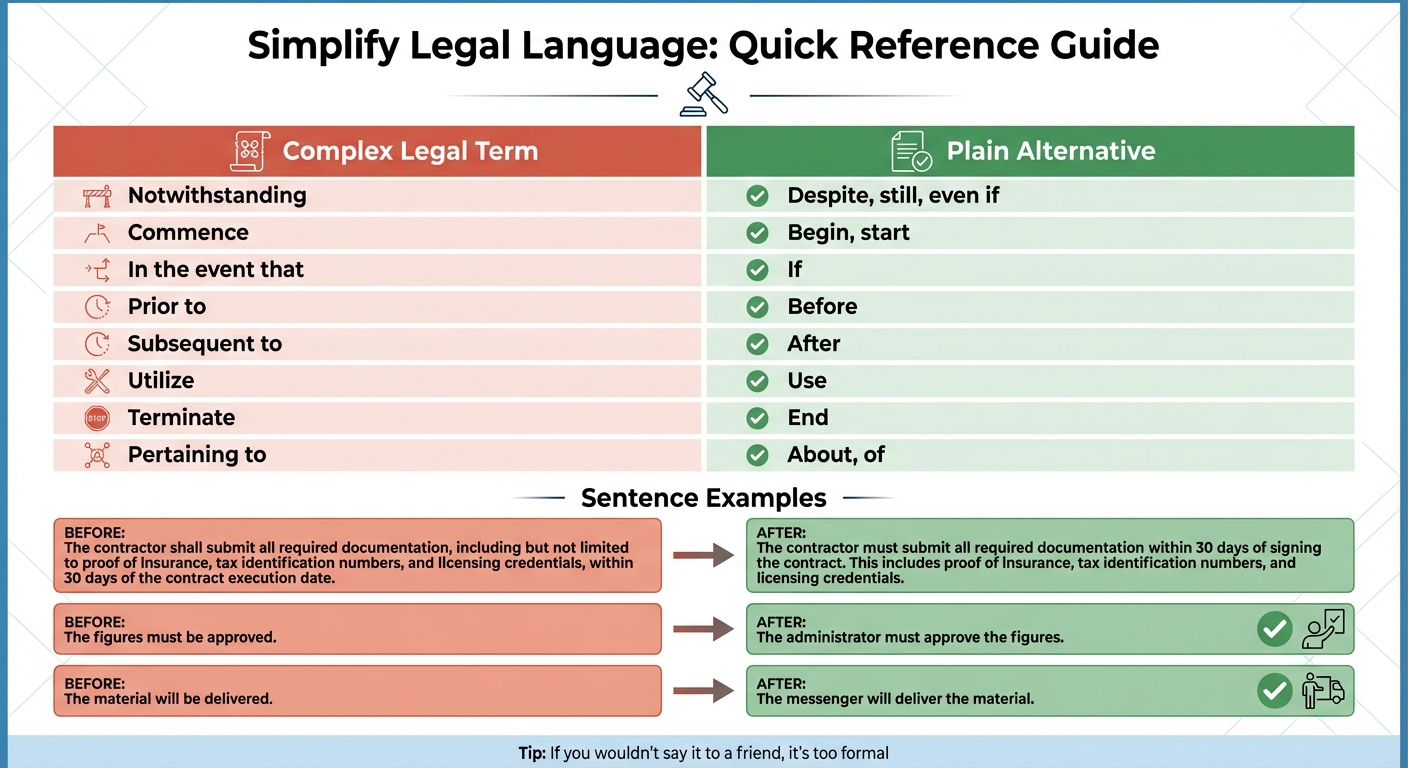
Legal Jargon vs Plain Language: Before and After Comparison
Legal documents often feel like they’re written in a foreign language, full of outdated terms and complex phrases. By swapping out this jargon for everyday words, you can make legal text much clearer without sacrificing accuracy. Start by identifying old-fashioned terms and replacing them with simpler alternatives.
Common Legal Terms and Simple Alternatives
Legal writing often includes clunky expressions like "here-" and "there-" terms – think hereinafter, heretofore, and herein. These words are rarely used in daily conversation and can easily be replaced. For example, instead of hereinafter, say "later in this document." Replace heretofore with "until now." Latin phrases like amicus curiae (friend of the court), de novo (anew), and ex parte (by one party only) can also confuse readers. Unless you’re writing specifically for legal professionals, explain these terms in plain English or leave them out altogether.
Another issue is nominalizations, where verbs are unnecessarily turned into nouns. For instance, legal writers might say "make payment" instead of the simpler "pay." Similarly, phrases like any and all or enclosed herewith are redundant and should be streamlined.
| Complex Legal Term | Plain Alternative |
|---|---|
| Notwithstanding | Despite, still, even if |
| Commence | Begin, start |
| In the event that | If |
| Prior to | Before |
| Subsequent to | After |
| Utilize | Use |
| Terminate | End |
| Pertaining to | About, of |
Once you’ve simplified the terms, focus on tailoring the language to fit your audience.
Use Context to Choose Simpler Words
Simplifying legal language doesn’t mean oversimplifying. It’s about striking the right balance – using words that are clear and precise for your audience, whether they’re small business owners, parents, or anyone else. A common misconception is that legal accuracy depends on complicated wording, but that’s not the case. As Judge Learned Hand wisely said:
The language of the law must not be foreign to the ears of those who are to obey it.
Context is also key to avoiding confusion. In legal writing, consistency is more important than variety. For example, if you refer to "vehicles" in a contract, don’t switch to "automobiles" or "transportation" later on – it could unintentionally alter the meaning. Stick with the term you initially chose, even if it feels repetitive. A good rule of thumb is the "talking" test: if you wouldn’t use a word when explaining something to a friend, it’s probably too formal for your document. For instance, would you naturally say "purchase", or would you just say "buy"? That’s your answer. These changes not only make legal writing more approachable but also ensure it’s accessible to all readers.
Break Down Long Sentences and Use Active Voice
Long, complicated sentences with multiple clauses can confuse readers and obscure the main point. The fix? Break them into shorter, clearer sentences and use active voice to clearly show who’s doing what. These simple steps improve readability and make your writing easier to follow.
Split Complex Sentences into Shorter Ones
Try to keep sentences between 15 and 20 words. Legal writing often ignores this, cramming 40, 50, or even 60 words into a single sentence. If a sentence requires a second read, it’s time to simplify. Stick to one idea or action per sentence. For instance, instead of writing:
"The contractor shall submit all required documentation, including but not limited to proof of insurance, tax identification numbers, and licensing credentials, within 30 days of the contract execution date,"
break it into:
"The contractor must submit all required documentation within 30 days of signing the contract. This includes proof of insurance, tax identification numbers, and licensing credentials."
Shorter sentences like these are easier to digest and keep the focus clear.
Remove Unnecessary Repetition
Legal writing is infamous for redundant phrases that add length without adding value. Word pairs like "any and all", "cease and desist", "full and complete", and "each and every" are prime examples. Choose one word – "any" works fine without "all", and "cease" already conveys the message.
Similarly, streamline compound prepositions. Replace "because of the fact that" with "because" or "since", and swap "for the period of" with just "for". These small changes make your writing more concise and easier to read.
Active vs. Passive Voice in Legal Writing
Active voice – where the subject performs the action (e.g., "The administrator must approve the figures") – is much clearer than passive voice (e.g., "The figures must be approved"). Passive voice often creates ambiguity, which is especially problematic in legal documents.
The National Archives and Records Administration puts it best:
"The active voice eliminates confusion by forcing you to name the actor in a sentence. This construction makes clear to the reader who is to perform the duty."
To identify passive voice, look for forms of "to be" (is, are, was, were, been) paired with a past participle (often ending in "-ed" or "-en"). Rewrite these sentences by naming the actor and placing them before the verb. For example, instead of saying, "The lake was polluted by the company", write, "The company polluted the lake." The active version is shorter, clearer, and directly assigns responsibility.
Here’s a quick comparison:
| Passive Voice (Unclear) | Active Voice (Clear) |
|---|---|
| The material will be delivered. | The messenger will deliver the material. |
| The start date is to be decided. | The contractor will decide the start date. |
| New regulations were proposed. | We proposed new regulations. |
Organize Content with Structure and Visual Aids
Even the clearest sentences can get lost in a sea of uninterrupted text. Legal documents, for instance, often stretch for pages without a single heading or visual cue, leaving readers to sift through the content to find what they need. By incorporating headings, lists, and tables, dense text can be reshaped into scannable, reader-friendly material. Once you’ve simplified the language, organizing it effectively with these tools makes it even more accessible.
Add Headings and Subheadings
Simplified language is just the start – clear, descriptive headings guide readers to the right sections quickly. Instead of vague labels like "Section 3" or "Terms", opt for specific titles such as "Payment Terms and Due Dates" or "Contractor Responsibilities." This creates a logical structure that shows how various sections connect.
Consistency is equally important. Use H1 for the main title, H2 for primary sections, and H3 for subsections. This hierarchy helps readers instantly grasp how the content is organized. Place key details at the beginning of each section to make the most important points easy to find.
Use Lists and Tables
When presenting multiple items, conditions, or requirements, lists are far more effective than a block of text. They break up the content and make essential points stand out. For instance, instead of writing, "The contractor must provide proof of insurance and tax identification numbers and licensing credentials", present it as a bulleted list:
The contractor must provide:
- Proof of insurance
- Tax identification numbers
- Licensing credentials
Make sure all items in a list follow the same grammatical structure. For example, if one starts with a verb, the others should too. Tables, on the other hand, are perfect for illustrating relationships, comparisons, or complex scenarios. They work especially well for "if/then" conditions or side-by-side comparisons.
Example Table: Original vs. Simplified Text
Tables can effectively show the difference between complicated and simplified text. Here’s an example:
| Original Legal Text | Simplified Version |
|---|---|
| When the process of freeing a vehicle that has been stuck results in ruts or holes, the operator will fill the rut or hole created by such activity before removing the vehicle from the immediate area. | If you make a hole while freeing a stuck vehicle, you must fill it before driving away. |
| If the location of the land is in a state other than the state in which the tribe’s reservation is located, the tribe’s justification of anticipated benefits from the acquisition will be subject to greater scrutiny. | If the land is in a different state than the tribe’s reservation, we will review the tribe’s justification more closely. |
| The Dietary Guidelines for Americans recommends a half hour or more of moderate physical activity on most days, preferably every day. The activity can include brisk walking, calisthenics, home care, gardening, moderate sports exercise, and dancing. | Do at least 30 minutes of exercise, like brisk walking, most days of the week. |
This side-by-side layout highlights the power of simplification and shows how clarity can make a big difference. By using headings, lists, and tables, you can turn dense, hard-to-read content into something that’s easy to navigate and understand.
sbb-itb-32359dc
Use BeLikeNative to Rephrase Legal Text
Once you’ve tackled manual simplifications, BeLikeNative steps in to automate the process, making legal language more accessible. This Chrome extension uses Natural Language Processing (NLP) to simplify complex legal text by identifying jargon-heavy clauses and rephrasing them into plain, everyday language. It transforms outdated legal terms into familiar words through lexical substitution and restructures long, convoluted sentences into shorter, more direct ones, each focusing on a single idea. The result? Legal text that’s easier to read and understand.
Install and Set Up BeLikeNative
You can install BeLikeNative directly from the Chrome Web Store. To ensure the rephrased text aligns with American legal standards, configure your preferences for US English. The extension integrates seamlessly with your clipboard: simply copy any legal text, press a shortcut, and receive a simplified version instantly. This streamlined setup allows you to rephrase legal text without leaving your workflow.
Features That Simplify Legal Writing
BeLikeNative is packed with features tailored for dense legal documents. It improves clarity by converting passive voice to active voice. For instance, “The contract shall be signed by the tenant” is rephrased as “The tenant must sign the contract.” The tool also clarifies obligations by replacing ambiguous terms like “shall” with “must” to ensure precision, adhering to US legal writing conventions.
You can even adjust the tone to suit your audience – whether you need formal language for court documents or a conversational style for client communications. With character limits ranging from 500 to 6,000, the tool works for everything from short clauses to lengthy contracts.
Pricing and Plans
BeLikeNative offers flexible pricing options to meet different needs:
| Plan | Price | Daily Uses | Character Limit | Best For |
|---|---|---|---|---|
| Explorer | $0/month | 5 | 500 | Testing the tool on short clauses |
| Learner | $4/month | 25 | 2,000 | Simplifying contract sections regularly |
| Native | $6/month | 50 | 4,000 | Handling multi-page legal documents daily |
| Premium | $14/month | 125 | 6,000 | High-volume legal work and added benefits |
Every plan includes support for over 80 languages, spelling and grammar correction, and data security. The Native and Premium tiers offer priority bandwidth and the ability to influence future updates – ideal for users with specific legal writing demands. Whether you’re working on short clauses or extensive documents, there’s a plan to suit your needs.
Edit, Proofread, and Test Readability
Simplifying legal text doesn’t stop once you’ve rephrased it. Every edit needs a thorough review to ensure legal precision isn’t compromised or ambiguity introduced. Striking the right balance between clarity and accuracy is essential. Even minor tweaks – like swapping “shall” for “must” or breaking up lengthy sentences – can unintentionally change the legal meaning if not carefully checked. The ultimate aim is to make the text more readable while keeping it legally sound.
Review Your Text for Clarity and Accuracy
Start by going through your simplified text with a step-by-step checklist. Focus on one aspect at a time: in one pass, ensure you’re using active voice; in another, check for consistent terminology. Be on the lookout for areas where too much detail might have been removed or where confusion might arise. For instance, make sure each requirement clearly states who is responsible for taking action.
Pay attention to clusters of nouns that can make sentences unnecessarily dense and hard to understand. Use prepositions to clarify how words relate to each other. Consistency is also key – stick to the same term throughout your document. As the National Archives and Records Administration advises:
Variation for the sake of variation has no place in regulation writing. Using a synonym rather than repeating the precise term you intend just confuses the reader.
So, if you refer to someone as a “tenant” in one section, don’t switch to “renter” later.
Make sure you’ve replaced “shall” with “must” for obligations, as “shall” can sometimes be misinterpreted as a prediction rather than a directive. Review lists carefully to ensure they follow parallel structure, with each item making sense when read alongside the introductory text. To gain a fresh perspective, try changing the font, printing the document, or using text-to-speech software to hear how it flows. After completing your internal review, seek external feedback to validate your edits.
Get Feedback from Non-Lawyers
Testing your simplified text with non-lawyers – like small business owners, tenants, or customers – can help confirm that the obligations and benefits are clear. This step is especially important because people naturally distrust what they can’t understand. Tari Dagogo-Jack, Assistant Professor of Marketing at the University of Georgia, highlights this point:
Consumers don’t trust what they don’t understand.
Non-lawyers can help identify areas where complex clauses remain confusing or where critical details might have been inadvertently removed. The 2010 Plain Writing Act even requires federal agencies to communicate in ways the public can understand, making this kind of testing legally necessary in some cases.
Revise Based on Feedback
Use the feedback you’ve gathered to make precise adjustments. If multiple people struggle with the same sentence, rewrite it. If a clause is consistently misinterpreted, add clarifying language or break it into shorter, more digestible parts. Look for recurring issues – perhaps readers need more connecting words like “but,” “although,” or “in addition” to follow the logic between legal ideas.
Remove vague modifiers like “might,” “maybe,” or “perhaps” that may have slipped in during the simplification process, as these can undermine the text’s authority. After revising, test the document again with a fresh group of readers to ensure the changes resolved the issues. Keep in mind that simplifying legal text can sometimes expose harsh terms that were previously buried in jargon. Be transparent about what the document actually requires. The goal isn’t to sugarcoat unfavorable terms – it’s to make all obligations clear and easy to understand.
Conclusion
Making legal text easier to understand starts with replacing complicated jargon and using straightforward language. For instance, swapping phrases like "notwithstanding the fact that" with "although" or using "must" instead of "shall" can make obligations much clearer. These small changes go a long way in simplifying legal responsibilities.
After simplifying the language, organizing the content visually can further enhance clarity. Tools like headings, bullet points, and tables break down dense material, making it easier for readers to find specific details and understand the structure of the document. When paired with plain language, this method turns complex legal documents into user-friendly resources.
BeLikeNative offers a seamless way to improve legal writing. It provides rephrasing, tone adjustments, and clarity improvements in over 80 languages – all accessible via a quick clipboard shortcut. Whether you’re working on contracts, compliance documents, or regulatory texts, the tool helps refine complex sentences without compromising legal accuracy. With flexible pricing options, including a free basic plan and advanced features for just $6/month, it’s a practical choice for anyone involved in legal writing.
The ultimate goal is not to remove technical terms or obscure critical clauses but to ensure every obligation, benefit, and requirement is clear and transparent. As Plainlanguage.gov explains:
Plain language – content that is clear and easy to understand – is critical to helping the public to make sense of their obligations and benefits.
FAQs
Why is simplifying legal text important for building trust and understanding?
Simplifying legal text is a powerful way to build trust. It shows that a company or organization values openness and respects the reader’s ability to understand critical information. When contracts, policies, or disclosures are written in plain language, people can quickly understand their rights and responsibilities without getting bogged down by complex legal terms.
Using clear and straightforward language not only minimizes confusion but also reduces the chances of misinterpretation. This makes it easier for readers to engage with the content confidently. By prioritizing clarity – through active voice, shorter sentences, and avoiding unnecessary technical jargon – organizations show accountability and strengthen their connection with their audience.
What are some common legal terms that can be simplified for easier understanding?
Many legal terms can be swapped out for simpler, everyday words to make documents easier to understand. For instance, “ab initio” can be rewritten as “from the beginning”, “hereinafter” can be changed to “later in this document”, and “indemnify” can be expressed as “compensate for loss or damage”. Likewise, “prima facie” works better as “at first glance”, and “abatement” can simply mean “stopping or reducing something”.
Even commonly used words in legal writing can benefit from simplification. For example, say “buy” instead of “purchase”, “help” rather than “assist”, and “about” in place of “approximately”. These small adjustments can go a long way in making legal texts more approachable, especially for those without a legal background.
How does BeLikeNative help simplify complex legal text?
BeLikeNative takes the headache out of deciphering legal documents by translating dense, jargon-filled text into plain, straightforward language. Its goal is to strip away the legalese, rephrase for better clarity, and make legal content accessible to anyone – no law degree required.
By leveraging advanced language tools and techniques, BeLikeNative improves readability while staying true to the original meaning and intent of the document. This ensures that even those without a legal background can confidently understand complex legal materials.