How To Write A Cover Letter That Sounds Like A Native Speaker
Want your cover letter to stand out? Here’s the key: Write in a natural, professional tone that aligns with U.S. workplace standards. A well-crafted cover letter can boost your chances of landing an interview, but common mistakes – like overly formal language or awkward phrasing – can hurt your application.
What you’ll learn:
- Follow the standard U.S. cover letter format (header, intro, body, closing, signature).
- Use clear, direct language that avoids excessive formality.
- Highlight your skills with action verbs and measurable results.
- Tailor your letter to each job by referencing the company’s needs.
- Avoid common errors like tense inconsistencies and indirect phrasing.
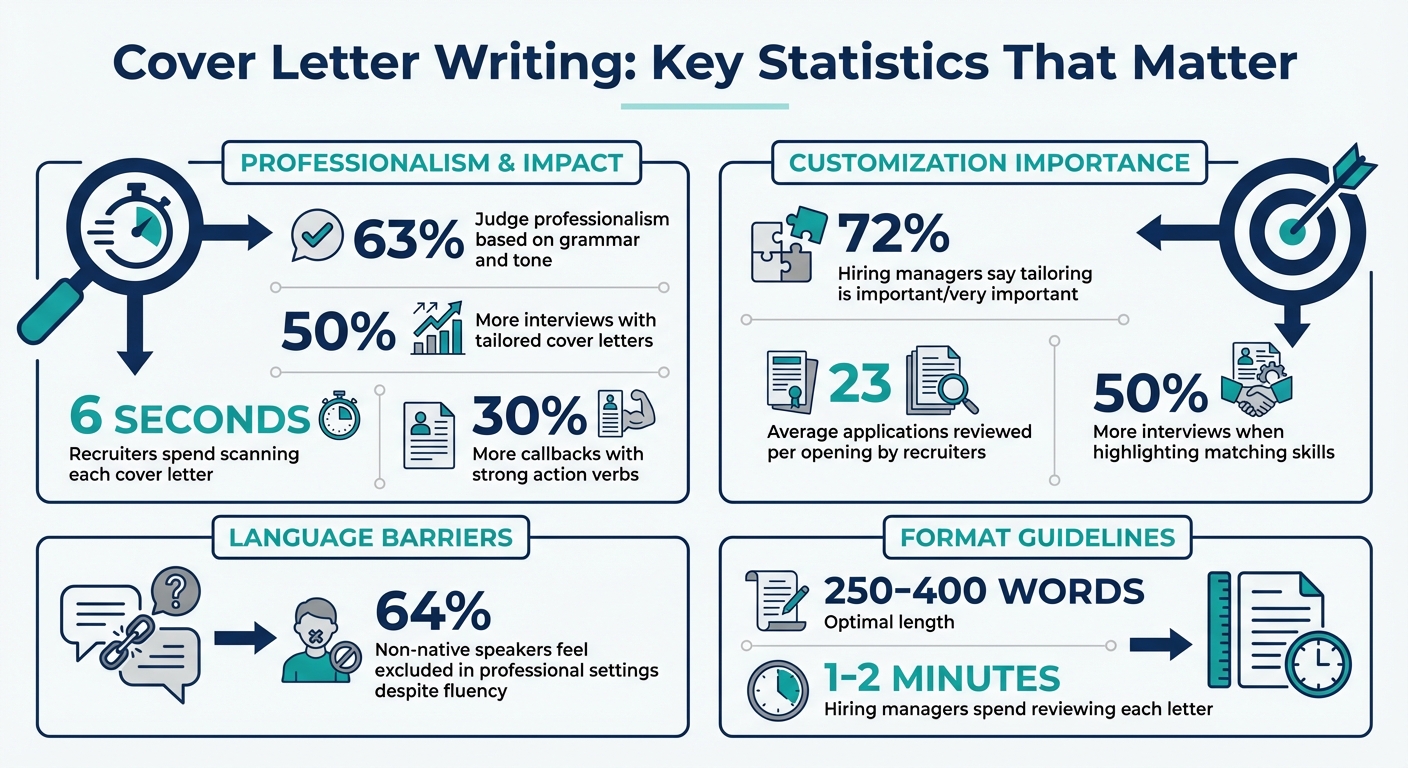
Why it matters: 63% of hiring managers judge professionalism based on grammar and tone, and tailored cover letters get 50% more interviews. By focusing on clarity, confidence, and personalization, you can make a strong impression.
Here’s how to write a cover letter that feels polished, natural, and ready for U.S. employers.
Cover Letter Writing Statistics and Impact Data for Job Seekers
This Cover Letter Formula Actually Gets Interviews
sbb-itb-32359dc
Follow the Standard US Cover Letter Format
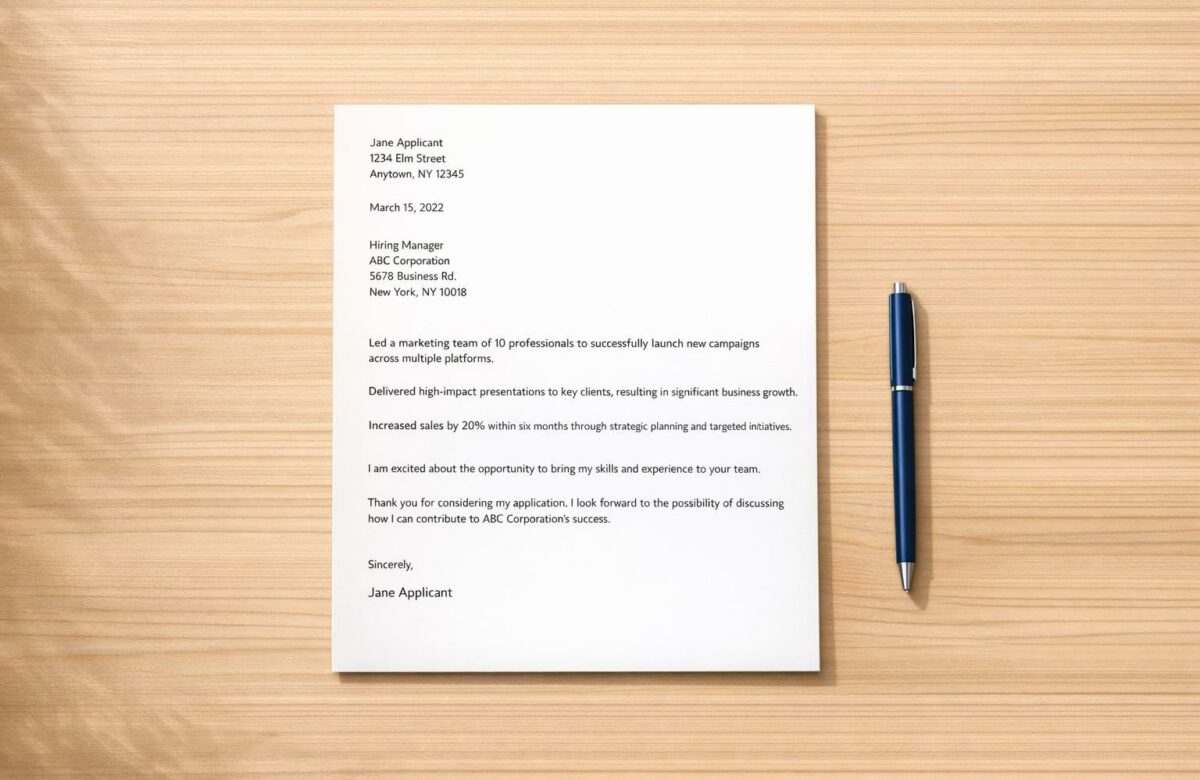
When writing a US cover letter, it’s important to stick to the format hiring managers are accustomed to. Aim for a length of 250–400 words, divided into three or four concise paragraphs. Use block formatting with 1-inch margins, a professional font like Times New Roman or Arial (10–12 pt), and align the text to the left.
The format generally includes six key parts: header, salutation, introduction, body paragraphs, closing paragraph, and signature. Keep paragraphs single-spaced, but leave a double space between sections to make it easy to read. Following these conventions ensures your cover letter looks polished and professional.
Opening and Introduction
At the top left, include your contact details (name, address, phone number, email), followed by the date and the recipient’s name, title, company, and address. For emails, skip the header and place your contact information in your signature instead.
Address the recipient with "Dear [Honorific] [Last Name]", if you know their name. If not, "Dear Hiring Manager", is a safe option. A bit of research – like checking the company’s website or LinkedIn – can help you find the hiring manager’s name, showing you’ve put in extra effort. In your opening paragraph, mention the specific job you’re applying for, where you found the listing, and why you’re a good fit.
Body Paragraphs: Skills and Experience
Use the body of your cover letter to connect your skills and accomplishments to the role. As Ben W, an English Language Consultant, puts it:
"Your cover letter should be a balance of who you are as a professional, what you can offer for the job you’re applying to, and what your interest in the company is".
Highlight two or three of your most relevant achievements instead of summarizing your entire career. Use action verbs like "Developed", "Managed", or "Executed" to convey a proactive tone. Whenever possible, include measurable results – for instance, "increased customer retention by 12%" or "completed the project $150,000 under budget". To make your letter ATS-friendly, incorporate keywords from the job description and cut any unnecessary filler words. Wrap up this section with a clear call to action, encouraging the reader to take the next step.
Closing and Signature
End your cover letter by reaffirming your enthusiasm for the role, referencing your attached resume, and requesting an interview. Thank the reader for their time and consideration. Use a professional closing like "Sincerely", followed by three blank lines for a handwritten signature (or one line for digital submissions) and your typed full name. If the header was omitted, include your contact details below your name to ensure they’re easy to find.
Use Natural Language and Professional Tone
For non-native English speakers, crafting natural-sounding sentences can be trickier than achieving perfect grammar. Often, writers think in their native language, then translate into English, which results in stiff, overly formal phrasing that stands out to hiring managers. In the U.S., business communication values directness, brevity, and an approachable tone over excessive formality. The goal is to write as if you’re having a professional conversation, not presenting an academic thesis.
One frequent misstep is being overly polite. For instance, saying, "I would be very grateful if you could consider my application" may sound hesitant or overly formal to an American audience. A more natural alternative would be, "I’m confident my skills in project management make me an ideal candidate for this role".
Interestingly, 63% of readers assess a candidate’s professionalism based on grammar and tone. Even small adjustments can make a big difference. For example, "I was responsible for managing a team" sounds less assertive than "I managed a team of eight engineers." The latter conveys confidence and clarity.
Before submitting your letter, read it out loud. If a sentence feels awkward or unnatural when spoken, it likely sounds the same to a native speaker. Pay attention to the tone used by the company on their website or social media. A tech startup might prefer a casual, energetic style, while a law firm would expect something more formal. Regardless of the tone, clarity should remain your top priority.
To further enhance your writing, focus on using dynamic verbs and including specific numbers to emphasize your achievements.
Use Action Verbs and Specific Numbers
Action verbs can transform bland statements into engaging, achievement-focused descriptions. Instead of writing, "I helped with sales", try, "I increased quarterly sales by 18% through targeted client outreach." Career Coach Lisa Monroe explains:
"A well-chosen verb can turn a bland bullet into a story of achievement".
In fact, resumes and cover letters that use strong action verbs receive up to 30% more callbacks than those that rely on weaker language.
A simple, effective formula to follow is: Action Verb + Quantifiable Result + Context. For example, "Streamlined data entry processes, cutting preparation time by 40%" paints a clear picture of your impact. Replace phrases like "responsible for" or "duties included" with verbs like "spearheaded", "optimized", or "negotiated." These words demonstrate leadership and initiative.
Adding numbers makes your accomplishments more concrete and memorable. Compare "improved customer satisfaction" to "increased customer retention by 25%." With recruiters spending an average of 6 seconds scanning each cover letter, quantifiable results help your achievements stand out immediately.
| Powerful Verb | Weak Counterpart | Impact |
|---|---|---|
| Accelerated | Helped | Shows timely initiative |
| Spearheaded | Was part of | Highlights leadership |
| Optimized | Made better | Implies measurable improvement |
| Negotiated | Talked to | Demonstrates strategic influence |
| Generated | Did | Quantifies output |
While using strong verbs is crucial, avoiding common language pitfalls ensures your tone remains natural and professional.
Avoid Common Non-Native Speaker Mistakes
Non-native speakers often find it harder to adapt to tone and style than grammar rules. In some cultures, indirectness is a sign of respect, but U.S. business communication tends to favor straightforwardness. For example, "I am writing to follow up regarding…" sounds formal and outdated compared to "I wanted to check in on…". Both are grammatically correct, but the latter feels more natural to native speakers.
Watch out for tense errors. Instead of "the proposal that you had sent to me", a native speaker might say, "the proposal you sent" or "I’ve reviewed the proposal". Similarly, "I am having one question" should be "I did have one question" or "I have a quick question". These subtle adjustments make your writing feel fluent and polished.
Avoid excessive apologies or overly cautious language. Saying, "I am very, very sorry for this mistake" can undermine your professionalism. Instead, briefly acknowledge the issue and focus on the solution: "I apologize for the delay. I’ve adjusted our process to ensure faster turnaround times."
Here are a few examples of common phrasing mistakes and their polished alternatives:
| Non-Native Phrasing | Native Alternative | Why It Works |
|---|---|---|
| "I think I am a good fit." | "I am confident my skills in X make me an ideal candidate." | Projects certainty and professionalism |
| "I would appreciate very much if you could share your thoughts." | "I’d love to hear your thoughts." | Feels more conversational and approachable |
| "Helped the team with…" | "Collaborated with the team to…" | Emphasizes active participation |
These adjustments can make a world of difference. For non-native English speakers, the challenge often lies in tone and phrasing rather than vocabulary. In fact, 64% of non-native speakers feel excluded in professional settings due to language barriers, even when they are technically fluent. The key is to write with precision, cultural awareness, and confidence. By composing directly in English rather than translating, your cover letter will sound natural, polished, and professional.
Customize Your Letter for Each Job
A one-size-fits-all cover letter is easy to spot – and just as easy to ignore. In fact, 72% of hiring managers say it’s "important" or "very important" for applicants to tailor their cover letters to the specific job description. Even more compelling, applicants who customize their cover letters to highlight how their skills match the job requirements land 50% more interviews than those who send generic letters. With recruiters reviewing an average of 23 applications per opening and spending just 6 seconds per cover letter, making your letter immediately relevant is crucial.
When you customize your letter, you’re showing the employer that you understand their unique needs. Think of the job requirements as challenges your skills can solve. This turns your cover letter into more than a list of qualifications – it becomes a direct pitch answering the employer’s question: "Why are you the perfect fit for this role at our company?" This approach not only highlights your compatibility with the job but also demonstrates the awareness of workplace expectations valued in the U.S.
Research the Company and Position
Start by breaking down the job description. Look for keywords that pop up repeatedly. For instance, if "data-driven" appears multiple times, it’s a clear signal to incorporate that term naturally when describing your skills. Words like "collaborative" or "proactive" should also find their way into your letter if they align with your experience.
But don’t stop at the job post. Dive deeper into the company’s "About Us" page to understand their mission and values. Scroll through their social media or recent press releases for updates on projects, awards, or milestones. If possible, find out the hiring manager’s name through LinkedIn or the company website – it’s a small detail that makes a big impression.
Instead of opening with a generic line like "I am writing to apply for the open position", lead with something specific to the company. For example: "I was excited to see GreenTech’s recent recognition for innovation in renewable energy solutions." This kind of detail immediately sets your letter apart and shows you’ve done your homework. From there, connect your achievements to the company’s goals. If they’re expanding into new markets, mention your experience: "I spearheaded a market expansion initiative that increased regional sales by 32% in under a year."
Match US Workplace Expectations
Once you’ve tailored your content, make sure your letter meets U.S. professional norms. Employers here value brevity, directness, and a focus on individual contributions. Shift the focus from what you hope to gain to what you can offer. For instance, instead of saying, "This position would help me grow my leadership skills", write, "My experience managing cross-functional teams of 12 aligns with your need for a project coordinator."
In the U.S., individual accomplishments carry more weight than group efforts. Use "I" rather than "we" to highlight your personal impact. For example, "I implemented a feedback system that reduced customer complaints by 40%" is far more compelling than "We improved customer satisfaction." This doesn’t mean downplaying teamwork – it’s about clearly showcasing your unique contributions.
Show enthusiasm, but keep it professional. Demonstrate genuine excitement for the company’s mission while maintaining a confident tone. Match their communication style by studying their website or social media. A tech startup might appreciate energetic language like, "I’m eager to bring my automation expertise to your innovative team", while a financial firm might expect something more formal: "My background in risk analysis positions me to support your compliance initiatives effectively." No matter the tone, end with a clear next step: "I’d love the opportunity to discuss how my experience aligns with your goals", instead of a passive "I hope to hear from you."
Edit and Improve Your Cover Letter
Careful editing is the final touch that ensures your cover letter leaves a lasting impression. Even the best content can fall flat if it’s riddled with errors or awkward phrasing. In fact, 63% of readers evaluate professionalism based on grammar and tone, even when the overall message is strong. Small mistakes can overshadow your achievements, so it’s worth taking the extra time to refine.
Think of your first draft as a starting point. If you used AI to generate a basic outline, make sure to personalize it – especially the opening and closing paragraphs – to reflect your voice. Swap out vague statements for concrete examples, like specific projects you’ve led, challenges you’ve overcome, or measurable results you’ve achieved. If a sentence doesn’t sound natural when read aloud, rewrite it. Once you’ve improved the flow and clarity, use specialized tools to polish your language further.
Use BeLikeNative for Grammar and Clarity
BeLikeNative is a powerful tool designed for non-native English speakers, helping bridge the gap between translated text and fluent, natural English. Supporting over 80 languages, it goes beyond basic spellcheck by addressing common challenges like preposition usage, verb tense consistency, and article placement.
One standout feature is its rephrasing tool, which transforms overly formal or passive sentences into more confident, impactful ones. For instance, instead of writing, “I am writing to you because I think I would be a good fit,” you could say, “I’d like to explore how my experience aligns with your needs”. This small tweak makes your tone assertive and professional – qualities that resonate with U.S. employers. The platform also helps tone down over-apologizing or excessive formality, which can unintentionally weaken your message.
Get Feedback and Do Final Checks
Once you’ve refined your letter using tools, it’s time for human feedback and a final review. Have a native English speaker look over your cover letter. While software can catch many issues, a human reader can identify subtle tone or phrasing nuances that might go unnoticed.
Double-check that your header follows U.S. standards (e.g., February 17, 2026) and that formatting details are correct. If you reference measurements, convert them to U.S. units like inches, feet, or pounds instead of metric units. Close your letter with a professional sign-off such as “Sincerely,” “Best,” or “Regards”. Finally, scan your letter for overused buzzwords or repetitive phrasing that might dilute its impact. Aim for a concise length of 250 to 400 words, structured into three to four clear paragraphs.
Conclusion
Writing a cover letter that feels natural and engaging comes down to three key elements: structure, language, and personalization. Start strong with an attention-grabbing opening, use the body to highlight specific skills with concrete examples, and end with a clear call to action and a thoughtful sign-off. Since hiring managers typically spend just one to two minutes reviewing each letter, every word needs to pull its weight.
The way you phrase things matters. Use contractions, vary your sentence length, and include measurable achievements to back up your claims. As Jacob Jacquet, Founder and CEO of Rezi, explains:
"The goal isn’t to hide that you used AI. The goal is to make the letter feel like a real person wrote it for this exact role".
Tailoring your letter shows effort and interest. Address the hiring manager by name, and connect your accomplishments to the company’s goals. These details help your letter resonate with U.S.-based employers and demonstrate that you’ve done your research.
To refine your writing, leverage tools designed for non-native speakers. BeLikeNative, for example, supports over 80 languages and helps adjust grammar, prepositions, and tone to project confidence and professionalism. It’s especially helpful for replacing overly formal language with a more natural, assertive style. For the best results, pair such tools with feedback from a native speaker.
Aim for a concise letter of 250 to 400 words, spread across three to four paragraphs. A well-written, personalized cover letter is your chance to make a strong impression – focus on clarity, relevance, and a tone that feels authentic to stand out from the crowd.
FAQs
Should I write a cover letter if it’s optional?
Yes, writing a cover letter is worth the effort – even if it’s listed as optional. It’s your chance to highlight your qualifications, convey genuine enthusiasm for the role, and make a lasting impression on potential employers. This extra effort can help you stand out from other applicants.
How do I quantify achievements if I don’t have metrics?
If you don’t have precise metrics to back up your achievements, focus on describing them in terms of their impact, the skills you used, or the positive results they brought about. Use phrases that convey context and significance, like "improved efficiency," "enhanced customer satisfaction," or "streamlined processes." By emphasizing your specific contributions and the outcomes they led to, you can demonstrate your value effectively – even without exact figures.
How do I make AI-written text sound like me?
To make AI-generated text feel more like your own, think of the AI’s output as a starting point, not the final product. Rewrite the main parts in your usual voice, using the words and expressions you naturally gravitate toward. Sprinkle in personal touches – like your experiences, anecdotes, or what drives you – to make it feel more genuine. Also, trim out anything that sounds too stiff or generic, and tweak the tone and phrasing so it reflects your personality and style.