How To Write A Grant Proposal With Better Vocabulary
When it comes to grant writing, the words you choose can make or break your proposal. Strong, precise language builds trust, demonstrates professionalism, and increases your chances of securing funding. Here’s a quick summary of how to improve your grant proposal vocabulary:
- Use strong action verbs: Replace weak phrases like "try to help" with "mentor" or "empower."
- Avoid vague terms: Instead of "improve outcomes", specify measurable goals like "increase reading proficiency by 20%."
- Cut filler words: Eliminate unnecessary words like "very" or "basically" to make your writing concise.
- Be confident: Replace hedging language like "we hope to" with assertive statements like "we will."
- Leverage tools: Use writing tools like BeLikeNative to refine tone, remove redundant phrases, and enhance clarity.
Grant reviewers often spend less than a minute on proposals, so every word counts. By focusing on clarity, precision, and measurable outcomes, you can craft proposals that resonate with funders and stand out in competitive environments.
How to Choose Better Words for Grant Writing
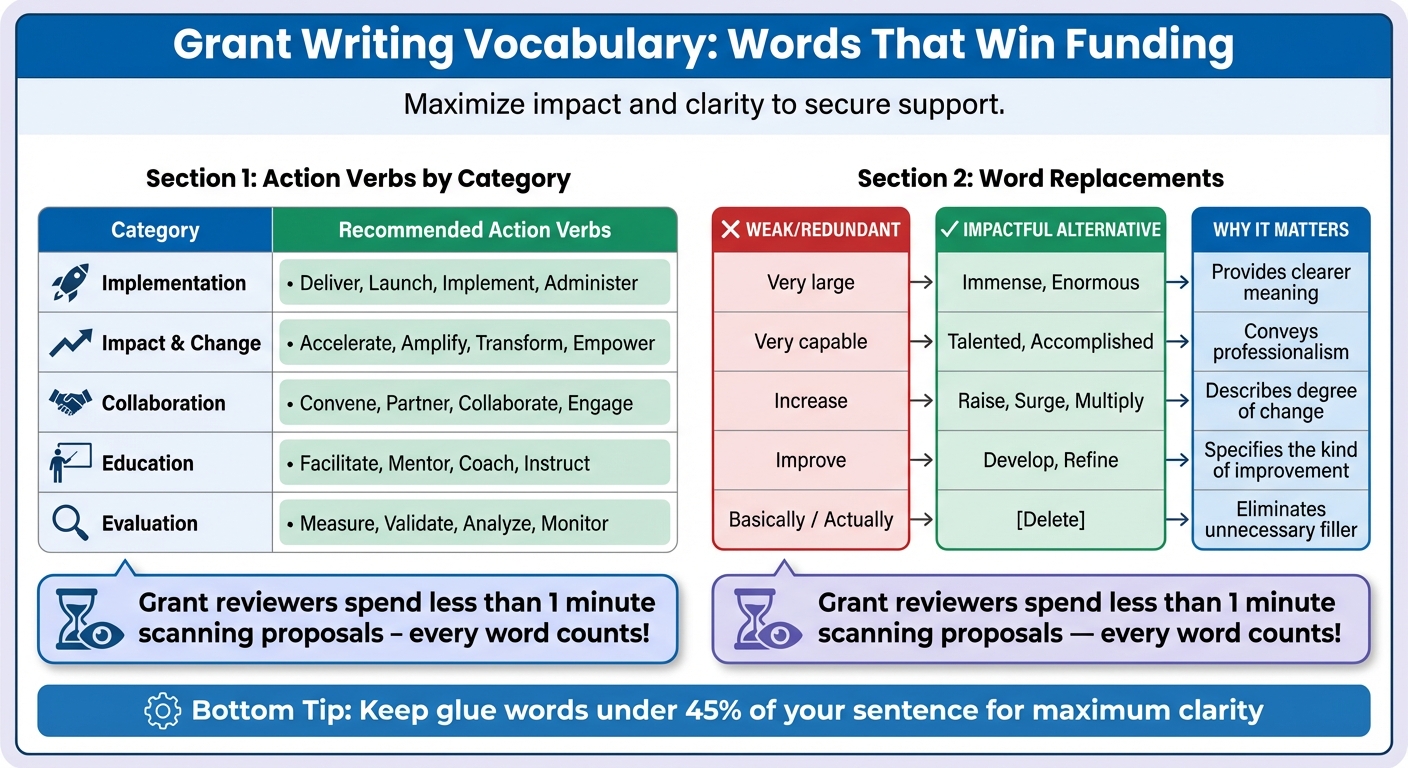
Grant Writing Vocabulary Guide: Weak vs Strong Words
The words you choose in grant writing reveal how well you’ve prepared and planned your project. Clear, active language shows reviewers exactly what you aim to achieve and how you’ll measure success. On the other hand, vague phrases like "we hope to improve outcomes" can leave room for doubt. Precise statements, such as outlining specific metrics, demonstrate a clear path forward. This precision lays the groundwork for using strong verbs and cutting unnecessary filler in your proposal.
A strong vocabulary can be the difference between securing funding and falling short. Libby Hikind, CEO of GrantWriterTeam, raised over $11 million for a single Brooklyn school district by using powerful, emotionally resonant language that connected with funders.
"Verbs energize. They add action, vigor, clarity, meaning, and imagery to your writing. These features ignite emotions, such as curiosity and excitement, that engage readers." – Crystal Herron, PhD, ELS(D), CMPP
Your word choices also reflect your credibility. Avoid unsupported claims like "world-class" or "uniquely qualified" unless you can back them up with evidence, such as awards or testimonials. Reviewers often spend less than a minute scanning proposals, so every word needs to pull its weight in communicating your value.
Using Strong Action Verbs
Dynamic verbs can turn clear plans into decisive actions. For example, instead of saying, "we will try to help students", write, "we will mentor 50 students." This not only clarifies your intent but also shows measurable results. Similarly, replace passive phrasing like "cell proliferation is inhibited by" with "inhibits cell proliferation" for more concise and engaging language.
Some verbs resonate more with funders than others. For example, "empower" carries more weight than generic terms like "help". When describing your work, swap overused verbs like "assess" or "evaluate" for more precise choices such as "define", "identify", or "calculate".
| Category | Recommended Action Verbs |
|---|---|
| Implementation | Deliver, Launch, Implement, Administer |
| Impact & Change | Accelerate, Amplify, Transform, Empower |
| Collaboration | Convene, Partner, Collaborate, Engage |
| Education | Facilitate, Mentor, Coach, Instruct |
| Evaluation | Measure, Validate, Analyze, Monitor |
To eliminate ambiguity, use definitive language. Replace weak words like "try", "attempt", or "might" with firm statements such as "we will." Words like "hope" or "aim" can suggest uncertainty, which may undermine confidence in your planning.
"Strong verbs add clarity and energy to your aims that spark your reviewer’s curiosity and fuel their excitement." – Crystal Herron, PhD
Once you’ve strengthened your verbs, refine your writing further by cutting weak or redundant phrases.
Removing Weak and Redundant Words
Filler words take up space without adding value. Take "very", for instance – it’s often unnecessary. Instead of "very large", use "immense." Replace "very strong" with "robust" or "powerful". As George Orwell once said, "If it is possible to cut a word out, always cut it out".
Words like "increase" and "improve" are too vague unless paired with baseline data. Without that context, opt for more descriptive terms like "expand", "refine", "maximize", or "multiply".
| Weak/Redundant Word | Impactful Alternative | Why It Matters |
|---|---|---|
| Very large | Immense, Enormous | Provides clearer meaning |
| Very capable | Talented, Accomplished | Conveys professionalism |
| Increase | Raise, Surge, Multiply | Describes the degree of change |
| Improve | Develop, Refine | Specifies the kind of improvement |
| Basically / Actually | [Delete] | Eliminates unnecessary filler |
Avoid buzzwords that sound flashy but lack substance. Instead of calling a program "innovative" or "cutting edge", describe it as "the first of its kind in the state" to provide verifiable context.
Use tools like your word processor’s "Find" function to identify and remove filler words such as "basically", "actually", "virtually", and "certainly". These words can clutter your writing and distract reviewers from your main points. For example, instead of "research shows", write "research findings provide evidence" for greater clarity.
sbb-itb-32359dc
Using Writing Tools to Improve Your Vocabulary
Technology has made it easier than ever to refine the vocabulary in your proposals. Take BeLikeNative, for example – a Chrome extension that does more than just correct spelling and grammar. It rephrases, translates, and polishes text in over 80 languages, focusing on real-time rephrasing and tone adjustments to enhance your writing as you work.
With a simple keyboard shortcut, you can highlight any sentence that feels clunky or unclear and instantly generate improved alternatives. The revised text is copied straight to your clipboard, ready to paste into your grant portal or document. This efficiency translates into a reported 66% productivity boost, saving users over 85 hours every month. For grant writers, this means more time to focus on crafting compelling proposals.
One standout feature is the formal tone setting, which transforms casual language into professional phrasing that aligns with funder expectations. The clipboard integration is especially handy when working in web-based grant portals that lack robust editing tools.
How BeLikeNative Helps with Rephrasing and Tone
BeLikeNative also tackles a common writing issue: overusing glue words like "in", "of", and "the." These small, overused words can make sentences feel awkward or overly complicated. With this tool, you can customize the output by selecting specific tones and styles to match your needs.
For grant proposals, the formal tone ensures your language comes across as precise and authoritative. If you’re applying to international funders, the tool’s ability to work in 80 languages ensures your message stays clear and professional, no matter the language.
Using it is simple: highlight the text, activate the shortcut, and paste the improved version. You can even cycle through multiple rephrasing options for complex sentences, experimenting until you find the clearest and most effective way to express your ideas.
BeLikeNative Pricing Plans and Features
BeLikeNative offers four subscription plans designed to cater to a range of grant writing needs. Each plan includes essential features like spelling and grammar correction, clarity improvements, and access to all 80+ supported languages.
| Plan | Price | Daily Uses | Character Limit | Best For |
|---|---|---|---|---|
| Explorer | $0/month | 5 | 500 | Testing the tool on short passages |
| Learner | $4/month | 25 | 2,000 | Occasional grant writers |
| Native | $6/month | 50 | 4,000 | Regular proposal development |
| Premium | $14/month | 125 | 6,000 | Professional grant writers with high volume |
For most grant writers, the Native plan at $6/month is a great fit. It offers 50 daily uses and a 4,000-character limit, which is enough to refine several pages of text each day. Plus, you can adjust your subscription level anytime through the dashboard, making it easy to scale up or down based on your workload.
Writing for International Grant Funders
When applying to funders outside the U.S., your choice of words becomes even more crucial. About 90% of international scientific communication is conducted in English, which means many reviewers are reading your proposal in a second or even third language. These reviewers are often trained in formal, literary English rather than casual, conversational styles. This calls for a writing approach that prioritizes clarity and precision. One way to achieve this is by simplifying your language and steering clear of complex phrasal verbs.
Instead of using phrasal verbs like "pick up", "run out of", or "pass on", opt for single, formal verbs such as "collect", "deplete", or "transmit." These choices are easier to understand for non-native speakers. Additionally, maintain structural clarity by including words like "that" in relative clauses. For instance, write "The specimen that we prepared" instead of "The specimen we prepared." Another helpful strategy is to structure sentences so they begin with familiar information and introduce new ideas at the end, making your content easier to follow.
Using person-first language is another critical aspect. For example, say "people experiencing homelessness" instead of "the homeless" to promote more inclusive and respectful communication. Likewise, replace vague phrases like "such as" with clearer alternatives like "including", and use assertive expressions like "We will" rather than tentative ones like "We hope to." These small adjustments help convey confidence and professionalism, which are essential when addressing international funders.
If your work involves multiple languages, tools like BeLikeNative, which supports over 80 languages, can be invaluable. You can draft in your native language and then refine the English version, ensuring your message is clear and effective across language barriers.
Steps to Improve Your Proposal Vocabulary
Strengthen your proposal vocabulary with daily practice. A good starting point is identifying specific weaknesses in your writing. For example, look for nominalizations – those moments when verbs are unnecessarily turned into nouns. Writing “undertook an analysis” instead of “analyzed” adds extra words and dilutes your message. Make it a habit to spot these and switch them back to active verbs every day.
Another key area to focus on is your glue index. This measures the proportion of filler words in your sentences. When these filler words make up more than 45% of a sentence, it often becomes clunky and harder to read. For instance, revising a sentence with a glue index of 57% down to 36% reduced its length from 28 words to just 11 – and made it much clearer. You can calculate this manually or use writing tools to flag problematic sentences.
Be specific and measurable in your language. Instead of saying, “service will improve,” try something like, “a 15% staff increase will enable 14 additional centers to receive access”. Replace hesitant phrases such as “we hope to” or “approximately” with confident, precise terms like “we will” or exact data points.
"Words are like spells. When we use the right ones, they can create clarity, connection and sometimes even funding magic." – Jessica Vestergaard, Founder, Written With Purpose
These small but focused adjustments create a solid foundation for a more impactful revision process.
How to Revise Your Draft for Better Impact
After fine-tuning your vocabulary, take a systematic approach to revising your draft for maximum effect. Start by replacing weak verb-noun combinations like “make a decision” or “give an explanation” with stronger, more concise verbs such as “decide” or “explain”. This simple shift makes your writing more direct and powerful.
Next, review your draft for inclusive language. Use people-first phrasing, such as changing “the homeless” to “people experiencing homelessness” or “substance abusers” to “people who use substances”. This demonstrates awareness of modern values and can resonate positively with funders. Also, replace technical jargon with plain, clear language to ensure accessibility.
Leverage tools like BeLikeNative to identify hedging language – words like may, might, or could potentially – and replace them with more assertive alternatives. These tools can also flag sentences with a glue index above 45%, helping you pinpoint areas to tighten. This iterative process not only improves clarity but also helps you meet strict page limits without compromising your message.
For federal proposals, where solicitations often run 40 to 120 pages, use AI tools to extract key terms from the RFP. Incorporating the funder’s exact language into your narrative shows you understand their priorities and can deliver on their goals. Finally, read your draft aloud to catch any awkward phrasing or unnatural flow that automated tools might overlook. This final step ensures your proposal feels polished and professional.
Conclusion
A strong vocabulary can elevate grant proposals from simple requests to engaging narratives that secure funding. For instance, transforming a vague statement like "we hope to help struggling communities" into something measurable, such as "we will serve 500 people experiencing homelessness through targeted interventions", can make all the difference. When reviewers face tough decisions about allocating limited resources, every word counts.
The techniques discussed here – using action-oriented verbs, avoiding hedging language, reducing glue words to less than 45%, and prioritizing person-first language – help ensure your proposals demonstrate professionalism and accountability. Tools like BeLikeNative make this process easier by identifying weak phrases and suggesting stronger alternatives. Over time, consistent practice with these strategies sharpens your ability to spot nominalizations, eliminate redundancies, and write with clarity.
"Clear writing is not just a courtesy. It is a form of respect that helps readers make better, faster decisions." – Dr. Karen Schriver, Researcher
Grant writing is a skill that evolves with each submission. Begin by identifying areas where you struggle – whether it’s overusing filler words, leaning on jargon, or writing with uncertainty – and apply these revision methods step by step. Look for hidden verbs, trim overly long sentences, and replace vague terms with specific, measurable outcomes. Combining deliberate practice with smart tools builds the kind of vocabulary that funders notice and value.
Take action now. Open your current draft and try one technique from this guide. Replace a weak verb-noun pairing with a stronger verb, or use BeLikeNative to flag glue-heavy sentences. These small, focused improvements add up over time, transforming your proposals from adequate to outstanding – and increasing your chances of securing funding.
FAQs
Which action verbs work best in grant proposals?
When writing grant proposals, the verbs you choose can make a big difference in how your plans are perceived. Strong, action-oriented verbs like lead, implement, coordinate, facilitate, deliver, and empower show confidence and capability. These words highlight your organization’s ability to take charge and get things done.
Other verbs, such as create, establish, and identify, help to clearly define your goals and make your objectives stand out. Using active and precise language not only showcases your commitment but also demonstrates the measurable results you aim to achieve. This approach can make your proposal more compelling and persuasive to funders.
How do I make my outcomes measurable in one sentence?
To express your outcomes clearly and concisely, include the target audience, the intended result, and a specific timeframe. For instance: "Within 12 months, 75% of the 200 seniors participating in our fall prevention program will correctly use home safety modifications, as verified by occupational therapist evaluations." This approach follows the SMART framework, focusing on clarity and measurable results.
How can I reduce “glue words” without sounding robotic?
To cut down on "glue words" while maintaining a conversational tone, focus on tightening your sentences. Eliminate unnecessary fillers like adverbs (e.g., "very", "really") and qualifiers (e.g., "sort of", "I think"). Use precise, specific language, and swap vague terms for stronger, more direct verbs. This approach keeps your writing clear and engaging, striking a balance between professional and approachable without sounding mechanical.