

How To Write A Resignation Letter That Keeps Bridges Burned
When leaving your job, your resignation letter can impact how you’re remembered professionally. A well-written letter ensures a smooth exit, protects your reputation, and keeps future opportunities open. Here’s what you need to know:
- Be Clear and Direct: State your resignation and include your last working day.
- Express Gratitude: Thank your employer for the opportunities provided, even if your experience wasn’t ideal.
- Offer Transition Support: Show professionalism by outlining how you’ll assist with the handover process.
- Keep It Professional: Avoid complaints or emotional language, as the letter becomes part of your formal employment record.
Use a standard format, maintain a neutral tone, and proofread carefully. Whether you’re providing two weeks’ notice or resigning immediately, a thoughtful approach can leave a positive impression.
Transform Any Text, On Any Site, In Seconds
Rephrase, translate, and improve text with one shortcut. Works everywhere you write.
Add to Chrome - It's Free!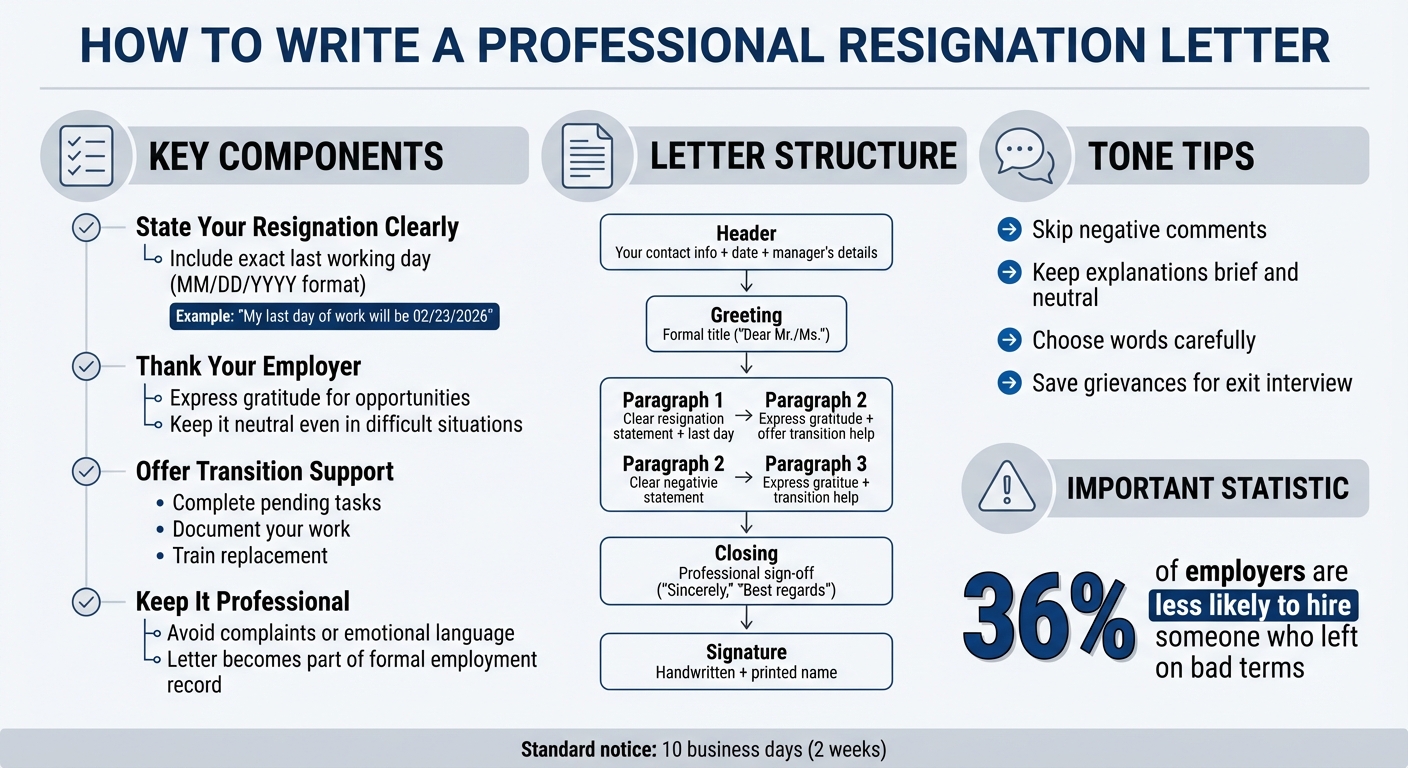
How to Write a Professional Resignation Letter: Key Components and Structure
The Resignation Letter That WON’T Burn Bridges! (Sample Included)
sbb-itb-32359dc
Key Components of a Professional Resignation Letter
A resignation letter doesn’t need to be overly complex, but it should include a few important elements to protect your professional reputation and ensure a smooth transition. These components help you leave on good terms while maintaining a positive relationship with your employer.
State Your Resignation Clearly
Be direct about your decision to resign and include your exact last working day. This clarity creates an official record for HR and helps your employer plan for your departure. For example, you might write: "My last day of work will be 02/23/2026." Using the MM/DD/YYYY format avoids any confusion and allows your employer to handle tasks like processing final paychecks, reassigning responsibilities, and starting the hiring process.
Career coach Amy Wolfgang highlights the importance of keeping your letter professional and concise:
"your resignation letter should be short, to the point and should be neutral in tone. This letter will be part of your formal employment file and should not be used as a vehicle to list all of your grievances."
While providing two weeks’ notice is customary, it’s not always legally required. Regardless, a courteous tone is essential to leaving a positive impression.
Thank Your Employer
Expressing gratitude, even in challenging situations, helps safeguard your professional future. A simple acknowledgment of the skills you’ve gained or the opportunities you’ve had can leave a lasting positive impression. Success.com explains:
"a thoughtful, respectful letter does more than leave your manager and team with goodwill; it preserves your reputation and relationships – critical if you need references for future opportunities."
If your experience was less than ideal, you can still keep things neutral. Phrases like "Thank you for the opportunity" or highlighting what you’ve learned can maintain professionalism without revisiting any grievances.
Offer Transition Support
Offering to help with the handover process shows professionalism and consideration. Whether it’s completing pending tasks, documenting your work, or training your replacement, this gesture can ease the transition for your team. Be specific about what you’re willing to do, but avoid overcommitting. An executive search firm emphasizes:
"quitting your job can leave your coworkers and company scrambling if the transition is not handled correctly."
How to Write Your Resignation Letter
Once you know what to include in your resignation letter, the actual writing becomes much easier. Using the key elements discussed earlier, here’s a simple way to craft your resignation letter. A formal resignation letter typically follows a standard business format and should be kept to a single page. This document helps set clear expectations for both you and your employer.
Set Up the Letter Format
Start by placing your contact information at the top of the page. Include your name, address, phone number, and email address. Below that, add the current date in MM/DD/YYYY format (e.g., 02/09/2026). Then, list your manager’s details: their name, title, the company name, and the company address. Use a formal title in your greeting, such as "Dear Mr. Smith" or "Dear Ms. Johnson". If you’re sending the letter via email, save it as a PDF with an electronic signature to ensure professionalism and prevent alterations.
Write the Main Content
Start with a direct and clear statement of your resignation. Be sure to include your job title and your last working day: “I am writing to formally resign from my position as Marketing Coordinator at ABC Company. My last day of work will be 02/23/2026.” This straightforward approach creates a formal record for HR and helps your employer plan ahead. Following this, express gratitude and offer to assist with the transition, such as training your replacement.
In the next paragraph, briefly share your appreciation for the opportunities you’ve had. Highlight specific skills you’ve gained or positive experiences you’ve enjoyed during your time at the company. If you choose to mention your reason for leaving, keep it short and neutral – overexplaining can sometimes come across as defensive or uncertain. Wrap up this section by offering your help with the transition, like completing unfinished projects or training a successor. This shows professionalism and ensures a smooth handover.
End with a Professional Closing
Close your letter with a respectful and positive sign-off. Common choices include “Sincerely,” “Best regards,” “Kind regards,” or “Warm regards”. Below your closing, add your handwritten signature (if submitting a physical letter) and your printed name. You might also include a short statement like, “I hope to stay in touch,” to express interest in maintaining a professional relationship. Provide your personal email or phone number for any future contact. As Carole Martin, The Interview Coach, wisely states:
"When you leave with a good feeling all the way around it is a win/win for everybody involved."
How to Keep Your Tone Professional
The tone of your resignation letter plays a key role in how you’re remembered professionally. This document isn’t just a formality – it becomes part of your employment record. That’s why it’s important to keep it professional and avoid letting emotions or frustrations seep into your message. As Amy Wolfgang, Career Coach at Wolfgang Career Coaching, puts it:
"Your resignation letter should be short, to the point and should be at the very least ‘neutral’ in tone. This letter will be part of your formal employment file and should not be used as a vehicle to list all of your grievances with your employer, manager or peers."
To ensure your tone stays polished and professional, here are some focused strategies to guide you.
Skip the Negative Comments
Resist the temptation to use your resignation letter as an outlet for complaints about the company, your boss, or coworkers. If there are issues you’d like to address, save them for your exit interview with HR. Even in frustrating circumstances, aim to express basic gratitude without diving into specifics about better offers or benefits at your new role. Including such details can create unnecessary tension and doesn’t add value to the formal record.
Keep Explanations Brief and Neutral
You’re not obligated to provide a detailed explanation for your decision. If you choose to mention a reason, keep it short and future-focused. For instance, you might note career growth opportunities or personal goals without highlighting past difficulties. Stick to the essentials: state your resignation and your final working day. As Tatiana Compton, Author at Ivy Exec, explains:
"It is courtesy to follow your resignation meeting with a letter, keep it short, you don’t need to give lengthy explanations on why you are leaving or address company failings."
This approach helps maintain a professional tone while keeping the focus on your next steps.
Choose Your Words Carefully
The language you use can make all the difference in balancing professionalism with clarity. Start with a clear opening, such as: "Please accept this letter as formal notification of my resignation." This sets a respectful tone from the start. Phrases like "after careful consideration" or "I have decided to resign" emphasize your decision without sounding overly emotional. When showing gratitude, be specific and genuine, such as: "I appreciate the opportunities I’ve had to develop my skills" or "Thank you for your mentorship and guidance."
If you’re offering to assist with the transition, outline exactly how you plan to help, such as: "I am committed to ensuring a smooth handover" or "I’m happy to help train my replacement." Before sending your letter, take a step back – either let it sit for a bit or ask someone neutral to review it. This ensures your message is clear, polished, and professional.
Resignation Letter Templates
Here are simple, single-page resignation letter templates designed with a three-paragraph structure. Each template caters to specific situations and aligns with recommendations from HR professionals.
Standard Two-Week Notice
This template is ideal for most resignation scenarios. A two-week notice typically means 10 business days from the date you submit your letter. As Estefania Rivera Gonzalez, a Bilingual Human Resources Professional, explains:
"Avoid being vague with your last official day of work date. There can be different interpretations of when the ‘two weeks notice’ begins and ends."
[Your Name]
[Your Phone Number]
[Your Email Address]
[Date]
Dear [Manager’s Name],
I am writing to formally resign from my position as [Job Title] at [Company Name], with my final day being [Specific Date].
I am grateful for the opportunities I’ve had to grow my skills and contribute to [specific project or team]. During this transition, I am committed to making the handover process as smooth as possible and am happy to assist with training my replacement or documenting my responsibilities.
Thank you for your guidance and support during my time here. Please feel free to contact me at [personal email] if you need to reach me after my departure.
Sincerely,
[Your Signature]
[Your Typed Name]
If your situation requires a different approach, check out the templates below.
Resigning for Personal Reasons
When personal circumstances prompt your resignation, this template provides a professional way to communicate your decision. Personal reasons are valid and do not require detailed explanation. As Daniel Meursing, CEO and founder of Premier Staff, advises:
"Maintaining privacy while being professional strengthens rather than damages relationships."
[Your Name]
[Your Phone Number]
[Your Email Address]
[Date]
Dear [Manager’s Name],
I am writing to formally resign from my position as [Job Title] at [Company Name], effective [Specific Date]. This decision is due to personal reasons that require my full attention.
I greatly appreciate the experience I’ve gained at [Company Name], particularly [mention specific skill or project]. I will ensure a smooth transition by wrapping up my current projects and preparing any necessary documentation.
Thank you for your understanding. You can reach me at [personal email] for any follow-up matters.
Best regards,
[Your Signature]
[Your Typed Name]
Immediate Resignation
If you need to leave your position right away, this template offers a direct yet professional approach. While all 50 U.S. states are at-will employment states, leaving without notice can affect professional relationships. Conor Hughes, an HR consultant, cautions:
"In many fields, quitting without proper notice is considered a major lapse in professionalism that can completely scorch that bridge."
If you must resign immediately, be sure to offer assistance remotely and return company property promptly.
[Your Name]
[Your Phone Number]
[Your Email Address]
[Date]
Dear [Manager’s Name],
I am resigning from my position as [Job Title] at [Company Name], effective immediately. Due to unforeseen personal circumstances, I am unable to provide the standard two-week notice period.
I am grateful for the opportunities I’ve had at [Company Name]. To assist with the transition, I have prepared a status report of current projects and key contacts, which I will send separately. I will also return all company property, including [laptop, badge, keys], by [specific date].
I apologize for any inconvenience this may cause. I am available via email at [personal email] to address any transition-related questions over the next [timeframe].
Sincerely,
[Your Signature]
[Your Typed Name]
Note: The signature block format (closing phrase, signature, and typed name) remains consistent across all templates to ensure a polished and professional presentation.
Using BeLikeNative to Improve Your Resignation Letter
When emotions are running high, crafting a clear and professional resignation letter can feel like a daunting task. That’s where BeLikeNative steps in. This tool helps refine your draft, ensuring it remains neutral and polished. Career Coach Amy Wolfgang from Wolfgang Career Coaching emphasizes:
"Your resignation letter should be short, to the point and should be at the very least ‘neutral’ in tone"
BeLikeNative’s tools are designed to strip out emotional language or grievances that could potentially harm your professional reputation, leaving you with a letter that communicates effectively and respectfully.
Adjust Tone and Rephrase Content
BeLikeNative simplifies the process of transforming your resignation letter into a professional document. Its rephrasing tools analyze your text and suggest adjustments to tone down negativity or unnecessary details. For instance, instead of venting frustrations about your workplace, the tool helps you reframe your message to focus on "pursuing new opportunities", keeping the tone positive and forward-looking.
Using BeLikeNative is straightforward: copy your text, activate the tool with a shortcut, and receive refined suggestions instantly. This ensures your letter remains clear, professional, and well-suited for any audience, whether you’re communicating in English or another language.
Write in 80+ Languages
For professionals who are non-native English speakers, BeLikeNative offers support in over 80 languages. It not only translates but also refines text to align with standard business practices. This feature ensures that your resignation letter is error-free, culturally appropriate, and adheres to professional standards. Additionally, the tool helps with formatting, ensuring proper margins, fonts, and overall presentation. This capability bridges communication gaps, making it easier for anyone to craft a polished resignation letter.
Pricing Plans
BeLikeNative provides flexible pricing options to meet a range of needs:
- Free Plan ($0/month): 5 uses per day with a 500-character limit for basic corrections.
- Learner Plan ($4/month): 25 uses daily with a 2,000-character limit.
- Native Plan ($6/month): 50 uses per day, a 4,000-character limit, and priority bandwidth.
- Premium Plan ($14/month): 125 daily uses with a 6,000-character limit for advanced requirements.
Whether you need occasional assistance or frequent support, these plans make it easy for professionals to communicate effectively and confidently.
Tips for a Smooth Resignation Process
Resigning gracefully is just as important as writing a professional resignation letter. Always begin by scheduling a private meeting with your manager to share the news before submitting your formal letter. This approach demonstrates respect and prevents your supervisor from being blindsided. If you work remotely, opt for a video call and follow up immediately by emailing a PDF version of your resignation letter. Follow these steps to ensure your resignation process is handled professionally and smoothly.
How to Submit Your Letter
The way you submit your resignation letter says a lot about your professionalism. If you’re in the office, hand-deliver a printed and signed copy during your meeting. For remote employees, share the news via video call and then send the formal letter electronically. To keep a secure record, forward a copy of your resignation email to your personal email account.
Plan Your Transition
Provide the standard two weeks’ notice, though higher-level roles might require 30 days or more. During your notice period, prepare a detailed handoff document that outlines your current projects and responsibilities. This ensures a smoother transition for your team. Additionally, offer to assist with training your replacement or wrapping up critical tasks. Terina Allen, an Executive Coach, emphasizes:
"The individual should make sure the employer knows that the resignation does not mean they are leaving the employer high and dry and should express whether they will be accessible for transitional assistance"
This proactive approach goes a long way in maintaining goodwill.
Proofread Before Sending
Take a 24-hour pause before finalizing your resignation letter. This short break helps ensure you’re not making decisions in the heat of the moment. When reviewing your letter, check for typos, formatting issues, and confirm that it’s clear on details like your last working day, the current date, and your manager’s correct title. If you’re resigning under difficult circumstances, ask a trusted friend to proofread to ensure your tone remains professional. Gail Nelson, an author, advises:
"It would be a shame if your last impression was careless and full of errors"
A polished and accurate letter helps protect your professional reputation.
Conclusion
A well-crafted resignation letter can protect your career and keep doors open for future opportunities. Research shows that 36% of employers are less likely to hire someone who left a previous role on bad terms. In close-knit industries, news of an unprofessional exit can spread quickly, potentially affecting your reputation in ways you might not even realize. As Michael Berger, Director at Talent Blueprint, puts it:
"A negative exit has the ability to derail future career opportunities in any industry without you even knowing. It is a small world and niche industry networks are even smaller, meaning that word travels fast."
Writing a professional resignation letter doesn’t have to be complicated. Stick to a neutral tone, express sincere gratitude, and offer to help with the transition. These straightforward steps can ensure you’re remembered for your professionalism rather than any challenges you faced.
If you’re unsure how to find the right tone, BeLikeNative offers tools to help you refine your letter effortlessly. With support for over 80 languages and free plans starting at $0/month, it’s an easy way to make sure your final impression leaves a positive mark. A few minutes spent polishing your letter can help secure valuable relationships and references for the future.
FAQs
What should I leave out of my resignation letter to stay professional?
To keep things professional, avoid making negative comments about your employer, colleagues, or workplace. Refrain from sharing complaints, personal frustrations, or detailed reasons for leaving that might sound critical or overly emotional.
By maintaining a respectful and constructive tone, you can safeguard relationships and leave on good terms – something that could be beneficial for future references or networking connections.
How can I show gratitude in my resignation letter if my experience wasn’t positive?
Even if your time at a job wasn’t the best, it’s still important to show gratitude in your resignation letter. This helps you stay professional and leave on good terms. Instead of dwelling on negatives, focus on neutral or positive aspects – like the chance to work there, the skills you picked up, or the experiences you gained.
For instance, you could write something like: “Thank you for the opportunity to be part of this team. I’ve gained valuable experience during my time here that I will carry forward in my career.” This approach keeps the tone respectful and constructive, helping you maintain relationships and avoid burning bridges, even if the situation was less than perfect.
Should I offer to help with the transition if I’m resigning immediately?
While you’re not obligated to provide transition support when resigning on short notice, doing so can reflect professionalism and help maintain good relationships. Simple actions, like documenting essential tasks or offering quick guidance to your successor, can leave a positive impression.
If you’re unable to assist due to the circumstances, ensure your resignation letter is polite and clear to uphold goodwill.
Related Blog Posts
- How to Avoid Bias in Multilingual Writing
- Multilingual Email Etiquette Checklist for Professionals
- How To Write Professional Rejection Emails Fast
- How To Write Polite Emails To Your Boss Without Sounding Weak
BeLikeNative fixes grammar, rephrases, translates, and simplifies text on any website in 1 second — just highlight and hit a keyboard shortcut. No tab switching. Try it free →