
How To Write A Thesis Statement With AI Assistance
Every essay needs a clear thesis statement – it’s the backbone of your argument and helps readers understand your main point. Writing one can be challenging, but AI tools like BeLikeNative simplify the process. They generate thesis variations, refine clarity, and ensure your argument is focused and debatable. Here’s how to create a strong thesis:
- What makes a strong thesis? Clear, specific, debatable, and focused. Avoid vague terms or overly broad claims.
- Why use AI tools? Save time by generating and refining thesis ideas in seconds. Tools like BeLikeNative offer clarity checks, paraphrasing tools, and tone adjustments.
- Best practices: Start with a basic idea, refine it using AI, and ensure it aligns with your essay’s evidence and scope.
AI tools streamline thesis writing, but it’s up to you to polish the output and maintain your voice. A strong thesis anchors your essay, and with the right tools, crafting one becomes much easier.
3 STEP PROCESS OF THESIS WRITING WITH AI TOOLS | AI TOOLS FOR RESEARCHER
sbb-itb-32359dc
What Makes a Good Thesis Statement
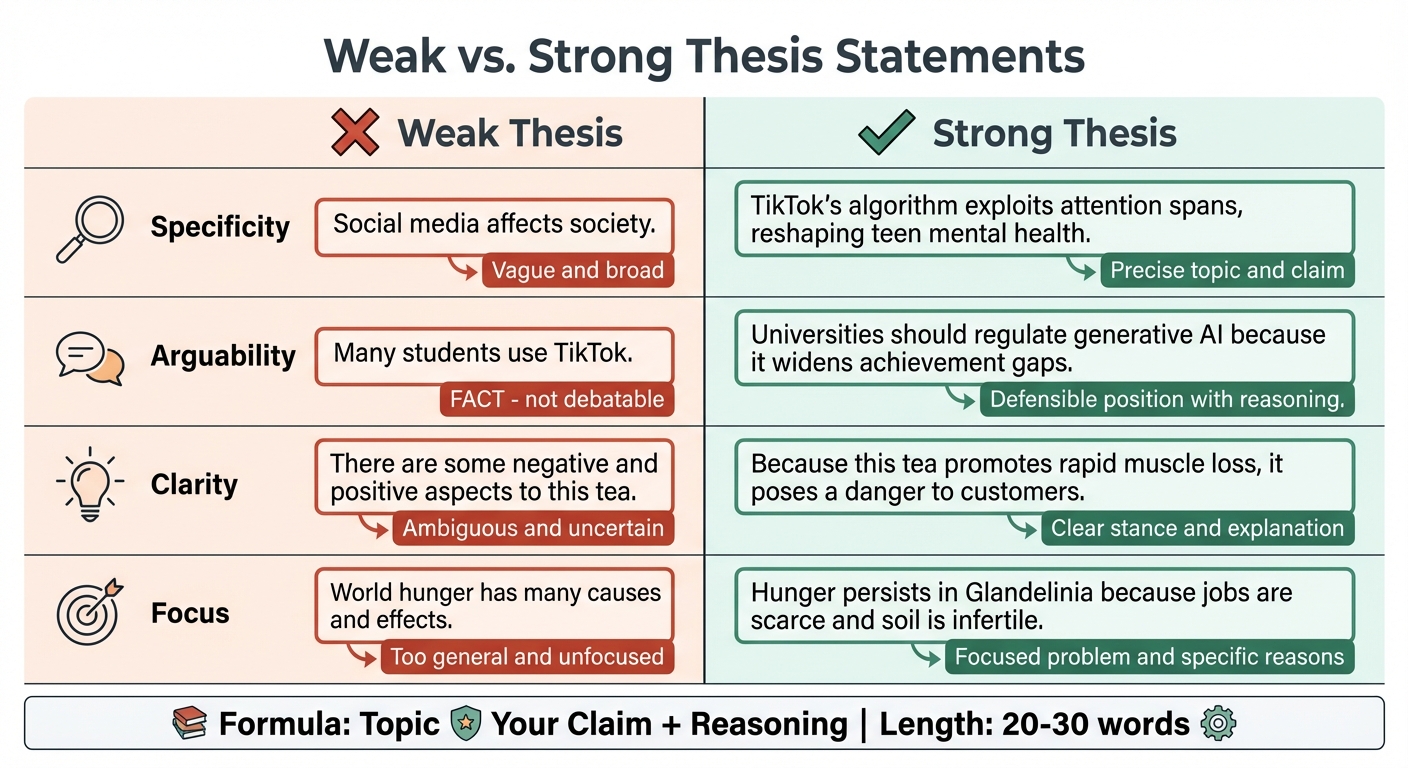
Weak vs Strong Thesis Statement Examples Comparison
A strong thesis statement is built on four key elements: clarity, specificity, arguability, and focus. It strikes a balance between being too general and overly specific, ensuring the argument is clear, manageable, and allows for in-depth analysis.
The ideal formula for crafting a thesis is: Topic + Your Claim + Reasoning. This structure ensures you’re presenting a debatable argument rather than stating a simple fact. For example, instead of saying, "Many students use TikTok", you could argue, "TikTok’s algorithm exploits attention spans, reshaping teen mental health through dopamine-driven feedback loops".
"A strong thesis statement takes some sort of stand… your thesis needs to show your conclusions about a subject." – Indiana University Writing Tutorial Services
BeLikeNative helps refine thesis statements by spotting vague terms like "impacts", "affects", or "good/bad", and ensures the statement’s scope matches the essay’s length. For instance, a 5-page essay requires a more focused thesis than a 20-page research paper. The tool suggests revisions that turn broad observations into well-defined arguments.
Key Features of a Strong Thesis Statement
A strong thesis statement has these four core traits:
- Clarity: Your argument should be immediately understandable.
- Specificity: Narrow your focus to something manageable. For example, instead of "World hunger has many causes", say, "Hunger persists in Glandelinia because jobs are scarce and soil is infertile".
- Arguability: Make a claim that invites debate. If everyone agrees with your statement, it’s not a thesis.
- Focus: Ensure your argument aligns with the evidence you’ll present in the body of your paper.
Typically, a well-crafted thesis is 20–30 words long, spanning one or two sentences, and is placed at the end of your introduction to act as a roadmap for your essay. BeLikeNative evaluates the arguability of your thesis – if it can’t generate a logical three-point outline from your statement, it’s likely too weak or unfocused.
Weak vs. Strong Thesis Statement Examples
Here’s how BeLikeNative transforms vague claims into focused arguments:
| Feature | Weak Thesis Statement | Strong Thesis Statement |
|---|---|---|
| Specificity | "Social media affects society." | "TikTok’s algorithm exploits attention spans, reshaping teen mental health." |
| Arguability | "Many students use TikTok." (Fact) | "Universities should regulate generative AI because it widens achievement gaps." |
| Clarity | "There are some negative and positive aspects to this tea." | "Because this tea promotes rapid muscle loss, it poses a danger to customers." |
| Focus | "World hunger has many causes and effects." | "Hunger persists in Glandelinia because jobs are scarce and soil is infertile." |
Notice how the strong examples replace vague language with precise, debatable claims. BeLikeNative identifies these weaknesses and ensures your thesis aligns with your essay’s content. By following these principles, the tool helps you build a clear, compelling argument that serves as the foundation for a strong paper.
How to Write a Thesis Statement with BeLikeNative
Creating Your Thesis Statement with BeLikeNative
BeLikeNative is a Chrome extension designed to fit right into your favorite writing tools, like Google Docs, Notion, Overleaf, or Microsoft Teams. It integrates directly into these platforms, so you won’t need to keep jumping between tabs. With this streamlined setup, users report saving over an hour each day – boosting productivity by up to 66%.
Getting started is simple. Install the extension in Chrome, then open your preferred writing tool. Begin with a basic thesis idea, such as "Social media affects teenagers." Highlight the text and press Cmd+E (Mac) or Alt+E (Windows). This opens a side panel with tools like a paraphraser and a simplifier to refine your idea.
Once installed, the tool walks you through options to enhance your thesis-writing process. Select the Academic writing style and Formal tone from the settings menu. The extension processes your draft and provides a polished version, ready to copy to your clipboard. It also ensures technical precision and proper citation of supporting evidence. Plus, with support for over 80 languages, it offers context-aware and culturally sensitive translations.
The extension has earned a 4.6/5 star rating on the Chrome Web Store, reflecting its popularity among users. It’s a great example of how AI tools can help maintain clarity and precision while crafting a thesis.
BeLikeNative Plans and Features
BeLikeNative offers flexible plans tailored to different academic needs, all of which include a 7-day free trial and support for over 80 languages.
| Plan | Monthly Price | Daily Uses | Character Limit | Best For |
|---|---|---|---|---|
| Learner | $4/month | 25 | 2,000 | Students polishing occasional papers |
| Native | $6/month | 50 | 4,000 | Writers handling regular assignments |
| Premium | $14/month | 125 | 6,000 | Grad students or researchers tackling large projects |
The Learner plan is perfect for undergraduate students who need basic refinement for their papers. The Native plan steps it up with faster processing and more daily uses, making it ideal for frequent academic writers. For those engaged in advanced research, the Premium plan offers extra perks like priority access to new features and tools for specialized tasks, such as extracting arguments from research notes. All plans come with editable shortcuts, premium support, and options to create custom AI functions for unique needs.
Improving AI-Generated Thesis Statements
AI tools can speed up the process of crafting thesis statements, but the output often needs polishing to meet academic standards. This step is crucial to turning a basic AI-generated idea into a well-defined and persuasive argument.
Making Your Thesis Statement Clearer and More Precise
AI can help you draft a thesis, but it’s up to you to refine it into something sharp and effective. Start by ensuring your thesis has three essential components: the topic, your specific position or argument, and a brief summary of supporting evidence. Avoid overly broad claims like "Social media affects society", as well as statements that are too narrow to explore fully.
Strengthen the language in your thesis by replacing weak verbs. For example, instead of saying "affects", try more precise terms like "accelerates", "undermines", or "challenges" to better align with your evidence. Adding conjunctions such as "although", "because", or "while" can introduce complexity and nuance. Also, eliminate filler phrases like "In this essay I will…" or "I believe", as they weaken the academic tone.
Tools like BeLikeNative can assist in this editing process. Its paraphrasing and simplifying features allow you to test different phrasings, while the Consistency Checker ensures your thesis aligns with the evidence presented in your paper. Additionally, the Tone Checker helps adjust formality to suit your audience. These tools make it easier to refine your thesis while maintaining clarity and precision.
Using BeLikeNative for Multilingual Writing
Beyond refining clarity, BeLikeNative is especially helpful for non-native English writers, supporting over 80 languages. It simplifies the challenge of translating complex ideas into a polished, academic tone. The platform excels at managing intricate aspects of language, such as syntax – the arrangement of words to convey meaning accurately.
"AI is getting better at more complicated aspects of language like syntax, the order in which words are arranged to convey the right meaning"
With BeLikeNative, you can select a target language and adjust the tone to suit your audience. Its cultural adjustment tools help adapt expressions that might not translate well, offering synonym suggestions that capture the right nuance. By replacing long-winded descriptions with concise terms and trimming unnecessary details, the platform helps sharpen your writing. However, it’s essential to carefully choose which AI-generated phrases to keep, ensuring your unique voice shines through and avoiding any risk of plagiarism.
Common Mistakes and Best Practices
Thesis Statement Mistakes to Avoid
One common misstep is crafting thesis statements that are too broad or vague. For instance, saying "Social media affects students" doesn’t explain how or which students, making it tough to build a focused argument. Another frequent issue is confusing facts with arguments. For example, "Many students use TikTok" is informative but doesn’t invite debate or analysis. A strong thesis should pass what’s known as the Skeptic Test: if no one could reasonably disagree with your statement, it’s likely a fact rather than a debatable claim.
Many writers also fail to address the "So What?" factor, leaving out why their argument matters or what makes it relevant. Over-reliance on AI for rewriting your thesis can also dilute your personal voice and lead to integrity concerns.
Watch out for "red flag" words like "effective", "significant", "good", or "bad" when they lack specific context, as these can weaken your argument. Avoid using announcement phrases, which can make your writing feel less academic.
Use these tips as a starting point, then refine your thesis with the checklist below.
Thesis Statement Review Checklist
To ensure your thesis is clear and focused, evaluate it with this checklist:
| Review Criteria | What to Check | BeLikeNative Feature |
|---|---|---|
| Clarity & Precision | Avoid vague or ambiguous terms | Clarity Check, Rephrasing |
| Arguability | Ensure your claim is debatable | Tone Adjustment |
| Significance | Explain why your argument is important | Rephrasing, Fluency Enhancement |
| Structural Logic | Indicate how your argument will be supported | Consistency Check |
| Scope | Keep the focus narrow enough for your paper’s length | Clarity Check |
A helpful tip is to apply the "Because" Test: add "because…" to your thesis. If it doesn’t naturally lead to an explanation of your reasoning, it’s time to revise. BeLikeNative’s tools, like grammar correction and fluency features, can help you eliminate filler phrases and tighten your language. The tone checker ensures your thesis maintains an academic tone by converting informal phrasing into professional language.
Conclusion
Creating a strong thesis statement doesn’t have to mean hours of frustration and endless drafts. BeLikeNative simplifies the process by helping you refine vague ideas into focused claims while ensuring your statement meets academic standards. Its multilingual support and tools for adjusting tone are especially helpful for non-native English speakers looking to express complex ideas clearly.
FAQs
How do I know if my thesis is actually debatable?
A thesis becomes debatable when it makes a claim that others can reasonably argue for or against, rather than stating a simple fact or a vague concept. For example, instead of saying, "Social media affects society," which is too broad, you might argue, "Social media’s emphasis on emotional appeals has weakened the quality of political debate." This approach narrows the focus and invites discussion. Fine-tuning your thesis in this way ensures it’s both specific and open to differing viewpoints.
What should I change in an AI-written thesis to keep my voice?
To keep your personal voice alive in an AI-generated thesis, inject it with your unique style, perspective, and tone. Start by reading the draft out loud – this can help you spot sections that sound stiff or overly mechanical. Once identified, tweak those areas to make them flow naturally. Steer clear of overly predictable phrases and bland transitions; instead, aim for wording that feels genuine and engaging. While AI is a fantastic tool for brainstorming ideas, make sure you customize and refine the content so it truly reflects your viewpoint.
How can I narrow my thesis to fit a 5-page paper?
When tackling a 5-page paper, a broad thesis can make your work feel scattered. Instead, zero in on a specific aspect or argument within your topic. This approach not only keeps your writing focused but also ensures you stay within the page limit.
Here’s one way to do it: break down your main idea into a smaller, more manageable subtopic or argument. For example, if your topic is climate change, you could narrow it down to something like “the impact of urban farming on reducing carbon footprints in U.S. cities.”
AI tools can be a great resource here. Use them to refine your thesis statement, making it concise and targeted. These tools can help you identify vague or overly broad phrasing, offering suggestions to tighten your focus. After revising, you’ll have a clear thesis that acts as a roadmap for your paper.
A well-defined thesis not only keeps your writing on track but also makes it easier to dive deeper into your argument, giving your paper the depth it needs without exceeding the page limit.