
How To Write A Scholarship Essay With Perfect Grammar
Want to stand out with your scholarship essay? Proper grammar can make or break your application. It’s not just about avoiding mistakes – it’s about ensuring your essay is clear, professional, and easy to read. Here’s how to nail it:
- Start with a plan: Outline your essay to stay focused and avoid common grammar errors.
- Master key grammar rules: Ensure subject-verb agreement, consistent tenses, and correct punctuation.
- Refine with tools: Use real-time grammar checkers like BeLikeNative for quick, accurate edits.
- Proofread thoroughly: Review your essay in stages – grammar, punctuation, and spelling – to catch every error.
- Format professionally: Stick to standard academic guidelines (e.g., 12-point Times New Roman, double spacing).
Scholarship Essay Tips To Help You Win! I Tips & Grammarly Service
Transform Any Text, On Any Site, In Seconds
Rephrase, translate, and improve text with one shortcut. Works everywhere you write.
Add to Chrome - It's Free!sbb-itb-32359dc
Step 1: Plan Your Essay Before You Start Writing
Planning before you write is like creating a roadmap – it keeps your essay focused and helps you avoid common grammar pitfalls. Without a plan, it’s easy to end up with run-on sentences, fragments, or awkward transitions that can distract readers from your main message.
"Focusing too much on individual words can obscure your overall message." – Matt Ellis, Academic Writing Expert
By separating structure from style, you can first focus on your core message and then refine grammar and word choice later. This approach ensures your essay flows smoothly and maintains clarity from start to finish.
Create a Clear Outline
Start with a clear outline to keep your essay on track. A common structure, like the five-paragraph model, works well: an introduction with a hook and thesis statement, three body paragraphs with supporting evidence, and a conclusion. Begin by pinpointing your key message – the main takeaway you want your readers to remember – and build each paragraph around that central idea. For prompts like "Tell us about yourself", consider this framework: open with a defining moment, explore your passions and achievements in the body, and wrap up with your goals and potential contributions.
Don’t forget to include formatting details in your plan. Most scholarship committees expect 12-point Times New Roman font, 1-inch margins, and 1.5 or double spacing. Planning these details early keeps you within word limits and ensures your essay looks polished and professional.
Organize Your Ideas for Smooth Transitions
Structure your body paragraphs so each focuses on a single main idea. Rank your points by importance – start with the strongest and work down to the weakest – and arrange them in a way that builds a compelling argument. If you’re tackling complex or emotional topics, place them after simpler points to guide readers naturally through your story.
Plan your transitions during the outlining phase, not while drafting. Use phrases like "as a result" or "that experience changed how I…" to connect ideas and show relationships between events. This avoids abrupt shifts that can confuse readers and lead to mistakes.
"A well-structured format makes your essay clear, professional, and more persuasive to the selection committee." – Bonnie Adair, Academic Writing Expert
Finally, choose a central theme – like persistence, leadership, or curiosity – and make sure every paragraph ties back to it. Essays with a clear focus and smooth transitions tend to score higher on scholarship rubrics, while disorganized ones often fall short. By planning thoroughly, you’ll be ready to refine grammar and style in the next step.
Step 2: Learn the Grammar Rules You Need to Know
Once your essay structure is planned, the next step is to get a handle on the grammar basics that scholarship committees expect. Even small mistakes can hurt your credibility and distract readers from the points you’re trying to make.
"Establishing your credibility is critical… Proving that you can reliably communicate using proper grammar is essential to establishing and maintaining the trust of your teachers, professors, readers, customers, and colleagues." – EasyBib
While modern word processors can catch spelling errors, they often miss more subtle mistakes, like using the wrong word. To avoid such pitfalls, focus on grammar rules that will make your essay clear and polished.
Check Subject-Verb Agreement and Tense Consistency
Start by ensuring that your verbs match their subjects in both number and person. Singular subjects need singular verbs, and plural subjects need plural verbs. Watch out for errors when phrases come between the subject and verb. For instance, in the sentence, "The scholarship committee reviews applications", the singular verb "reviews" matches the singular subject "committee", which is treated as a single entity in American English.
"Academic writing often requires consistent verb tense. Switching tenses unnecessarily can confuse readers." – PaperCheck
Tense consistency is equally important. Stick to one timeframe unless you’re deliberately describing events that occurred at different times. For example, if you begin a paragraph in the past tense, don’t suddenly shift to the present tense without a clear reason.
Avoid Common Punctuation Mistakes
Once you’ve nailed subject-verb agreement and tense, focus on punctuation. Errors in punctuation are some of the most noticeable mistakes in scholarship essays. One common issue is the comma splice – joining two complete sentences with just a comma. To fix this, use a period, semicolon, or a coordinating conjunction like "and", "but", or "so."
Apostrophes can also trip people up. Use them for contractions (e.g., "don’t", "it’s") and possessives (e.g., "mother’s advice"), but never for plurals. The distinction between "its" and "it’s" is a frequent stumbling block: "it’s" means "it is" or "it has", while "its" shows possession without an apostrophe.
"A missing or misplaced comma, for example, can entirely change your meaning." – EasyBib
To catch recurring mistakes, keep a personal list of punctuation errors you tend to make and review your essay specifically for those issues. Automated tools can help, but they might not catch everything.
Mix Sentence Types for Better Readability
Varying sentence structures keeps your writing engaging and shows off your grammatical skills. Use a mix of simple, compound, and complex sentences to hold the reader’s attention and make your essay more dynamic.
Be cautious of sentence fragments – phrases that lack a subject, verb, or complete idea – and avoid run-on sentences that cram too many clauses together without proper punctuation. The FANBOYS acronym (for, and, nor, but, or, yet, so) is a helpful way to remember how to join independent clauses correctly.
Additionally, keep modifying phrases close to the words they describe. Misplaced modifiers can confuse your meaning or lead to unintended interpretations. Reading your essay out loud is a great way to catch these and other lingering errors.
Step 3: Use BeLikeNative for Real-Time Grammar Checking
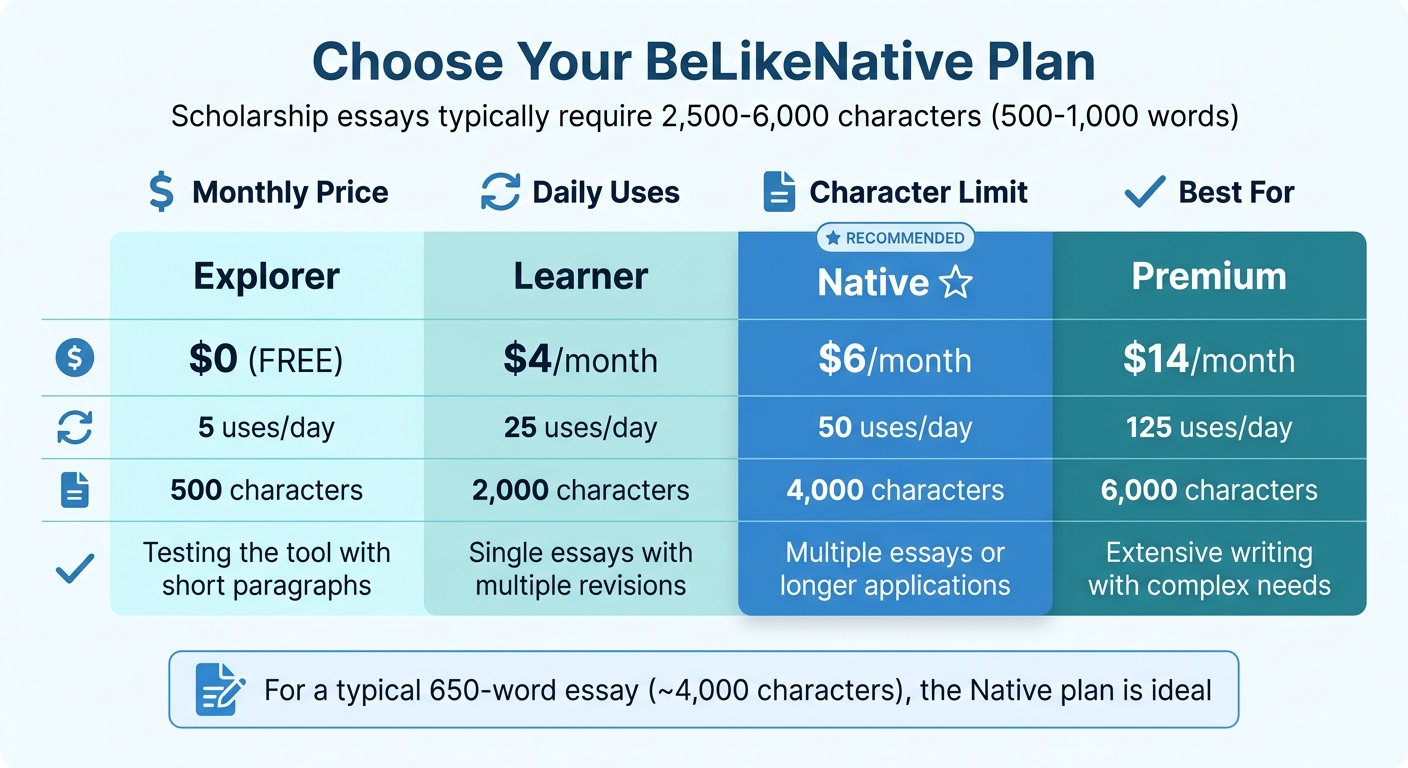
BeLikeNative Pricing Plans Comparison for Scholarship Essay Writing
Once you’ve got the basics of grammar down, adding a real-time tool to your writing process can make everything smoother. Tools like these catch common mistakes – think subject-verb mismatches, comma splices, or run-on sentences. They also help refine your work by flagging overly wordy sentences or passive voice, making your writing clearer and more polished.
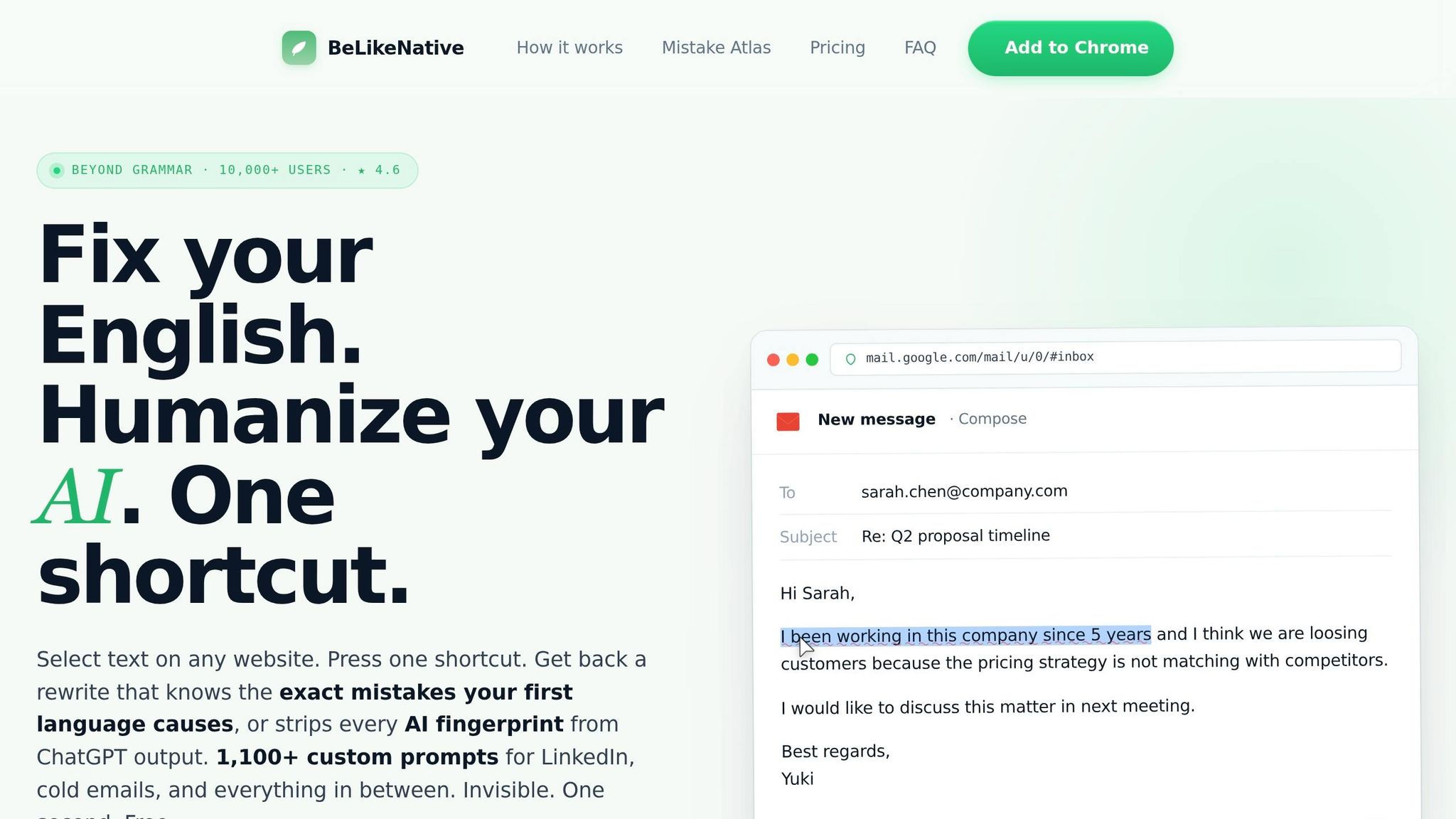
Take BeLikeNative, for example. This Chrome extension lets you refine your text instantly using keyboard shortcuts. You write your paragraph, activate the shortcut, and voilà – your draft is cleaned up without breaking your creative flow. This streamlined editing process ensures your essay is clear, professional, and ready to impress scholarship committees.
Key Features of BeLikeNative for Better Writing
BeLikeNative integrates directly with tools you already use, like Google Docs, Notion, and Gmail, so there’s no need to juggle between apps or tabs. Once it refines your text, it automatically copies the improved version to your clipboard, saving you time. According to users, this feature alone can save over an hour a day, with productivity boosts of up to 66%. With a 4.6/5 star rating on the Chrome Web Store and over 5,500 users, BeLikeNative has become a trusted go-to for smoother writing.
One standout feature is its contextual rephrasing. This allows you to tweak the tone and style of your writing – perfect for scholarship essays that require a formal, professional tone. You can easily switch between formal and casual styles to suit different requirements. Plus, it supports over 80 languages, making it especially useful for non-native speakers who want their essays to shine.
Choose the Right BeLikeNative Plan
Your choice of plan should match your writing needs, especially since scholarship essays typically fall between 500 and 1,000 words (roughly 2,500 to 6,000 characters, including spaces). If you’re working on multiple essays, you’ll want enough daily uses to revise each draft several times.
| Plan | Monthly Price | Daily Uses | Character Limit | Best For |
|---|---|---|---|---|
| Explorer | $0 | 5 | 500 | Testing the tool with short paragraphs |
| Learner | $4 | 25 | 2,000 | Single essays with multiple revisions |
| Native | $6 | 50 | 4,000 | Multiple essays or longer applications |
| Premium | $14 | 125 | 6,000 | Extensive writing with more complex needs |
For a typical 650-word essay (about 4,000 characters), the Native plan is a solid choice. It gives you enough room to revise full paragraphs at once without hitting any limits.
Once you’ve made these revisions, you’ll have a strong base to finalize your proofreading and formatting.
Step 4: Proofread and Format Your Essay
Once you’ve used real-time tools to refine your draft, it’s time to proofread carefully. This step demands close attention – rushing through it can lead to overlooked typos, formatting issues, or awkward phrasing that might weaken your essay.
Proofreading Checklist for Error-Free Essays
Instead of trying to catch every mistake in one go, break your proofreading into three focused passes:
- Grammar: Check for subject-verb agreement, consistent verb tense, and proper pronoun use.
- Punctuation: Look for misplaced commas, missing apostrophes, and unclosed quotation marks.
- Spelling: Double-check tricky homophones like "their", "there", and "they’re."
"Proofreading is a critical final stage of the writing process where you correct small mistakes in grammar, spelling, style, and formatting." – Grammarly
To improve accuracy, set your draft aside for at least 30 minutes before proofreading. This pause allows you to return with fresh eyes, making it easier to spot errors. Read your essay aloud or even backward to identify awkward phrasing or overlooked mistakes. For a typical scholarship essay, allocate 30–45 minutes to ensure a thorough review.
After eliminating errors, focus on formatting your essay according to academic guidelines.
Format Your Essay Correctly
With a polished draft ready, confirm that your essay aligns with standard academic formatting. Here’s a quick rundown of the essentials:
- Font and Margins: Use a 12-point font (like Times New Roman, Arial, Calibri, or Georgia), 1-inch margins on all sides, and double-spaced text.
- Header Information: Include your full name, mailing address, professional email (e.g., firstname.lastname@email.com), phone number, and the current date.
- File Format: Save your essay as a PDF with a professional file name, such as
LastName_FirstName_ScholarshipName.pdf. This ensures formatting remains intact and prevents accidental edits. Double-check that the file is selectable text, not just a scanned image, and confirm you’re within the word count limit.
For paragraph formatting, choose one style and stick with it: either indent the first line (0.5 inch) without extra spacing between paragraphs, or use block formatting with a blank line between paragraphs. Avoid any unprofessional elements like informal fonts, colored text, or excessive bold and italics.
Step 5: Do a Final Review to Catch Remaining Errors
After your detailed proofreading and formatting, this final review is the last step to ensure your essay is polished and professional. It’s your chance to catch any lingering mistakes that could detract from your work. Pay close attention to grammar issues like run-on sentences and fragments, tighten up sentence structures, and ensure your writing flows naturally.
Fix Run-On Sentences and Fragments
Run-on sentences happen when two independent clauses are joined incorrectly – either with no punctuation (fused sentence) or only a comma (comma splice). To spot these, check if coordinating conjunctions from the FANBOYS list (for, and, nor, but, or, yet, so) are used properly. If two independent clauses are joined by a comma alone, you can fix it by:
- Replacing the comma with a period to create two sentences.
- Using a semicolon to link the clauses.
- Adding a coordinating conjunction after the comma.
Similarly, sentence fragments – sentences missing a subject or verb – should be corrected. Make sure every sentence includes both an actor (subject) and an action (verb) to convey a complete thought effectively.
Read Your Essay Out Loud
Once structural issues are addressed, focus on the rhythm and clarity of your writing. Reading your essay aloud is a simple yet powerful way to catch subtle errors. It forces you to slow down and notice every word, punctuation, and phrasing.
"If you stumble while reading or have to reread a sentence, mark it – that’s a clue that something may be off." – Grammarly
Mark any sentences that feel awkward or disrupt the flow. If needed, use text-to-speech tools to help identify clunky phrasing or punctuation problems. This final step ensures your essay transitions smoothly and delivers a cohesive, professional message.
Conclusion: How to Write a Scholarship Essay with Perfect Grammar
Creating a standout scholarship essay starts with a step-by-step approach: brainstorming, outlining, drafting, and editing. Breaking the process into manageable parts helps you tackle what might seem overwhelming and turn it into a well-organized, polished piece of writing.
"Following this process is the easiest way to draft a successful essay, whatever its purpose might be." – Kathryn Knight Randolph, Associate Content Editor, Fastweb
This method not only simplifies the writing process but also ensures your essay is structured and cohesive. Use planning tools to visually organize your ideas and focus on smooth transitions between sections. Pay close attention to grammar basics, such as subject-verb agreement and correct punctuation. Tools like BeLikeNative can be a lifesaver, catching errors like misplaced commas or inconsistent verb tenses that might otherwise go unnoticed. With real-time feedback, it helps refine your essay beyond what manual proofreading might achieve.
Scholarship committees often sift through thousands of applications where academic records and test scores are nearly indistinguishable. What sets candidates apart is the essay. Committees value essays that feel authentic, show clear purpose, and demonstrate personal growth – not just a pristine academic history.
"Committees fund clarity. They trust students who have thought carefully about their direction, even if it evolves later." – AP Guru
Before sending in your application, double-check that your essay aligns with the scholarship’s specific guidelines. Make sure you’ve followed all formatting and content requirements. If you’re feeling fatigued, take a break and come back with fresh eyes. Reading your essay aloud can help you catch awkward phrasing or unnatural sentences. By following this thorough process – from brainstorming to final proofreading – you’ll create an essay that showcases your strengths and attention to detail.
FAQs
How do I keep my verb tenses consistent in a personal story?
When writing a personal story, it’s important to keep your verb tenses consistent within each section. For instance, if you’re describing past events, use the past tense throughout that part. On the other hand, stick to the present tense when discussing current goals or actions. This consistency helps your story flow smoothly and avoids confusing the reader.
Take the time to proofread your essay carefully. If possible, ask someone else to review it as well – they might catch tense inconsistencies you may have missed. A fresh set of eyes can make all the difference!
What’s the fastest way to fix run-on sentences and fragments?
The quickest solution is to use grammar-checking tools like Grammarly, which can identify and suggest corrections for these mistakes in no time. To avoid such errors in the first place, focus on mastering how to connect independent clauses properly. You can use semi-colons, coordinating conjunctions (like FANBOYS), or simply break longer sentences into smaller, more manageable ones. These techniques make it easier to handle run-ons and sentence fragments effectively.
How can I use BeLikeNative without changing my voice or sounding robotic?
To make the most of BeLikeNative while staying true to your personal voice, aim for clear and accurate writing without over-polishing. Take the time to review your work, ensuring any edits improve professionalism while keeping your tone intact. Tools like Grammarly or Hemingway are great for spotting mistakes without compromising your style. The goal is to strike a balance between polished grammar and genuine expression, creating an essay that’s both engaging and error-free.
Related Blog Posts
- Everything You Need To Know About Johnson Grammar Rules
- How Grammar Practice Changes by Skill Level
- How Context-Sensitive Grammar Correction Works
- Fix “Wordiness” In College Admissions Essays
BeLikeNative fixes grammar, rephrases, translates, and simplifies text on any website in 1 second — just highlight and hit a keyboard shortcut. No tab switching. Try it free →